
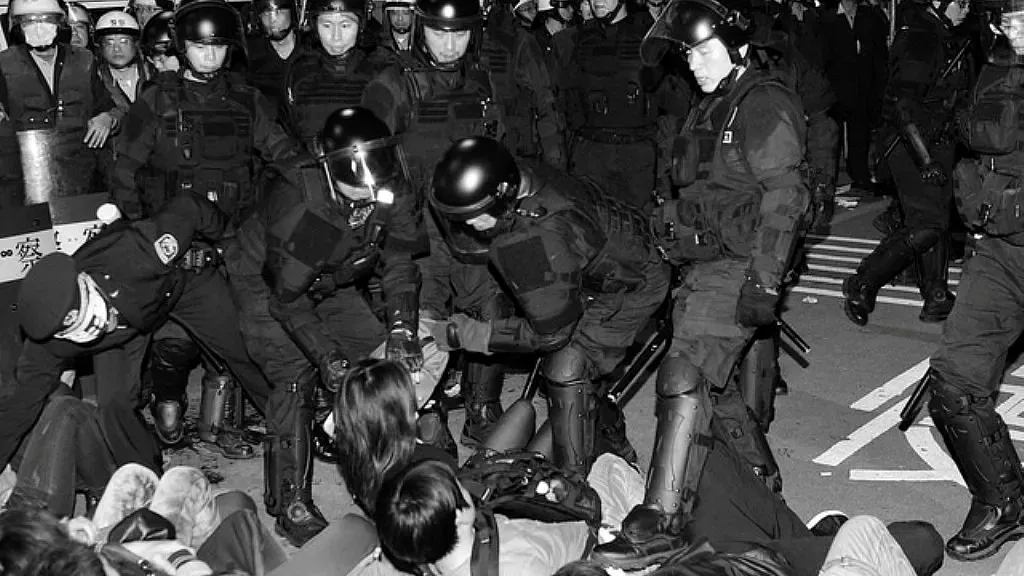
The Bloody Suppression of the March 24 Incident Ultimately Ended Without Anyone Being Held Responsible
Last edited: 2026-07-27
Photography/nondavidmirage
Taiwan's democracy and freedom today are the hard-earned results of generations of Taiwanese courageously protesting on the streets without fear of powerful authorities. However, in a true democracy, not a single person engaged in a precinct assembly should have their head bloodied by police batons, nor should anyone escape accountability after the state employs illegal violence.
The occurrence of the March 24 Incident during the 2014 Sunflower Student Movement stemmed from the public's fear that the government was rapidly leaning toward the Chinese Communist Party and falling into a united front trap—fearing that one day even the dignity of standing and speaking would be stripped away. Therefore, upon hearing that a small group of frontline protesters had broken into the Executive Yuan, over 10,000 people successively brought cell phones and bottled water to peacefully sit-in at the Executive Yuan's plaza, parking lots, and roadways. This was the first time citizens entered the Executive Yuan to protest, reflecting the public's extreme anxiety and distrust. Looking at Hong Kong's cruel scenery today, this concern was not groundless worry.
Police Violently Disperse Protestors While Shirking Responsibility Level by Level
However, the Ma-Chiang administration at the time only thought about dispersing the crowd before dawn to preserve its own prestige (in fact, the office areas had already been cleared by 10:00 p.m. on the 23rd). Orders were passed down layer by layer through the command chain, and ultimately Police Precinct Chief Fang Yang-ning and others successfully fulfilled their "mission"—at the cost of the people's blood and violations of the law.
Not a single law in Taiwan allows police to use batons, shields, fists, or kicks to perpetrate violence against non-resistant sit-in protesters. On the contrary, as early as before 1985, the law required police to abide by the principle of proportionality, avoid inflicting injury on fatal body parts, and mandated that police supervisors oversee subordinates in performing their duties according to the law. Yet in the early hours of March 24, although there were at least 18 high-ranking police officers of the rank of three-stripe-one-star or above and 200 police officers of two-stripe-two-star or above at the scene—representing a density of supervision rarely seen in history—officers still brazenly used batons to heavily strike citizens' heads, shields to chop at shins, and swarmed and kicked people, resulting in hundreds of injuries. Police are civil servants; without the connivance or even tacit approval of their superiors, how would they dare to engage in such large-scale illegal violence?
Nevertheless, to shirk responsibility, police supervisors led by the Premier all competed to play blind and deaf. Ambulances wailed throughout the night, and citizens shouting "Police are beating people" until their voices grew hoarse went unheard; the media flooded the airwaves with reports of police violence and students bleeding, and even police kicking and beating people right before their eyes went unseen; when all of Taiwan and even foreign countries knew the Executive Yuan was beating people, these high-ranking officials still insisted they knew nothing. A certain official repeatedly complained through the media, claiming he was dutiful and did not regret making the dispersal decision; yet in court, he uniformly claimed he was asleep, that he did not "order" the dispersal but merely "hoped" for it, and that everything was carried out spontaneously by the police. Segmented responsibility, shirking accountability level by level—superiors pushed all responsibility onto the emotional out-of-control frontline officers, treating them as disposable tools, while securing promotions and retirements for themselves safely.
Over the past six years, the government has not only failed to find a single perpetrator of violence, but no police supervisor has been held responsible. Some have even utilized their access to public discourse to continuously stigmatize the victims: despite no hydraulic cutters being seized and the offices having been cleared long ago without anyone re-entering, they portrayed the tens of thousands of citizens as rioters each holding hydraulic cutters and wreaking havoc in the Premier's office; they mocked citizens for crashing into utility poles and falling down to injure themselves, while saying not a single word about how the government treated the people that night.
The people of Taiwan have the right to peaceful assembly, and even more so, the right to be free from state-sanctioned abuses of power and violence. Investigating responsibilities according to the law, apart from healing historical wounds, is ultimately to prevent such mistakes from happening again. Unfortunately, justice is still on the way.
※ This article was published in the Apple Daily on September 16, 2020
This article is an AI-generated translation of the original Chinese text. In the event of any discrepancy, the Chinese version shall prevail.