
JRF Newsletter
Crossing the Unknown, Drawing Closer to Wrongful Convictions: The School-Developed Required Course "The Distance Between Evidence and Truth"
Last edited: 2026-08-29
Editor's Note: With the rollout of Taiwan's Curriculum Guidelines of 12-Year Basic Education (commonly known as the "108 Curriculum Guidelines"), schools gained more flexibility in curriculum design. Chen Miao-Hsien and Hsiao Hao-Liang, biology teachers at Banqiao Senior High School, designed a year-long school-developed required course, "The Distance Between Evidence and Truth," using wrongful-conviction cases as its central theme.
The course can be divided into three broad stages:
- Issue Exploration: Using the Chen Lung-Chi and Chen Ching-Kai cases, students learn the facts of the cases as well as relevant forensic methods and scientific principles.
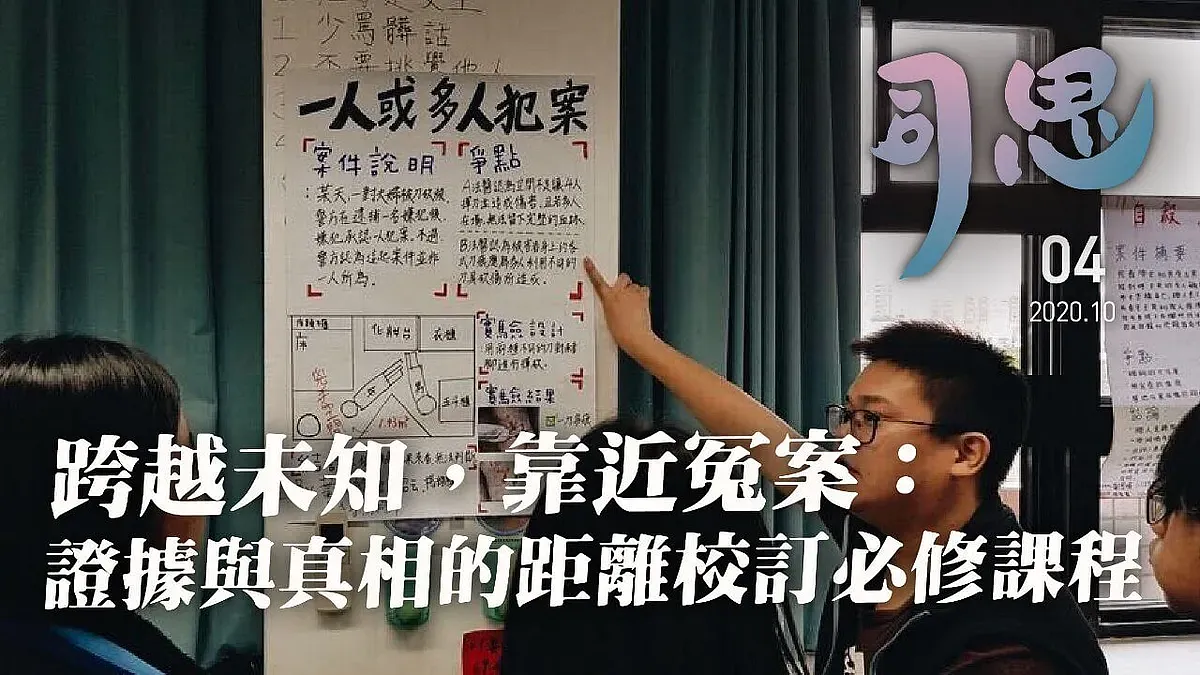
- Inquiry and Hands-On Practice: Using the Su Chien-Ho, Hsu Tzu-Chiang, and Houfeng Overpass cases, the teachers de-identify case materials and present conflicting expert findings on key disputed issues from the prosecution and defense. Students then discuss and design experiments to assess which conclusion is better supported.
- Action Planning: Students work in groups to design action plans centered on wrongful convictions.
Readers who would like to learn more about the course can read the article published in Humanist Education Journal No. 369, written by Chen Miao-Hsien, "Encountering Wrongful Convictions in the Biology Classroom-Part 2: How Do We Guide Students to Understand Wrongful Convictions and Build Competencies?" Now that the course has entered its second academic year, this article invites Hsiao Hao-Liang to share his reflections.
"I Actually Didn't Know What Else I Could Do"
I had known about wrongful convictions since I was young, but influenced by older family members, I used to think that people claiming wrongful conviction were just playing the victim. As I grew older and encountered more information, my views gradually changed. But even after changing my mind, I still didn't know what else I could do.
After deciding to offer a school-developed required course on wrongful convictions, I was extremely anxious. With my limited and superficial understanding of the subject, how on earth was I supposed to teach students about it?! (Laughs) So I started frantically reading more material and attending seminars held by the Taiwan Innocence Project, hoping to fill the gaps in my knowledge. I still remember seeing Cheng Hsing-Tse and Su Chien-Ho at one seminar. I was both moved and shocked; I wanted to go over and speak with them, but worried that I might disturb them or reopen painful memories.
The seminar helped me understand that wrongful convictions have many causes, including structural problems, and that both the natural sciences and social sciences offer ways into the subject. Together with the impact of meeting people who had experienced wrongful convictions, that convinced me it was important for students to understand these cases.
Start with Emotion, Then Move to Reason
During the first stage, issue exploration, I realized that starting with highly technical material would make students feel the subject was too difficult and remote-and would also place a heavy burden on the teacher. My co-teacher, Chen Miao-Hsien, therefore chose to begin with emotion and curiosity, allowing students to start thinking about the cases before confronting the technical details. For example, we showed a documentary about the Chen Lung-Chi case and asked students to shift perspectives-to imagine the experience of Chen Lung-Chi, his family, and even the judges who decided the case-before moving on to DNA test reports and the scientific principles behind the testing.
"It Doesn't Matter If Students' Experimental Conclusions Differ from the Actual Outcome"
In wrongful-conviction cases, prosecutors and innocence organizations often rely on competing expert reports. Experts on the two sides can interpret the same objective facts in completely different ways, disagreeing on everything from experimental methods and source data to the ultimate conclusion. That became the basis for the course's second stage: inquiry and hands-on practice.
After reviewing expert materials from a number of cases, we first selected cases that could realistically be replicated in a school setting, ruling out experiments that required specialized equipment. We also looked for experiments with relatively simple procedures that nevertheless had a decisive bearing on the case.
When designing the hands-on portion of the course, safety risk was not actually my biggest concern. The first stage had already helped students appreciate the seriousness of wrongful convictions, and before each experiment we reminded them about safe procedures. At least one teacher was also present to assist each group.
To prevent students from simply searching online for news reports and court outcomes, I de-identified the experimental materials and removed irrelevant information so they could complete the work within limited class time.
During the second-stage practical work, it did not matter if students' final experimental conclusions differed from the actual case outcome. What mattered was whether they could formulate an appropriate hypothesis, design a reasonable experiment to test it, and draw a sound conclusion from the results.
"From Social-Science Materials and Teaching Methods to Guiding Students-Every Step Is a Challenge"
The third-stage action plans brought together social-science materials, design thinking, and systems thinking. My background is in biology; none of these were areas I knew well or had taught before, so every class felt like walking on thin ice.
Guiding students as they developed their action plans was also difficult. When they drifted too far off course, you had to step in; when they hit a wall, you had to wait patiently and let them work through it. The whole process was enough to give you a stroke (laughs). From social-science materials and teaching methods to guiding students through the process, every step was a challenge.
Stay Open-Minded and Adjust as You Go
After teaching the course for a full academic year, two pieces of student feedback stayed with me. One student said the course made them realize that wrongful convictions are real and can be closely connected to what they learn in school. I found that moving, but it also made me wonder: has school education become disconnected from the real world for students?
Another student challenged me in class, saying that I would not let them read the judgments and only talked about what was wrong with the justice system, so I was biased and the course was terrible. I explained that the student's own view had emerged from group discussion after reviewing a range of materials. The reason I had not asked the class to read the judgments was practical: in earlier attempts, students had struggled even with relatively short materials written in plain language. The student accepted that explanation to some extent. The exchange reminded me that in the classroom I have to present information from multiple perspectives, stay open to adjustment, and make clear that any position is welcome if it is well reasoned and supported by evidence.
Staying open-minded and adjusting as I go also describes my own journey-from a young person who once thought people claiming wrongful conviction were merely playing the victim to a middle-aged teacher hoping to use education to help address wrongful convictions.
This article is an AI-generated translation of the original Chinese text. In the event of any discrepancy, the Chinese version shall prevail.
