
JRF Newsletter
The Courage to Confront Controversy: A Hands-On Wrongful Conviction Course in the Biology Classroom
Last edited: 2026-08-29
Preface
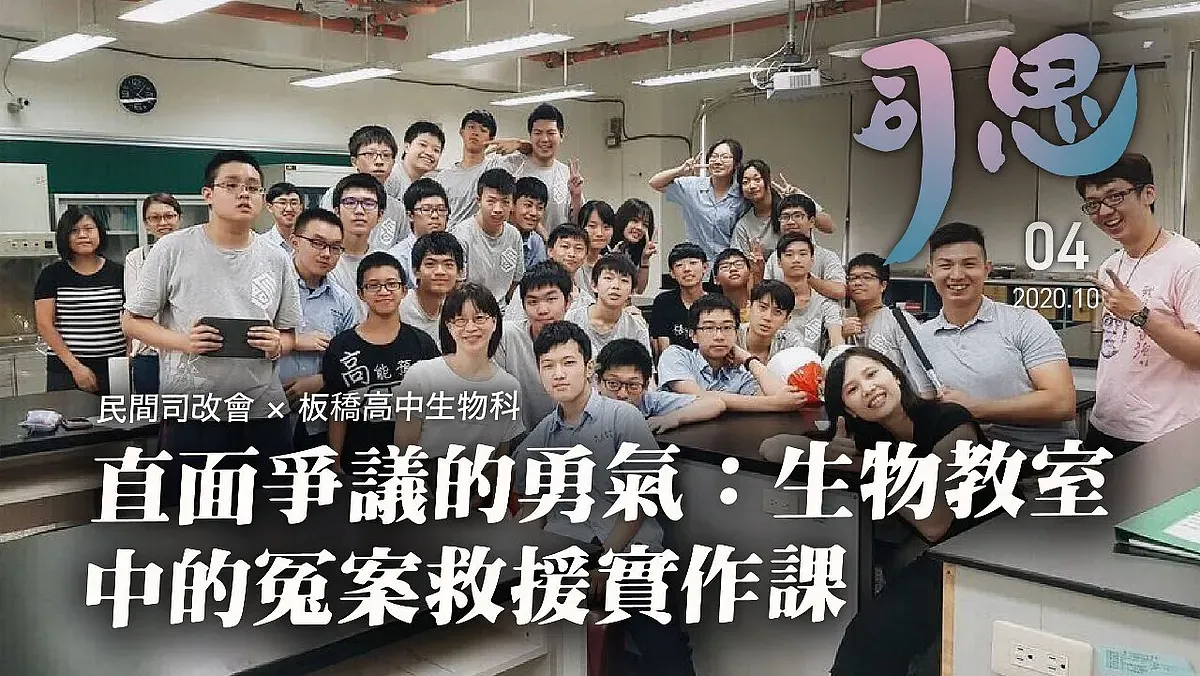
Last summer, JRF collaborated with Lai Hsueh-Hui, a biology teacher at Banqiao Senior High School, and 23 first-year students in the school's math and science gifted program on an experimental course. We developed the real-life wrongful-conviction case of Chen Ching-Kai into an eight-session course that approached wrongful convictions through the natural sciences.
- Week 1: Students learned about the case through news reports and videos, raised questions through discussion, and worked in groups to identify issues that needed clarification.
- Weeks 2-3: Students learned how visual perception works and how visual acuity is defined, then closely read and discussed the expert reports and scientific methods used in the case while revisiting the questions they had raised in the first week.
- Week 4: Chen Ching-Kai came to class to share his experience. Interactive activities helped students better understand everyday life for people with visual impairments.
This experimental summer course also paved the way for a later collaboration with Chen Miao-Hsien and Hsiao Hao-Liang on the school-developed required course "The Distance Between Evidence and Truth."
This article speaks with Lai Hsueh-Hui about how a biology teacher became connected with wrongful-conviction cases and the educational philosophy behind her teaching.
"Doing these things-and being willing to do them-was something that built up little by little."
Lai Hsueh-Hui first encountered a wrongful-conviction case through the Li Shih-Ko bank robbery case. Police initially arrested another man, Wang Ying-Hsien. After being tortured into a false confession, Wang jumped from a bridge and died while being escorted by police; only later was the actual perpetrator arrested. It was the first wrongful-conviction case she had ever heard about, through Tangwai magazines she read at home while in high school. During graduate school, as underground radio stations became popular, she learned about the Su Chien-Ho case and later took part in support activities for Su and the other defendants.
After Lai began teaching at Banqiao Senior High School, the school's open atmosphere gave her room to bring these issues into the classroom. More than a decade ago, before the Su Chien-Ho case had been exonerated, she invited the Humanistic Education Foundation to speak to students about it. Later she took over the library's "Author Series" and ran it for five years, inviting the Taiwan Alliance to End the Death Penalty to discuss wrongful convictions in death-penalty cases and bringing people such as Cheng Hsing-Tse, Hsu Tzu-Chiang, and Chen Lung-Chi to campus. Whether in homeroom, biology class, or the Author Series, wrongful convictions became part of her teaching.
Collaboration with the JRF
"Mei-Hui came to see me last summer. Her role was quite unusual-she had worked at a textbook publisher and dealt with teachers, and later moved into NGO work, so she already understood these issues," Lai said. "We only talked for about two hours. Mei-Hui explained the case clearly because she had already digested the material. A teacher would normally need a great deal of time to do that, but she had already given me a structure to work with."
"I remember she came on a Tuesday during summer break. Two days later, on Thursday, I reopened the file and immediately regretted agreeing to it (laughs). Understanding the case was one thing; turning it into a course was another. But once I started, the teaching experience I had built up over the years-dialogic teaching, scaffolding, and guided questioning-began to come into play. I spent a day working out the first outline of the lesson plan."
The first students to try the new course were members of the math and science gifted class moving from their first to second year of high school. They had biology during the summer and, as it happened, did not need to move ahead in the regular syllabus or spend the time reviewing old material. Without pressure to cover the syllabus, the class was ideal for trying something new. Even after the lesson plan was designed, we had no idea how much time it would actually take. These students liked to think and enjoyed challenging material. I remember several moments when a student's question made me realize that I had overlooked something crucial while preparing the lesson. Teacher and students were learning from one another.
"Always standing in the middle is actually a form of laziness."
At the start of the first class, Lai joked, "What I hate most is people pretending to be neutral." She wanted students to develop a position of their own and learn to make a choice.
Lai said that many people believe teachers should be "neutral," without first asking what neutrality actually means. To her, neutrality means understanding different sides clearly and then forming your own view-not mechanically standing in the middle on every issue. "Always standing in the middle" requires no thinking. If you do not know enough to choose, then admit that you do not know enough rather than pretending to be neutral. And views can change: if you later discover that you were wrong, you revise them.
Finding Answers Together Through Dialogue
Lai's classroom looks very different from a traditional one-way lecture. She engages students in constant back-and-forth discussion, keeps asking follow-up questions, and rarely gives them the answer outright.
"When I first started teaching, I was still inexperienced, and students would ask why I had to take such a roundabout route instead of simply telling them the answer," Lai said. "At the Humanistic Education Foundation, I learned the idea of 'conjecture and refutation': you put forward a view, I disagree with it, and we challenge each other's arguments through debate. That takes practice. In class, you have to keep reminding students that discussion is not an attack on the person; it is a challenge to the argument. They learn to understand another person's reasoning, identify the weaknesses, and respond. It isn't question-and-answer. We are looking for the answer together through dialogue."
"What makes us different from more traditional teachers is that we can accept not being all-knowing in front of students. We can admit that we don't know something. That means we don't have to fear difficult questions, and real dialogue can actually begin."
"Different educational philosophies take us in different directions and shape us into different kinds of teachers."
Hands-On Wrongful-Conviction Work in the Biology Classroom
Working with Hsueh-Hui, Miao-Hsien, and Hao-Liang, we saw several qualities they shared: they were willing to innovate, put ideas into practice immediately, make mistakes, and correct course quickly. Those qualities created the conditions for an interdisciplinary, hands-on course on wrongful convictions. Their concern did not stop at sympathy; they brought difficult and controversial issues directly into the classroom and invited students to confront questions that do not yet have a single "correct answer."
This article is an AI-generated translation of the original Chinese text. In the event of any discrepancy, the Chinese version shall prevail.
