
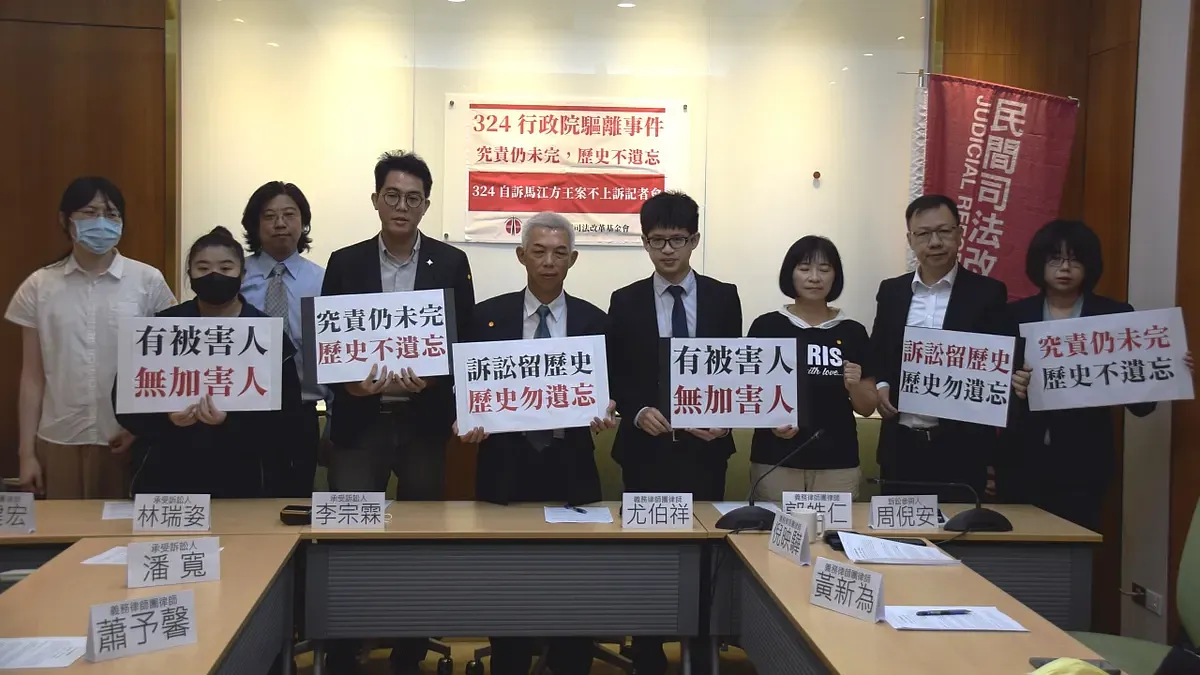
March 24 Executive Yuan Eviction: Accountability Remains Unfinished, and History Must Not Be Forgotten - Press Conference on the Decision Not to Appeal the Private Prosecution of Ma, Chiang, Fang, and Wang
Last edited: 2026-08-29
Six and a half years have passed since the March 24, 2014 Executive Yuan eviction. That night, several people who were peacefully sitting in at the Executive Yuan compound were unlawfully beaten and injured by police. The victims brought private prosecutions in an effort to establish what happened that night. Regrettably, on September 15 the Criminal Division of the Taiwan Taipei District Court acquitted Ma Ying-Jeou (then President), Chiang Yi-Huah (then Premier), Wang Cho-Chun (then Director-General of the National Police Agency), and Fang Yang-Ning (then an on-site commander). After discussion, the legal team and private prosecutors decided not to appeal-not because they accept the court's judgment, but because they have lost all confidence in the judiciary.
Accountability for State Violence on March 24 Remains Unfinished
On the night of the March 24 Executive Yuan eviction, many people peacefully sitting in at the scene were beaten with police batons and struck with shields. Ambulances came and went throughout the night while the media broadcast the violence live. Yet despite state violence on this scale, not a single officer who used unlawful force has faced administrative discipline or criminal prosecution, and none of the commanders who ordered or directed the eviction has taken responsibility.
To pursue the truth and accountability, and to prevent evidence of the state violence from disappearing into investigative files, the injured victims and the volunteer legal team were forced to take on work ordinarily performed by the state: bringing private prosecutions and presenting criminal evidence. They separately brought cases against senior executive and police officials, on-site commanders, and unidentified officers for attempted homicide, intentional injury, and other offenses. (See the Appendix: Table of Private Prosecution Cases Arising from the March 24 Executive Yuan Eviction.)
Many of these cases were dismissed before any substantive examination. Only in the past two years did a small number finally proceed to trial on the merits. Yet the government officials and police commanders who appeared in court never acknowledged responsibility for the bloody eviction or offered even a single apology. Ma Ying-Jeou, then President, testified that the functioning of constitutional institutions was more important than citizens' physical safety. Chiang Yi-Huah, then Premier, said bluntly that after learning police had begun the eviction, he went to sleep. Wang Cho-Chun, then Director-General of the National Police Agency, and Huang Sheng-Yung, then Commissioner of the Taipei City Police Department, were plainly directing operations from the command center that night, yet claimed that they were merely coordinating resources and knew nothing about conditions on the ground. On-site commanders Hsueh Wen-Jung, Yang Hung-Cheng, and Fang Yang-Ning likewise failed in their duty to protect the public, allowed officers to assault citizens, and have never acknowledged wrongdoing for the police violence that unfolded before them.
The History Preserved Through Six and a Half Years of Litigation Must Not Be Forgotten
Over six and a half years of litigation, many private prosecutors withdrew after becoming exhausted by the process. Those who persisted faced an additional burden: after hearings and judgments, government and police officials with far greater access to the media repeatedly distorted what had happened that night, even as public attention to the March 24 Executive Yuan eviction gradually faded. After one disappointing result after another, the legal team's expectations of the judiciary have also been steadily worn away.
Even so, the litigation preserved valuable historical records: police video footage obtained and retained through the proceedings, transcripts of open-court examinations of footage showing officers striking protesters, testimony from medical personnel, statements placed on the record by the private prosecutors, and cross-examination of police commanders. Subject to redaction of personal information and applicable legal requirements, these materials will later be made available to the public for research.
Taiwan has been transitioning from authoritarian rule to democracy for more than 30 years. Under authoritarian rule, people seeking democracy and freedom repeatedly suffered state violence during protests. The violence of March 24 is not only a serious stain on Taiwan's protection of freedom of assembly; it also destroyed many people's trust in the state. Unresolved truths are a major obstacle to building democratic identification with the state and the rule of law. The private prosecutors and legal team continued seeking truth and accountability because they hoped Taiwan's judiciary would not repeat the authoritarian-era tragedy of state violence with "victims but no perpetrators." Although the litigation has not achieved accountability, we will continue working to ensure that the truth of that night is neither buried nor forgotten.
Appendix
| Private-Prosecution Defendant | Case Number | Outcome |
| Unidentified officers who used violence | Taipei District Court 103-Tzu-Tzu No. 29 | Private prosecution dismissed because the defendants were not identified; final (case closed) |
| Commander Hsueh Wen-Jung | Taipei District Court 105-Tzu-Tzu No. 60 | Acquitted at first instance; private prosecutor did not appeal; final (case closed) |
| Taipei District Court 105-Tzu-Tzu No. 67 | Same matter; private prosecution dismissed (case closed) | |
| Taipei District Court 107-Tzu-Tzu No. 15 | Same matter; private prosecution dismissed (case closed) | |
| Commander Yang Hung-Cheng | Taipei District Court 105-Tzu-Tzu No. 62; Taiwan High Court 108-Shang-Tzu No. 3478 |
Acquitted at first and second instance (case pending final closure) |
| (Defendant was Peiping E. Rd. Commander) | Taipei District Court 105-Tzu-Tzu No. 58 | Defendant unspecified, private prosecution rejected (Case Closed) |
| Taipei City Police Department Commissioner Huang Sheng-Yung | Taipei District Court 103-Tzu-Tzu No. 61; Taiwan High Court 108-Shang-Tzu No. 3009; Supreme Court Criminal Judgment 109-Tai-Shang No. 2784 |
Acquittal became final after third-instance judgment (case closed) |
| (Defendants: Chiang Yi-Huah, Wang Cho-Chun, Fang Yang-Ning, and Huang Sheng-Yung) | Taipei District Court 103-Tzu-Tzu No. 35; Taiwan High Court 104-Shang-Tzu No. 2630; Supreme Court 108-Tai-Shang No. 1728 |
Same matter; private prosecution dismissed (case closed) |
| (Defendants: Chiang Yi-Huah, Wang Cho-Chun, Fang Yang-Ning, and Huang Sheng-Yung) | Taipei District Court 103-Tzu-Tzu No. 35 | Same matter; private prosecution dismissed (case closed) |
| President Ma Ying-Jeou Premier Chiang Yi-Huah National Police Agency Director-General Wang Cho-Chun Commander Fang Yang-Ning |
Taipei District Court 108-Tzu-Keng-Er No. 5 | Acquitted at first instance; no appeal to be filed (case pending final closure) |
Attendees
Attorneys
Yu Po-Hsiang
Kuo Hao-Jen
Hsiao Yu-Hsin
Huang Hsin-Wei
Lin Chien-Hung
Ni Ying-Hua
Plaintiffs
Li Tsung-Lin
Lin Jui-Tzu
Chou Ni-An
Press Contact
Lee Ming-Ju, Staff Attorney, Judicial Reform Foundation
This article is an AI-generated translation of the original Chinese text. In the event of any discrepancy, the Chinese version shall prevail.