
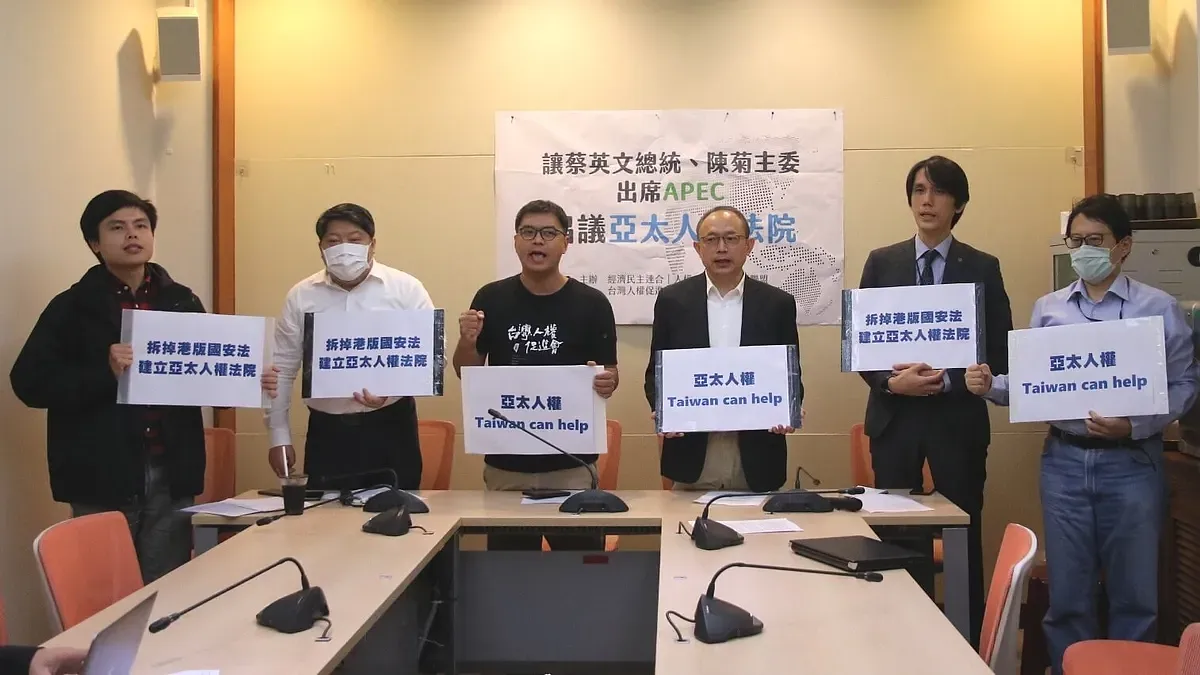
Call for President Tsai Ing-Wen and NHRC Chair Chen Chu to Attend APEC and Advocate an Asia-Pacific Court of Human Rights
Last edited: 2026-08-29
This year's APEC (Asia-Pacific Economic Cooperation) Economic Leaders' Meeting will be held in late November. At a press conference today (the 20th), the Economic Democracy Union, Taiwan Association for Human Rights, Judicial Reform Foundation, and Covenants Watch jointly called on Malaysia, this year's APEC host, to allow President Tsai Ing-Wen and National Human Rights Commission Chairperson Chen Chu to attend the APEC Economic Leaders' Meeting and advocate the establishment of an "Asia-Pacific Court of Human Rights." Chiang Min-Yen, a researcher at the Economic Democracy Union, said that Taiwan, as an APEC member economy on the front line of China's authoritarian expansion, should actively advocate including a human-rights mechanism in negotiations over the Free Trade Area of the Asia-Pacific (FTAAP).
Recent reports indicated that President Tsai might participate by video. Chinese Foreign Ministry spokesperson Wang Wenbin responded that any attempt by the Taiwan authorities to use the occasion to seek a "breakthrough" would be futile. Chiang Min-Yen rejected that view. Unlike Europe, where economic integration developed alongside shared human-rights values and ultimately the European Union, the U.S.-China trade war and the humanitarian crisis in Hong Kong have exposed the weakness of regional consensus on human rights in the Asia-Pacific. Fundamental differences between the United States and China over freedom of communications and expression, personal liberty, privacy, democratic elections, and other human-rights values have aggravated economic and trade conflicts and contributed to regional instability.
Chiang Min-Yen said an "Asia-Pacific Court of Human Rights" should draw on European mechanisms and create a cross-border avenue of redress for human-rights cases. Since the imposition of Hong Kong's National Security Law, the personal safety of Taiwanese and Hong Kong citizens-and cross-border movement throughout the Asia-Pacific-has faced the threat of arrest and secret detention by China. Taiwan should work with the international community now to establish a mechanism that can take an important step toward regional human-rights protection and stability. Chiang added that civil society groups would march on October 25 to demand the release of the 12 Hongkongers detained in China and to support Taiwan's advocacy for an Asia-Pacific Court of Human Rights.
Starting with APEC: Taiwan Should Seize the Opportunity to Advance an Asia-Pacific Court of Human Rights
Lai Chung-Chiang, convener of the Economic Democracy Union Think Tank, noted that APEC member economies issued the Bogor Declaration in 1994, setting a goal of achieving free and open trade and investment by 2020. The 2010 Yokohama Leaders' Declaration then adopted the "Pathways to FTAAP," identifying the Free Trade Area of the Asia-Pacific as a principal vehicle for APEC economic integration and the Bogor Goals. Although progress has been slow, Lai emphasized that Taiwan is an APEC member economy and therefore cannot be excluded from the planning, negotiation, or eventual formation of the FTAAP. As 2020 was the Bogor Declaration's original target year, Taiwan should seek participation by President Tsai Ing-Wen and National Human Rights Commission Chairperson Chen Chu at the APEC summit and use the occasion to advocate incorporating an Asia-Pacific Court of Human Rights into the FTAAP framework.
Lai said the U.S.-China trade war shows that the key to future regional economic integration is no longer simply tariff reduction, but dispute-resolution mechanisms for cross-border economic and trade conflicts. These include mechanisms for investment and intellectual-property disputes, as well as human-rights issues arising from cross-border movement-for example, where telecommunications-fraud suspects from the Philippines should be repatriated, or whether foreign citizens and businesspeople secretly detained and deprived of liberty in China can seek judicial relief. Taiwan should learn from the European Union and give an Asia-Pacific Court of Human Rights a role in integrating human-rights values into regional integration, making it a pillar of long-term economic and trade cooperation.
Lai Chung-Chiang explained that incorporating human rights clauses into economic and trade negotiations is not unfamiliar to Taiwan; in the past, the Ma administration negotiated and signed an investment protection agreement with China that incorporated a personal freedom notification mechanism, and the economic cooperation agreement between Taiwan and New Zealand even incorporated specialized chapters on labor, the environment, and indigenous peoples. Recently, the Hong Kong National Security Law enacted by China's National People's Congress has endangered the personal freedom of business people from various countries, as well as students, workers, tourists, and transit passengers in Hong Kong. It is indeed necessary to incorporate human rights mechanisms into the planning of the Free Trade Area of the Asia-Pacific (FTAAP).
Facing China's Wolf Warrior Diplomacy: Regional Human-Rights Protection Is Essential to Long-Term Interests
Sung Cheng-En, convener of the Economic Democracy Union's Sovereignty, Foreign Affairs, and National Defense Group and an international-law scholar, noted that President Tsai Ing-Wen identified "deepening democracy" as one of Taiwan's forward-looking national priorities in her May 20 inaugural address. Human rights are closely connected to economic development and regional trade. Without security for people, a state cannot be secure.
Sung said China's wolf warrior diplomacy and authoritarian coercion have created an unprecedented threat to people in Taiwan and across the Asia-Pacific. Li Ming-Che, for example, was wrongfully convicted and remained imprisoned; Hong Kong's National Security Law criminalized expression and political thought through serious offenses; and a series of baseless "Taiwan spy" accusations showed that anyone in China could be saddled with fabricated charges and turned into a hostage. Because abusive prosecutions within China's judicial system offer no meaningful domestic remedy, Sung argued that only a regional human-rights mechanism can effectively protect foreigners in China. China's recent election to the UN Human Rights Council also means it has formally endorsed international human-rights mechanisms, including individual complaints and international review. Taiwan's representative at APEC should therefore place regional human-rights protection squarely on the agenda. Sustainable regional economic and development cooperation, Sung emphasized, must rest on democracy, freedom, and respect for pluralism.
Wang Lung-Kuan, an attorney and convener of JRF's International Cooperation Group, said civil society organizations have long called for APEC to establish a human-rights mechanism, regardless of where its meetings are held, only to be told that "economics is economics, and human rights are human rights." Citing the Li Ming-Che case, in which JRF provided assistance, and China's detention of Canadian citizens, he asked: if personal safety cannot be guaranteed, how can anyone do business? Human-rights protection, he said, is a prerequisite for stable economic and trade activity.
Wang Lung-Kuan noted that APEC once added clauses on privacy protection to conduct limited cross-border cooperation on privacy, which indicates that it is also feasible for APEC to incorporate human rights mechanisms. Even if an Asia-Pacific Court of Human Rights cannot be achieved overnight, he believes that Taiwan can facilitate this change.
Continuing Taiwan's International Mission and Fostering the Asia-Pacific Human Rights Protection System
Shih Yi-Hsiang, secretary-general of the Taiwan Association for Human Rights, quoted former President Chen Shui-bian's remarks during his acceptance speech for a human rights award presented by the International League for Human Rights in the United States: Taiwan must continue to promote a regional Asian human rights protection system; Taiwan can serve as a platform, contributing Taiwan's experience and strength to the improvement and advancement of human rights in Asia.
Looking back at that important human-rights speech 17 years later against the backdrop of current U.S.-China tensions, Shih Yi-Hsiang argued that Taiwan now has stronger geopolitical conditions for promoting a regional human-rights protection system. He called on President Tsai Ing-Wen to propose a comprehensive Asia-Pacific framework at this year's APEC meeting, including a human-rights charter and human-rights court. Such a framework would serve Taiwan's own interests while responding to the threat posed by Hong Kong's National Security Law and the growing number of cross-border human-rights cases in which victims have nowhere to seek relief.
Shih Yi-Hsiang said cross-border human-rights problems-from the 12 Hongkongers and the cases of Li Ming-Che and Li Meng-Chu, to the Rohingya in Myanmar and refugees at the U.S.-Mexico border-require mechanisms for human-rights remedies and dispute resolution. Taiwan has posted significant achievements internationally in recent years, including becoming the first country in Asia to legalize same-sex marriage and earning recognition for its pandemic response. If President Tsai Ing-Wen takes the lead at APEC in proposing an Asia-Pacific human-rights mechanism, Shih argued, it would only strengthen Taiwan's international standing.
Huang Sung-Li, convener of Covenants Watch, explained that in addition to the United Nations human rights system, international human rights mechanisms also include regional systems. Europe, the Americas, and Africa all have regional human rights conventions and committees to examine whether individual countries violate the conventions; the Council of Europe has even established a human rights court capable of directly handling human rights violations within its borders.
He explained that civil society issued the Asian Human Rights Charter in Gwangju, South Korea, in 1998, but most Asian governments at the time resisted external scrutiny and invoked "Asian values" to blur universal human-rights standards. Taiwan's human-rights standards, by contrast, have increasingly aligned with high international standards in recent years. On democratization, personal liberty, freedom of thought and expression, and respect for gender and religion, Taiwan has advanced further than many countries in the region.
Huang Sung-Li therefore argued that Taiwan is well placed to help build a regional human-rights protection mechanism that uses international standards to scrutinize governments and regional institutions to issue warnings. He proposed using APEC as the platform, drawing on the UN's core human-rights treaties, and establishing an "Asia-Pacific Commission on Human Rights" within APEC's existing framework to receive complaints and conduct necessary investigations concerning human-rights violations in APEC member economies. Whether such a commission could later develop into an "Asia-Pacific Court of Human Rights" under the APEC framework would depend on further progress.
Attendees
Lai Chung-Chiang|Convener, Economic Democracy Union Think Tank; Attorney
Sung Cheng-En|Convener, Sovereignty, Foreign Affairs, and National Defense Group, Economic Democracy Union; International-Law Scholar
Shih Yi-Hsiang|Secretary-General, Taiwan Association for Human Rights
Wang Lung-Kuan|Convener, International Cooperation Group, Judicial Reform Foundation; Attorney
Huang Sung-Li|Convener, Covenants Watch
Media Contact
Chiang Min-Yen|Researcher, Economic Democracy Union
This article is an AI-generated translation of the original Chinese text. In the event of any discrepancy, the Chinese version shall prevail.