
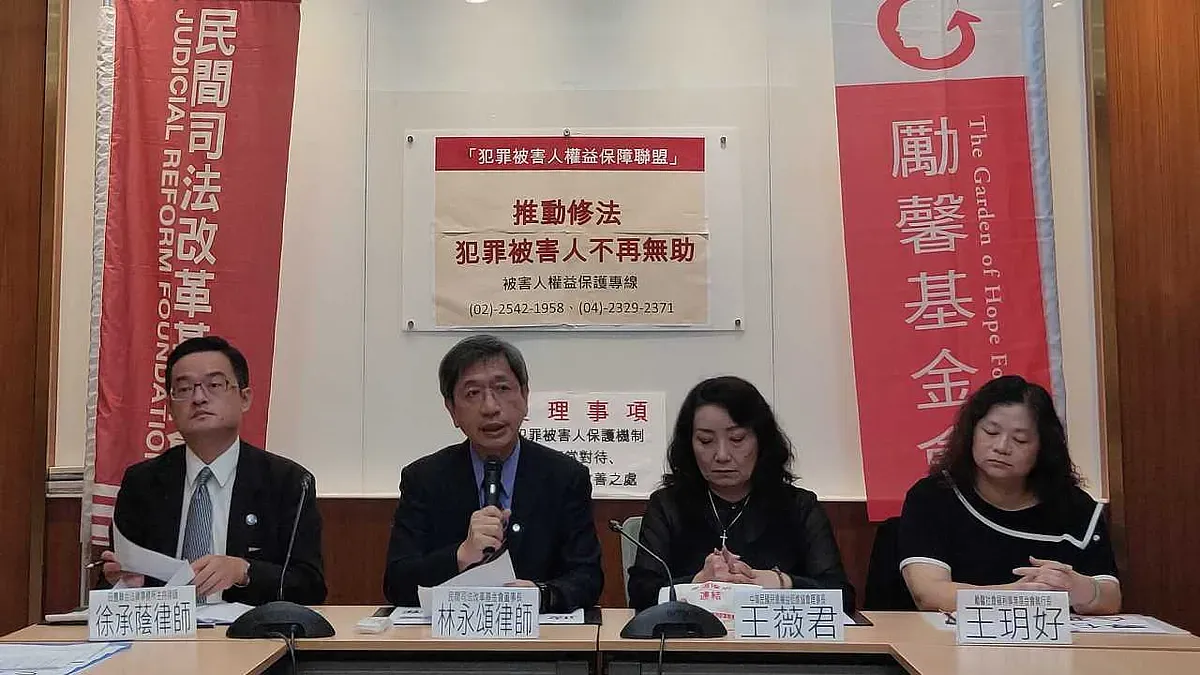
"Promote Legal Reform So Crime Victims Are No Longer Left Helpless" - Launch of the Civil Alliance for Crime Victims' Rights Protection
Last edited: 2026-08-29
Crime victims and their families are often overlooked and left without support in criminal proceedings. In response, several civil society organizations concerned with crime victims' rights have formed the "Civil Alliance for Crime Victims' Rights Protection" to promote legislative reform. JRF has also opened a "Crime Victims' Rights" complaint hotline at 02-2542-1958 and 04-2329-2371 to receive reports of deficiencies in the current victim-protection system and suggestions for improvement.
| Current Deficiencies | Reform Demands | |
1 |
Government-dominated, rigid services | Civil-society-led, proactive, and flexible services |
2 |
Insufficient and opaque funding | Adequate and transparent funding |
3 |
Too many part-time staff; low pay and overwork | Full-time professionals with reasonable compensation |
4 |
Low institutional status and unclear responsibilities | Executive Yuan coordination and clear division of responsibilities |
5 |
Benefits treated as discretionary assistance, with no effective remedy | Rights-based protection with access to remedies |
| See Attachment Comparison Table of Selected Articles of the Crime Victim Rights Protection Act | ||
Crime Victims' Rights Hotline
02-25421958
04-23292371
Report deficiencies in victim-protection mechanisms
and submit suggestions for improvement
1. Existing crime-victim protection organizations are too heavily dominated by government actors, making their services rigid. The Alliance's draft would instead move toward a government-supported but civil-society-led model capable of providing more proactive and flexible services.
Article 6 of the current Regulations on the Organization and Supervision of Crime Victim Protection Institutions and Article 9 of the Endowment and Articles of Association of the Crime Victim Protection Association provide for boards of 11 to 25 directors. Only the former requires that scholars or practitioners with research or experience in crime-victim protection make up at least one-fifth of the board. Paragraph 3 further provides that the chairperson is to be the chief prosecutor of the High Prosecutors Office, reinforcing government dominance. The large size of the board has also drawn criticism: budget evaluation reports for 2019 and 2020 both identified low attendance and poor deliberative efficiency and quality.
At the local level, branch-office directors were once directly drawn from the chief prosecutors of district prosecutors offices. The system was reorganized into committees in 2003, with private citizens serving as committee chairs in an effort to make the organization more independent of government. Yet an additional position of "honorary chairperson" was created. Although the rules do not expressly require a district chief prosecutor to hold that post, in practice most honorary chairpersons have been chief prosecutors, creating tension between the chairperson and honorary chairperson.
The Alliance's draft would therefore establish a new "Crime Victim Rights Protection Foundation," reduce the board to 15 directors to improve deliberative efficiency and quality, and limit government representation to one member each from the Judicial Yuan, Executive Yuan, Ministry of Justice, and Ministry of Health and Welfare. The remaining seats would be filled primarily by civil-society professionals with backgrounds in law, psychology, counseling, social work, and related fields, together with two representatives of crime victims. At local branches, the government-dominated honorary-chairperson position would be abolished and professionals in social work, law, psychology, or related fields would be appointed, creating a victim-rights organization led by civil society and capable of providing proactive, flexible services.
2. The law should expressly require reasonable and transparent use of crime-victim protection funds.
Budget evaluation reports for the Crime Victim Protection Association over the past two years show that many existing programs have fallen short of expectations and require improvement. Annual budgets and final accounts also show that too little funding is actually spent on protecting and serving crime victims, while expenditures unrelated to protecting victims' rights are included in the same budget. In the 2020 budget, for example, "protection expenses" accounted for only 40.77% (NT$83,043,000) of total expenditures of NT$203,666,000.
The Alliance's draft would require the competent authority to budget annual subsidies according to the Foundation's operational needs, ensuring adequate funding. It would also require the Foundation to prepare annual work plans and budgets consistent with its statutory purposes. After each fiscal year, the Foundation would have to submit its annual work report, final accounts, property inventory, and related materials to the competent authority for recordation and proactively disclose them within one month, helping ensure both adequate and transparent funding.
3. Staff should be full-time professionals, primarily in social work, psychology, law, and related fields, and should receive reasonable compensation comparable to similar professional positions.
Existing crime-victim protection organizations rely too heavily on branch volunteers for frontline services, while part-time staff greatly outnumber full-time staff, resulting in uneven service quality and weak quality control. The Alliance's draft would therefore require the Foundation to appoint a full-time chief executive with expertise in social work, law, psychology, or related fields. Local branches would have a part-time branch chair but a full-time branch director responsible for operations, and could hire additional full-time staff. Full-time directors and professional staff, other than dedicated administrative personnel, would be required to have relevant backgrounds in social work, law, psychology, or related fields. Compensation would be benchmarked against government positions involving comparable work, helping ensure professional staffing at reasonable pay.
4. Responsibilities must be clearly defined and linked to the relevant government agencies.
The current Crime Victim Protection Act addresses the work of victim-protection organizations in Article 30, but does not clearly allocate responsibilities or provide for coordination among the relevant ministries and agencies. The Alliance's draft would place overall coordination with the Executive Yuan, clearly define the respective responsibilities of government bodies, and require them to establish a cooperative network with the Crime Victim Rights Protection Foundation.
5. Protection of crime victims' rights should be treated as a legal right, with meaningful avenues for remedy.
In practice, crime-victim compensation is often processed slowly. Moreover, because the current Crime Victim Protection Act treats compensation as a form of payment by the state on behalf of the offender, victims may be required to return compensation if the defendant is later acquitted. Rather than compensating victims for harm caused by the crime, this can subject them to a second injury. The current Act also does not clearly define victims' other rights or the remedies available when those rights are violated. The Alliance's draft would therefore expressly define crime victims' rights, identify reviewable matters and available remedies, create an expedited process for compensation claims, and abolish the existing state-payment recovery mechanism.
The Alliance expects to release proposed provisions for its civil-society draft amendment next month. We welcome comments and suggestions from all sectors, and encourage crime victims to speak up, file complaints, and join the effort to strengthen protection of crime victims' rights.
Attachments
Attendees
Joseph Lin / Chairperson, Judicial Reform Foundation
Wang Yueh-Hao / CEO, Garden of Hope Foundation
Wang Wei-Chun / Chairperson, Association for Rights Promotion of Children, R.O.C.
Hsu Cheng-Yin / Managing Attorney, Tian Feng Joint Law Firm
Press Contact
Hsiao I-Min, Office Director, Judicial Reform Foundation
This article is an AI-generated translation of the original Chinese text. In the event of any discrepancy, the Chinese version shall prevail.