
JRF Newsletter
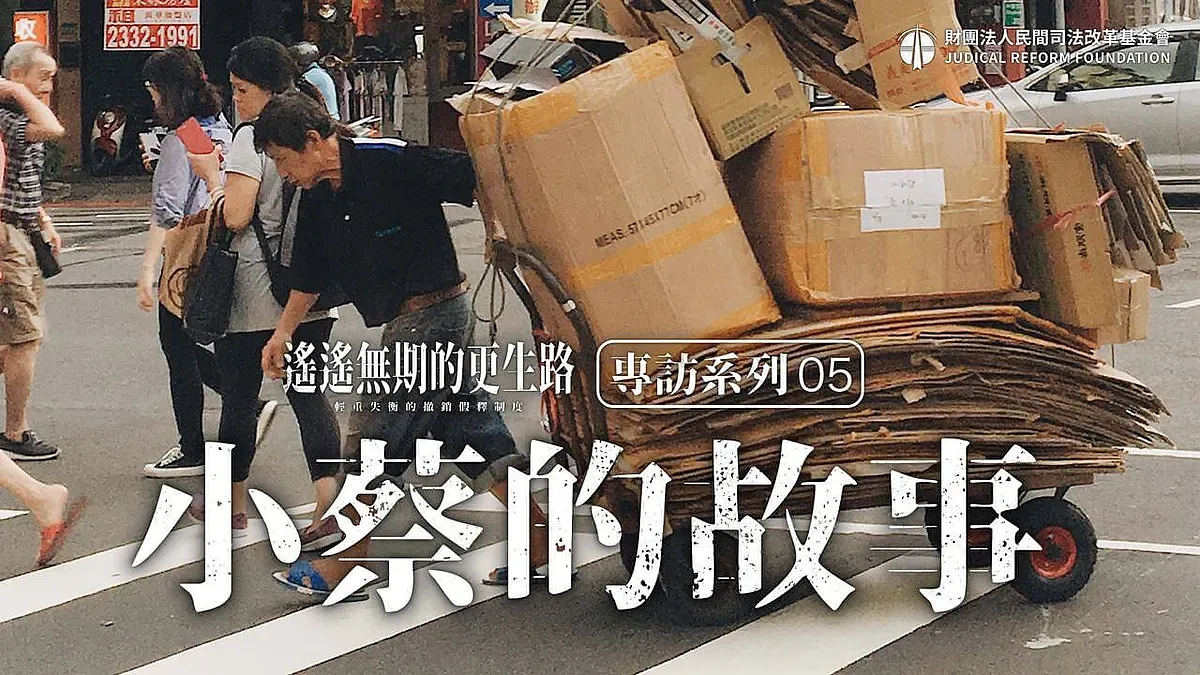
The Endless Road to Reintegration ❺: Hsiao-Tsai's Story
Last edited: 2026-08-29
In July 2007, the U.S. subprime mortgage crisis erupted, triggering financial turmoil on an unprecedented global scale. The crisis deepened dramatically in September 2008, when Lehman Brothers filed for bankruptcy, Bank of America acquired Merrill Lynch, and American International Group (AIG) sought emergency financing from the Federal Reserve. What followed became the global financial crisis.
I had just graduated from college. My peers were all looking for work, but both job openings and salaries had been hit hard by the downturn, and the government's "22K program" only deepened the anxiety among new graduates. Even for someone with a university degree, the memory of that economy is unsettling. It is difficult to imagine how someone released from prison with only a junior-high-school education and no particular vocational skills was supposed to survive that winter.
A Parolee at the Bottom of the Economic Downturn
Hsiao-Tsai was one of those people. He had a moderate disability certificate. He was released on parole on April 26, 2007, after maintaining a good prison record-but the real difficulty began after he got out.
He scraped together a living for himself and his mother, who was already in her eighties, by collecting recyclables and scrap. On May 1, 2008-Labor Day-he took a hammer and a crowbar to an empty, unoccupied dormitory and removed eight aluminum strips from the window frames, worth only about NT$1,000 in total. Before he had even carried the metal away, police arrived and arrested him.
The price of those eight pieces of metal would prove far heavier than anyone might expect.
Article 78, Paragraph 1 of the Criminal Code then provided: "If, during parole, a person intentionally commits another offense and is sentenced to imprisonment for a fixed term or a more severe punishment, the parole shall be revoked within six months after the judgment becomes final."
In other words, the rule allowed no exception. If a person committed an intentional offense while on parole and received the qualifying sentence, the law treated the new conviction as proof that the person had not reformed, and parole had to be revoked regardless of the circumstances or how minor the new offense was.
Looking Layer by Layer into a Life with Almost No Hope
After Hsiao-Tsai returned to prison, his mother did not know what to do. She could only visit him from time to time. When word spread through prisons that JRF had begun helping people whose parole had been revoked under Article 78 petition for constitutional review, Hsiao-Tsai mentioned it to her during one of those visits.
We were told that one morning, before the JRF office had even opened, Hsiao-Tsai's mother was already waiting outside. No one knows how long she had been sitting in the stairwell. She had traveled north from Yunlin the day before and stayed at a friend's home. She knew nothing about law and understood only Taiwanese. She wanted only one thing: for someone to help her son come home sooner.
After I joined JRF's prison-reform team, his case was assigned to me. The others asked me to look through it and decide whether there was anything we could do. At first, I thought the issue was simply whether revoking his parole produced a disproportionate result. But as one record after another came in, I began to feel that the cage of reality had shown him almost no mercy at all.
A Shabby Judgment from the Earlier Case
The old judgment we obtained from the prosecutors office listed his occupation in two faded characters: "業工." What did that even mean? I stared at the words for a long time. In today's language, it meant simply that he was a laborer. Strangely, I found myself almost relieved that when he was young, someone had at least once recognized Hsiao-Tsai as a working man.
The judgment's statement of facts was only a few lines long:
"Tsai Ching-Sung, acting jointly for profit with an unidentified adult man known as 'Hsiao-Huang,' unlawfully sold the synthetic narcotic amphetamine. At about 11:00 p.m. on February 12, 1992, after 'Hsiao-Huang' received a telephone call from a person seeking to purchase amphetamine, Tsai Ching-Sung was instructed to deliver 41 bottles of amphetamine to a designated location in Tucheng Township, Taipei County. While passing No. 138 Qingyun Road, Qingshui Village, Tucheng Township, Taipei County, he was stopped by police, who seized 41 bottles of amphetamine. The case was referred by the Yonghe Precinct of the Taipei County Police Bureau to the Taiwan Banqiao District Prosecutors Office for investigation and prosecution."
That was it: 177 Chinese characters including punctuation, written in the era of the Statute for the Punishment of Banditry. The sparse judgment mixed uncertain facts with a peculiar investigative story. The alleged accomplice could not be identified. Neither could the buyer. The size of the "41 bottles" was never explained, nor how they were being transported, nor the actual delivery location. And yet police happened to intercept him directly in front of No. 138 Qingyun Road in Tucheng-the present location of the New Taipei District Court and New Taipei District Prosecutors Office-with the investigation conducted across precinct lines by the Yonghe Precinct of the Taipei County Police Bureau.
Apparently the future site of the New Taipei District Court and District Prosecutors Office exerted an irresistible, bait-like pull on criminal suspects. The more I read, the less the story made sense.
Ultimately, the conviction rested almost entirely on a police statement that Hsiao-Tsai said had been extracted after officers "punched and kicked me and forced me to confess." From the first-instance proceedings onward, he maintained his innocence and submitted hospital records documenting his injuries. Yet the court credited the evidence against him while discounting what supported his account. It rejected the torture allegation largely because he had not sought medical care immediately after being released on bail, but three days later.
The judgment devoted only a few short lines to Hsiao-Tsai's denial, but the possibility of a wrongful conviction is difficult to dismiss. Hsiao-Tsai was also a socially disadvantaged person with a disability certificate-something the judgment did not mention even once.
In the end, the court characterized him as having a serious criminal disposition, and the aggregate sentence he was ordered to serve reached 30 years and four months.
A life with little hope, it turned out, could still become more desperate.
Hsiao-Tsai had been dealt a bad hand from the start. If he had had money and opportunity, perhaps he too would have wanted to be what society calls a "good citizen." Instead, he survived by collecting scrap, then stole metal worth NT$1,000-and, after finally showing that he could change, discovered once again that the world seemed to have no place for him.
As a lawyer, I do not especially like preaching abstract theory. More often, I hope that legal practice can make life a little less painful for people who are suffering. But whenever I think of Hsiao-Tsai, anger still rises in my chest. I want to shout that justice which blindfolds itself to the suffering of the people before it does not create a better society; it only pushes those already at the bottom even further down.
Case Timeline
| (Prior Case) Amphetamine Case | |
| Time | Proceedings |
| February 12, 1992 (Wed) around 23:00 | Hsiao-Tsai arrested on suspicion of trafficking amphetamine |
| February 13, 1992 (Thu) | Hsiao-Tsai released on bail |
| February 17, 1992 (Mon) | Hsiao-Tsai seeks medical treatment |
| April 22, 1992 (Wed) | Taipei County Banqiao Hospital issues an injury diagnosis certificate documenting Hsiao-Tsai's injuries |
| June 29, 1992 (Mon) | First instance judgment |
| (Prior Case) Kidnapping for Ransom and Intimidation | |
| Time | Proceedings |
| Afternoon, October 3, 1994 | Intimidation: attempted telephone threat (no answer) |
| Around 22:00, October 3, 1994 | Intimidation: telephone threat |
| Around 22:00, October 20, 1994 | Kidnapping for ransom: (1) victim's hands handcuffed; (2) handcuffs removed and victim bound with rope |
| Around 03:00 to 04:00, October 21, 1994 | NT$3,700 forcibly taken |
| Around 10:00, October 21, 1994 | Victim frees themself from the rope and escapes |
| Around 12:20, October 21, 1994 | Hsiao-Tsai discovers that the victim has escaped |
| Around 16:00, October 21, 1994 | Hsiao-Tsai pawns the victim's Rolex watch |
| Around 17:00, October 24, 1994 | Kidnapping for ransom |
| Around 16:30, October 27, 1994 | Hsiao-Tsai arrested |
| March 3, 1995 | First instance judgment |
| Parole | |
| April 26, 2007 | Released on parole |
| (Subsequent Case) Theft | |
| May 1, 2008 | Hsiao-Tsai commits theft |
This article is an AI-generated translation of the original Chinese text. In the event of any discrepancy, the Chinese version shall prevail.