
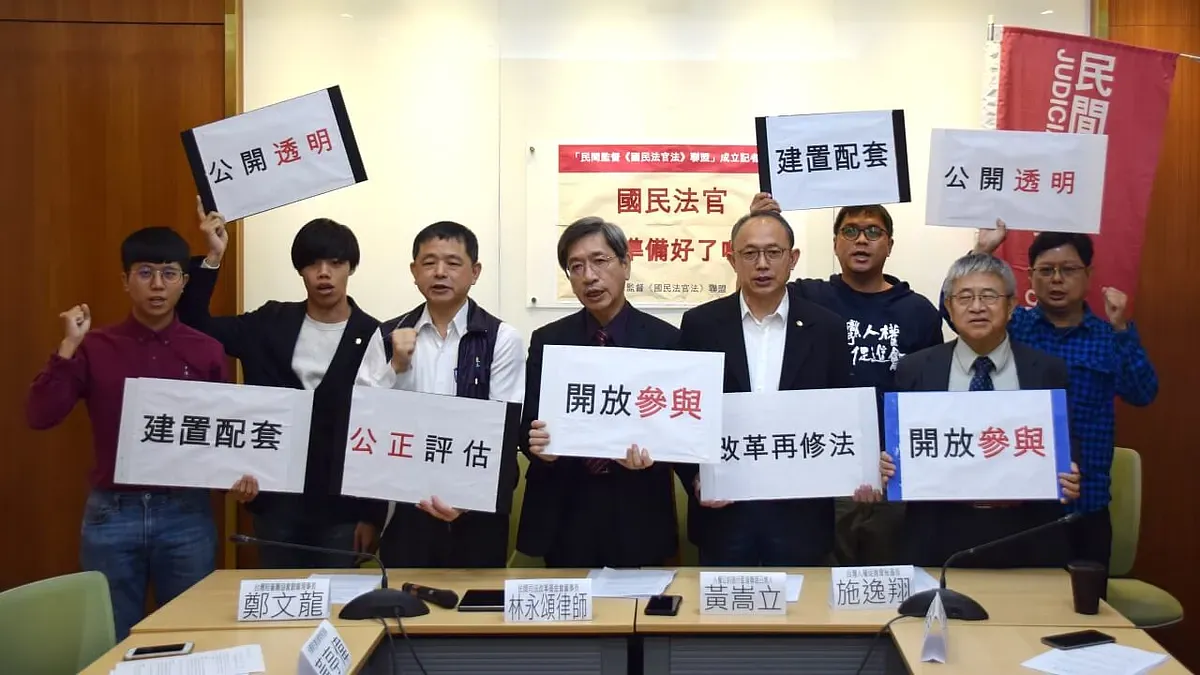
Citizen Judges: Is Everyone Ready? - Press Conference Launching the Civil Society Coalition for Monitoring the Citizen Judges Act
Last edited: 2026-08-29
On July 22, the Legislative Yuan passed the Citizen Judges Act, formally introducing citizen participation into Taiwan's criminal courts. With this major change to criminal procedure scheduled to take effect on January 1, 2023, the question is: citizen judges-and the government-are we ready?
To promote popular sovereignty and give practical effect to the public's right to participate in trials, nine organizations concerned with judicial reform-Covenants Watch, Taiwan Association for Human Rights, Taiwan Jury Association, Taiwan Youth Association for Democracy, Taiwan Criminal Defense Attorney Association, Taiwan Labor Front, Judicial Reform Foundation, Taiwan Alliance to End the Death Penalty, and Garden of Hope Foundation-have formed the "Civil Society Coalition for Monitoring the Citizen Judges Act." The Coalition has set out five core principles: transparency, open participation, supporting measures, impartial evaluation, and further legislative reform. It will pursue the following work (see the attached founding statement):
-
Transparency
Article 1 of the Citizen Judges Act states that the Act is intended to enable citizens and judges to participate jointly in criminal trials, increase judicial transparency, reflect citizens' legitimate legal sentiments, strengthen public understanding of and trust in the judiciary, and realize the principle of popular sovereignty. The Coalition therefore calls on the Judicial Yuan and the Ministry of Justice to fully disclose administrative information concerning budgets, planning, implementation, publicity, education, evaluation, and legislative amendments, so that the public can scrutinize and oversee the process and trust can be earned through transparency.
Coalition Work Monitor government disclosure and build online platforms for information and policy communication.
-
Open Participation
Because the Citizen Judges Act is intended to realize popular sovereignty, civil-society participation should extend beyond the courtroom. The Coalition calls on the Judicial Yuan and Ministry of Justice to open administrative processes involving budgeting, planning, implementation, publicity, education, evaluation, and legislative amendments to civil-society participation. The public should have a role not only in trials themselves but also in the administrative process of building the citizen-participation system.
Coalition Work Monitor whether the government meaningfully opens the process to civil society and promote public education on citizen participation in trials.
-
Supporting Measures
The Coalition believes the Citizen Judges Act should drive broader judicial reform. Supporting reforms-including the indictment-only system, rules of evidence, plain-language legal communication, and broader rule-of-law and civic education-must move forward immediately so that the criminal justice system is genuinely prepared for citizen participation in trials.
Coalition Work Monitor the government's supporting measures and prepare corresponding civil-society draft amendments.
-
Impartial Evaluation
Article 105 of the Citizen Judges Act requires the Judicial Yuan, after the Act takes effect, to establish a performance-evaluation committee for the citizen-participation system, conduct necessary research, issue annual reports on implementation, and submit a final report after the evaluation period with an overall assessment and recommendations for future amendments and supporting measures. The Coalition will use procedural participation, courtroom observation, surveys, and other monitoring tools to produce parallel civil-society evaluations and recommendations. The goal is to safeguard the committee's independence and impartiality and prevent it from becoming a rubber stamp for the government's position.
Coalition Work Monitor the performance-evaluation committee and publish corresponding civil-society evaluation reports.
-
Further Legislative Reform
The Citizen Judges Act contemplates a final evaluation and recommendations for legislative amendments after six years. Based on its own evaluation reports and recommendations, the Coalition will likewise prepare civil-society draft amendments and engage in legislative advocacy, with the aim of deepening the public's right to participate in trials and continuing the reform process.
Coalition Work Prepare civil-society draft amendments based on evaluation reports and recommendations.
The Legislative Yuan will review the central government's general budget during this session. The Judicial Yuan has budgeted NT$331.64 million in 2021 to promote the citizen-judge system, including NT$120 million for publicity. Yet the Judicial Yuan has repeatedly failed to disclose relevant policy and implementation materials. Legislators have therefore raised concerns that the publicity budget could be misused for online influence operations or ineffective promotion, while the public remains unable to understand what the government is doing. The Coalition makes two demands:
-
The Judicial Yuan Should Disclose All Plans and Supporting Measures Before the Citizen Judges Act Takes Effect
Implementation of the Citizen Judges Act requires changes to criminal procedure involving the indictment-only system, rules of evidence, cross-examination, and courtroom practice, as well as public legal education. At present, the Judicial Yuan has been preparing local "Citizen Judge System Briefings" that are not open to the public. It has also failed to disclose the content and methodology of its surveys or the format and content of its promotional lecture tours. The Coalition calls on the government to disclose all plans and supporting measures before the Act formally takes effect so that they can be subject to public oversight.
-
Citizen-Judge Mock Trials Should Be Open, and Related Documents Should Be Published
Mock trials are an important part of training judges, prosecutors, defense counsel, and citizens to understand how the Citizen Judges Act will operate in practice. The government should make mock deliberations and related written materials-including indictments and prosecution and defense submissions-publicly available, and should plan for live streaming and full video recording. People who cannot attend in person should still be able to understand the procedure through live or recorded video, maximizing public familiarity with the new system.
A closed and opaque approach by the Judicial Yuan and Ministry of Justice will not achieve meaningful policy communication, regardless of how much is spent on publicity. The Coalition calls on legislators from both the governing and opposition parties to use the budget-review process to require the two agencies to respond to civil-society demands and to begin the final two years of preparation for implementation by putting transparency into practice.
Attendees
Joseph Lin / Chairperson, Judicial Reform Foundation
Cheng Wen-Lung / Founding Chairperson, Taiwan Jury Association
Wang Yueh-Hao / CEO, Garden of Hope Foundation
Huang Sung-Li / Convener, Covenants Watch
Shih Yi-Hsiang / Secretary-General, Taiwan Association for Human Rights
Sun Yu-Lien / Secretary-General, Taiwan Labor Front
Chang Yu-Meng / Chairperson, Taiwan Youth Association for Democracy
Huang Ting-Wei / Standing Board Member, Taiwan Students' Union
Chang Cheng-Hsiu / Professor, Department of Law, Kainan University
Press Contacts
Chen Yang, Legislative Researcher, Judicial Reform Foundation
This article is an AI-generated translation of the original Chinese text. In the event of any discrepancy, the Chinese version shall prevail.