
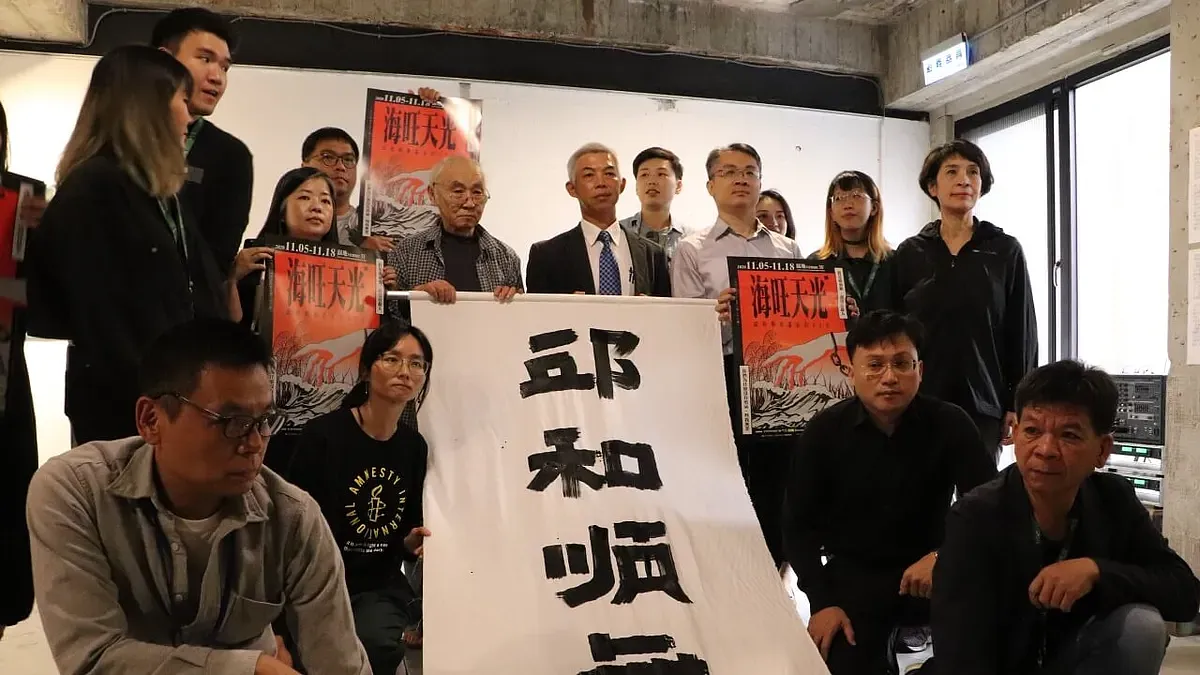
Hai-Wang's Daybreak ✸ Chiu Ho-Shun's Forgotten 32 Years - Exhibition Press Conference
Last edited: 2026-08-29
In 1988, police and prosecutors falsely accused Chiu Ho-Shun of masterminding the Lu Cheng and Ko Hung Yu-Lan cases. As many as 288 interrogation records containing self-incriminating statements contradicted one another, were riddled with inconsistencies, and were unlawfully obtained through torture. Courts at multiple levels nevertheless imposed death sentences based only on confessions by Chiu and his co-defendants. Since his conviction became final in 2011, Chiu has filed multiple petitions for retrial and extraordinary appeal, all of which have been rejected. With judicial remedies going nowhere, advocacy groups went to the Presidential Office on April 7, 2020 to submit a petition asking the President to pardon Chiu Ho-Shun and bring an end to 32 years of injustice.
The President has yet to respond. Continuing the dialogue with society has therefore become an ongoing task that the legal team and advocacy organizations remain committed to.
In the year Chiu Ho-Shun turned 60, the Judicial Reform Foundation, Taiwan Association for Human Rights, Amnesty International Taiwan, Taiwan Alliance to End the Death Penalty, Covenants Watch, and other civil-society groups held the special exhibition "Hai-Wang's Daybreak ✸ Chiu Ho-Shun's Forgotten 32 Years" from November 5 to November 18. Through art and cultural experiences, the exhibition invited the public to learn Chiu's story and confront the cruelty of wrongful conviction.
On the opening day, November 5, Cheng Hsing-Tse, who was exonerated in 2017, wrote the calligraphy "Chiu Ho-Shun Is Innocent" for the exhibition. The Tsai Jui-Yueh Dance Research Institute, a longtime supporter of Chiu, also gave a powerful dance performance. Through calligraphy and movement, the performers used their own artistic languages to speak out for Chiu Ho-Shun.
Wu Ting-Chen, media and marketing specialist at the Taiwan Association for Human Rights and one of the exhibition's curators, said she was deeply shaken when she first encountered the Chiu Ho-Shun case at age 23. Like many young people trying to understand the case, she wondered: How could something like this still happen in democratic, free Taiwan in the twenty-first century? That shock gave her both the motivation and the strength to take part in the exhibition.
Wu said that throughout the curatorial process she kept asking how an exhibition could make visitors feel the pain of having 32 years of freedom taken away. Even after more than two months of preparation and the installation was completed on the eve of opening, she still had no answer. Perhaps, she said, no matter how hard one tries, it is impossible to fully experience Chiu Ho-Shun's suffering. All the curators could do was use interactive spaces, audio and visual experiences, and written material to bring more people into contact with the issue of wrongful conviction. The exhibition also included a wall devoted to wrongful convictions, in the hope that public attention might help stop the "bullet" that has hung over Chiu for 32 years.
Mido, a designer at the Judicial Reform Foundation and another curator of "Hai-Wang's Daybreak," said that in the year since joining JRF, she had gradually worked through the advocacy materials accumulated around the Chiu Ho-Shun case. Everywhere she looked she could see traces of the people who had worked on the case for more than a decade: A-Shun's handwritten letters, videos, events, photographs of advocacy booths, and more. The materials made clear how long and difficult wrongful-conviction advocacy can be. While the pro bono legal team continues to pursue judicial remedies, everyone else can only contribute what strength they have to speak for him and help more people see the injustice of the case.
Mido compared the advocates to catchers in the rye, trying to catch innocent people before they fall into the bottomless abyss of the justice system. She hoped the exhibition would lead more people to see the case, see an aging Chiu Ho-Shun, and refuse to let him wither away in a prison cell. Chiu did not kill anyone, she said, and the state should have the courage to acknowledge its mistake and acquit him. "Hai-Wang" was Chiu's childhood nickname; the hope is that daybreak-and the day of his exoneration-will come soon.
Dancer Chan Tien-Chen, who performed at the opening, said the dominant emotion she experienced while creating the work was pain. "If we know and understand the Chiu Ho-Shun case, how can we allow this kind of injustice in society to keep pressing down on it? That is what this work is trying to show." Chan said she had never had problems sleeping, but for the previous two weeks the case had remained constantly on her mind and kept her from sleeping peacefully. It is a wound carried by society as a whole, she said. She hopes Chiu can be released soon so that the wound can begin to heal; otherwise, an artist's soul is continually eroded by it.
Attorney Yu Po-Hsiang, convener of the pro bono legal team, said he had been discouraged by President Tsai Ing-Wen's failure to respond to the pardon campaign. He has long felt that Chiu Ho-Shun is not the only one trapped: all of us, and the conscience of society itself, are caught in the same net. Our bodies may not be inside, he said, but our consciences are. He hopes the day will come soon when both A-Shun and society's conscience can be set free.
"Only when society speaks openly about the problems in this case will there be a chance to break out of the net," Yu said. "We can see the net covering Chiu Ho-Shun and something outside pressing down on it. The only way to remove the huge rock weighing on the net is from the outside. Without outside forces lifting that rock, I don't think we can rescue Chiu Ho-Shun. That is why I am so grateful that so many friends are still walking with us today."
Hsu Tzu-Chiang, an exoneree who once spent time with Chiu Ho-Shun in prison, said everyone gathered at the exhibition shared a common mission: to keep the dialogue with society going for Chiu. Sustained public dialogue remains an essential task for the legal team and advocacy organizations, and that is why the exhibition exists. He called on the President to respond to the request for a pardon: "We all owe Chiu Ho-Shun an answer. When an innocent person is convicted, no one is truly free. Every day Chiu goes without an answer adds another layer of frost to his years in detention, while society allows the injustice to continue."
"As someone who has lived through a wrongful conviction, I want to say once more to President Tsai: you cannot imagine the pain of Chiu Ho-Shun losing his freedom for 32 years-11,901 days. If the key that can open the bars and bring 'Hai-Wang's Daybreak' is in your hands, will you please open that door for Chiu Ho-Shun?" With that renewed appeal for a pardon, Hsu Tzu-Chiang brought the opening gathering to a close.
Supporters in Attendance
Huang Wen-Hsiung (Human rights activist)
Hsu Tzu-Chiang (Wrongful-conviction exoneree)
Cheng Hsing-Tse (Wrongful-conviction exoneree)
Feng Hsien-Hsien (Senior journalist)
Li Hui-Jen (Documentary filmmaker)
Chan Tien-Chen (Dancer, Tsai Jui-Yueh Dance Research Institute)
Yu Po-Hsiang (Attorney; Convener, Chiu Ho-Shun Pro Bono Legal Team)
Chiu I-Ling (Secretary-General, Amnesty International Taiwan)
Wang Jung (Senior Advocacy Officer, Amnesty International Taiwan)
Lin Hsin-I (Executive Director, Taiwan Alliance to End the Death Penalty)
Shih Yi-Hsiang (Secretary-General, Taiwan Association for Human Rights)
Yang Kang (Researcher, Covenants Watch)
Ko Yun-Ching (Communications Director, Taiwan Innocence Project)
Pan Hung-Peng (Legal Staff, Taiwan Innocence Project)
Chen Chien-Fu (Researcher, Taiwan Innocence Project)
Hsiao I-Min (Office Director, Judicial Reform Foundation)
Yang Ya-Ling (Office Director, Taiwan Innocent Prisoners Action Alliance)
Pan I (East Asia Program Director, International Federation for Human Rights)
Press Contact
Chang Chih (Deputy Director, Organization and Advocacy Department, Judicial Reform Foundation)
This article is an AI-generated translation of the original Chinese text. In the event of any discrepancy, the Chinese version shall prevail.