
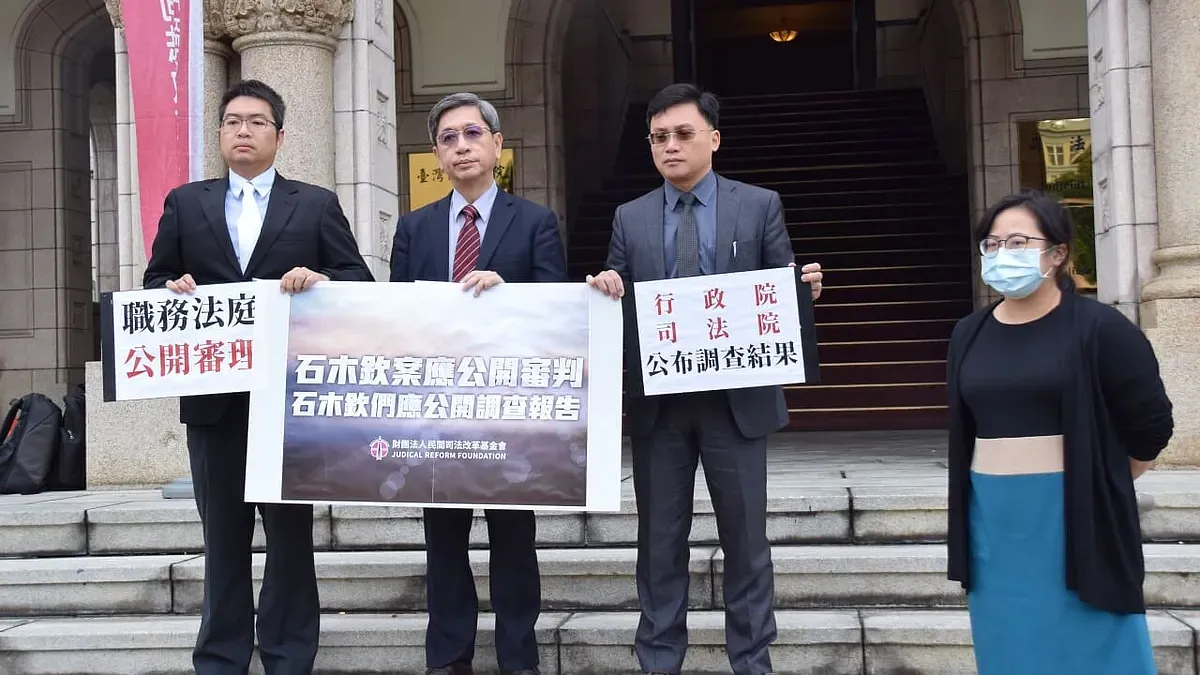
The Shih Mu-Chin Case Should Be Heard in Public, and Investigation Reports on the Other "Shih Mu-Chins" Should Be Released - Monitoring the Shih Mu-Chin Case, Press Conference II
Last edited: 2026-08-29
Two months ago, on September 9, the Control Yuan released Investigation Report No. 109-Ssu-Tiao-0069 on the Shih Mu-Chin case, exposing what it described as longstanding, structural, and systemic corruption involving members of the judiciary. The report identified former Public Functionary Disciplinary Sanction Commission Chairperson Shih Mu-Chin, former Control Yuan Member Fang Wan-Fu, former Tainan District Prosecutors Office prosecutors Chu Hung-Yu and Lo Jung-Chien, former Supreme Court judges Yen Nan-Chuan, Hua Man-Tang, and Hsieh Chia-Ho, former Supreme Administrative Court President Lin Chi-Fu, former Supreme Court Presiding Judge Wu Hsiung-Ming, former Taipei Investigation Station Mobile Division Director Chin Tai-Sheng, senior National Police Agency officers Liu Po-Liang and Chou Yu-Wei, police officer Chiu Hsiu-Yueh, and others as having engaged in improper contacts with a wealthy businessman, including golf outings, meals, and stock transactions. The Control Yuan called on the Executive Yuan and Judicial Yuan to thoroughly investigate the seized materials and complete their handling of any judicial personnel involved within two months.
-
The Executive Yuan and Judicial Yuan Should Publish Their Investigation Reports and Disciplinary Findings
Yesterday, the two-month deadline expired. The Control Yuan report raised numerous serious issues-including allegedly improper non-prosecution decisions, unlawful adjudication, and possible insider trading-that may involve not only ethical or disciplinary responsibility but also criminal liability. Yet the Executive Yuan and Judicial Yuan have neither released their internal investigation reports nor announced the results of their internal reviews. That silence fails to answer the public's demand for meaningful reform and accountability within the judiciary.
JRF calls on the Executive Yuan and Judicial Yuan to immediately publish their investigation reports, clarify the facts, disclose the results and any disciplinary referrals, and refer suspected criminal conduct to prosecutors for investigation. If anyone was wrongly implicated, the investigation should also clear that person's name. The government should use this case to conduct a comprehensive institutional review, draw clear lines against improper conduct, and prevent similar incidents from recurring.
If the Executive Yuan and Judicial Yuan refuse to disclose their reports and findings, or simply shield those involved and allow the matter to disappear, JRF calls on the Control Yuan to intervene, exercise its constitutional oversight powers, establish the facts of the Shih Mu-Chin case, and impeach or refer officials who violated the law.
-
Judicial Corruption Cases Before the Court of the Judiciary Should Be Heard in Public
Article 57 of the Judges Act provides that proceedings before the Court of the Judiciary are generally closed, but may be opened when the Court deems a public hearing necessary or when the judge referred or sued requests one. In other words, closed proceedings are the default, but the Court has discretion to open a case where necessary. Since the Court of the Judiciary was established in 2012, however, it has never on its own initiative ordered a case to be heard publicly. Its approach to what counts as "necessary" has been excessively restrictive.
By contrast, Article 44 of the Civil Service Discipline Act, amended in June 2019, provides that proceedings before the Disciplinary Court are generally to be conducted in open court, subject to exceptions involving national security or an approved request by a party for a closed hearing. Disciplinary proceedings involving ordinary public officials have thus moved away from the old presumption of secrecy. Proceedings concerning judicial discipline should be at least as open and should return to the basic principle of transparent, public adjudication.
JRF recognizes that the general rule of closed proceedings before the Court of the Judiciary is intended in part to protect the judiciary's institutional reputation and the individual judge's reputation. Where discipline concerns a judge's courtroom management or exercise of judicial discretion in an individual case, confidentiality may sometimes be justified. But where the allegation is judicial corruption, there is plainly a compelling need for public scrutiny-to demonstrate that the judiciary will not protect its own and that it is serious about integrity. If a case as prominent as Shih Mu-Chin's is heard behind closed doors, the evidence for and against him is never exposed to public examination, and the ultimate result is then rejected by society, the damage to public confidence in the judiciary will only deepen.
JRF therefore calls on the panel of the Court of the Judiciary to order a public hearing in the Shih Mu-Chin case and to establish, beginning with this case, a presumption that judicial-corruption proceedings should be open to the public.
Attendees
Joseph Lin / Chairperson, Judicial Reform Foundation
Shih Hung-Cheng / Convener, Individual Evaluation of Judges and Prosecutors Group, Judicial Reform Foundation
Hsiao I-Min / Office Director, Judicial Reform Foundation
Contact
Ma Chien-Ya, Legal Specialist, Judicial Reform Foundation
This article is an AI-generated translation of the original Chinese text. In the event of any discrepancy, the Chinese version shall prevail.