
Call on Taiwan's APEC Representatives to Raise Human-Rights Cases with China
Last edited: 2026-08-29
President Tsai Ing-Wen recently announced that TSMC founder Morris Chang would again serve as Taiwan's representative to the APEC Economic Leaders' Meeting, with Taiwan emphasizing two themes: its contribution to pandemic control and stronger international supply-chain links. Chiang Min-Yen, Secretary-General of the Taiwan Citizen Front, said that while Taiwan was promoting economic resilience for post-pandemic recovery, the Chinese government was moving in the opposite direction by secretly detaining or restricting the liberty of people who travel across borders in the Asia-Pacific region.
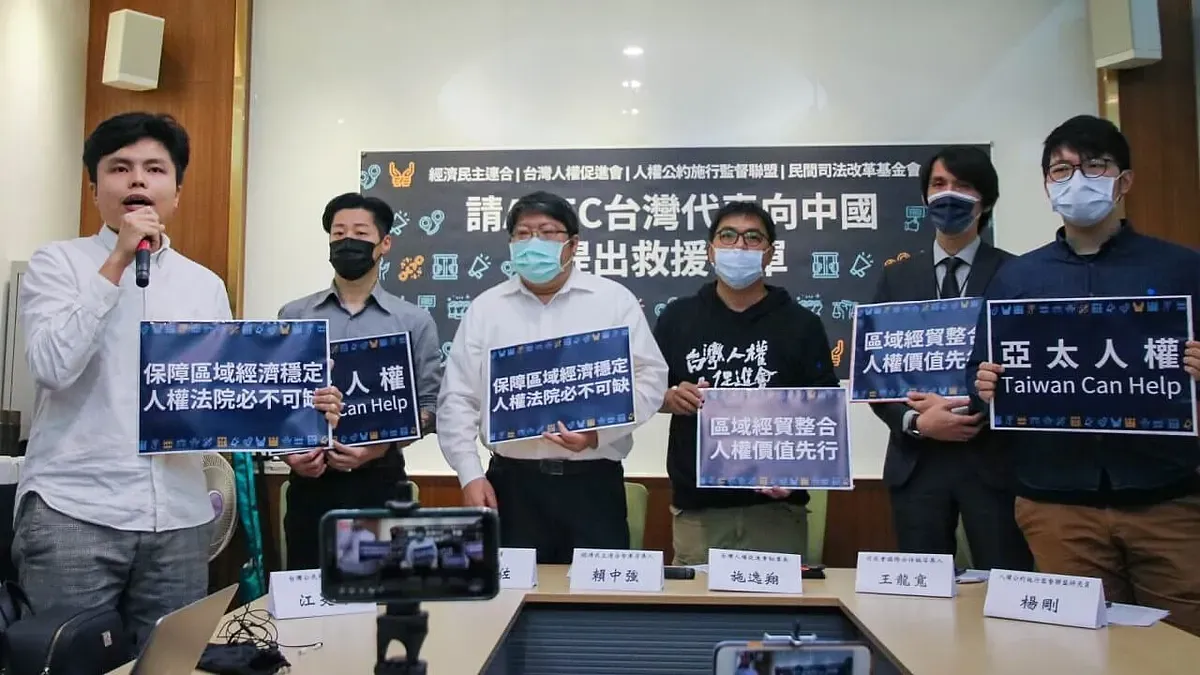
In response to what they described as China's threat to economic and trade security in the Asia-Pacific, the Economic Democracy Union, Taiwan Association for Human Rights, Judicial Reform Foundation, and Covenants Watch held a press conference today (the 12th). They called on Taiwan's APEC representatives-Morris Chang, Minister without Portfolio John C. C. Deng, and National Development Council Minister Kung Ming-Hsin-to raise with the Chinese delegation a list of people subjected to enforced disappearance, arbitrary detention, or other serious human-rights abuses in China, including Taiwan's Li Ming-Che and Lee Meng-Chu, the 12 Hongkongers detained in Shenzhen, and other international cases.
Chiang Min-Yen said the groups were continuing their earlier advocacy for an "Asia-Pacific Court of Human Rights" and urged Taiwan's APEC representatives to place a regional human-rights mechanism within the APEC Putrajaya Vision 2040 agenda. Drawing on European mechanisms, he argued that an Asia-Pacific human-rights court could provide cross-border remedies and better protect the personal liberty and safety of businesspeople and ordinary citizens traveling across borders. Such a mechanism, he said, could also help stabilize the regional economic order amid sharp differences between China and other societies over freedom of communications and expression, personal liberty, privacy, and democratic elections.
Two Calls at APEC: Advance an Asia-Pacific Court of Human Rights and Raise a List of Human-Rights Cases with China
Attorney Lai Chung-Chiang, convener of the Economic Democracy Union Think Tank, recalled that on October 20 the group and other organizations held a Legislative Yuan press conference calling on Malaysia, the APEC host, to allow President Tsai Ing-Wen and National Human Rights Commission Chairperson Chen Chu to attend the leaders' meeting and advocate an Asia-Pacific Court of Human Rights. Presidential Office spokesperson Xavier Chang responded that human rights are a universal value and that Taiwan would continue to raise human-rights concerns regardless of who represented it at APEC. The groups therefore made two requests of Morris Chang, who would attend the leaders' meeting on November 20, and of Kung Ming-Hsin and John C. C. Deng, who would attend the ministerial meeting on November 16: publicly advocate an Asia-Pacific Court of Human Rights through APEC, and raise with China a list of people whose human rights had been violated.
Lai Chung-Chiang argued that personal liberty and physical safety have become central economic risks in doing business with China. He pointed to the sudden death in Shenzhen of Irish Huawei executive Joe Kelly, the earlier abductions from Hong Kong of Causeway Bay Books owner Lam Wing-Kee and Tomorrow Group founder Xiao Jianhua, the Hong Kong National Security Law, and past cases in which Taiwanese businesspeople were arbitrarily detained in China. He noted that the 2012 Cross-Strait Bilateral Investment Agreement therefore included a separate consensus on protection of personal liberty and safety. Lai also recalled that APEC's 2016 discussions of its post-2020 direction included unfinished Bogor Goals, the Free Trade Area of the Asia-Pacific, sustainable development, and environmental protection.
Lai emphasized that personal liberty and personal safety are essential to economic development in the Asia-Pacific and urged Taiwan to seek inclusion of an Asia-Pacific Court of Human Rights in APEC's post-2020 agenda. He also pointed to the Hong Kong government's disqualification of four Legislative Council members under a decision of China's National People's Congress Standing Committee, which prompted the resignation of the remaining pro-democracy legislators. In his view, these developments underscored the need for a regional mechanism capable of protecting people moving and doing business across borders.
Shih Yi-Hsiang, Secretary-General of the Taiwan Association for Human Rights, reiterated the organization's call for the Tsai administration to use the APEC Leaders' Meeting to advocate a comprehensive regional human-rights framework-including an Asia-Pacific Human Rights Charter, a human-rights court, and effective protection mechanisms. Such protections, he said, serve not only Taiwan's own interests but the national and economic interests of economies throughout the Asia-Pacific; without credible safeguards, cross-border commerce and movement remain vulnerable to arbitrary detention and coercion.
Shih said Taiwan can contribute to the region not only through its pandemic response but also through its strong record on freedom, democracy, human rights, and civic space. He argued that Taiwan should work with other economies to build a regional human-rights mechanism. Based on publicly available information, the groups had identified at least 402 cross-border cases involving alleged human-rights abuses in China, while acknowledging that many additional cases may never become public.
The groups called on Taiwan's APEC representatives-Morris Chang, Minister without Portfolio John C. C. Deng, and National Development Council Minister Kung Ming-Hsin-to raise the following cases with the Chinese delegation:
| Nationality | Case | Human-Rights Situation | Number |
| Taiwan | Li Ming-Che | A Taiwanese NGO worker who followed social developments and human-rights defenders in China, Li Ming-Che flew from Taipei to Macau on March 19, 2017 and disappeared after traveling from Zhuhai toward Guangzhou to visit friends. Ten days later, on March 29, China's Taiwan Affairs Office confirmed that he was in custody on suspicion of "endangering national security." On November 28, he was sentenced to five years in prison and deprivation of political rights for two years, becoming the first Taiwanese person imprisoned in China for subversion of state power. | 1 |
| Taiwan | Taiwanese Cross-Border Telecommunications Fraud Case in Spain | In July 2016, China and Spain formed a joint task force to investigate telecommunications fraud targeting people in China from operations based in Spain. In December, authorities arrested 237 suspects, including 218 Taiwanese nationals. The Office of the UN High Commissioner for Human Rights warned that the Taiwanese suspects faced a risk of torture, ill-treatment, or the death penalty if sent to China. | 218 |
| Taiwan | Taiwanese Businessman Surnamed Chien | In 2015, a Taiwanese businessman surnamed Chien was allegedly set up by Chinese shareholders, held for 37 days in an unofficial detention site, and later confined to the factory premises. | 1 |
| Taiwan | Mainland Affairs Council Data | The Mainland Affairs Council said in 2020 that the Straits Exchange Foundation had received 149 reports of Taiwanese people missing in China between May 2016 and late October 2019. In 101 cases, the person's whereabouts had been confirmed-including people who had returned to Taiwan or whose place of detention was known. In 48 cases, the person's whereabouts remained unconfirmed. | 48 |
| Taiwan | Lee Meng-Chu | Fangliao Township Mayor Chen Ya-Lin said in 2019 that Lee Meng-Chu had participated in Hong Kong's anti-extradition movement and told him on August 20 that he was near the Hong Kong-Shenzhen border and intended to cross into Shenzhen, sending a photograph of People's Liberation Army troops gathering nearby. Lee then disappeared. Chinese authorities later confirmed that he had been detained on suspicion of endangering national security. In October 2020 he appeared on China Central Television's Focus Report program in what critics described as a forced televised confession. | 1 |
| Taiwan | Tsai Chin-Shu | Tsai Chin-Shu, chairperson of a southern Taiwan cross-strait relations association, traveled to Quanzhou, Fujian in July 2018 for a cross-strait food trade fair and disappeared after checking out of a hotel in Xiamen the following day. The Straits Exchange Foundation contacted its Chinese counterpart and made inquiries through multiple channels, but had received no concrete response. | 1 |
| Taiwan | Cheng Yu-Chin | China Central Television accused Cheng Yu-Chin of espionage in China and of smearing China while in the Czech Republic. He was arrested upon entering China in April 2019. | 1 |
| Taiwan | Shih Cheng-Ping | Shih Cheng-Ping, a retired associate professor at National Taiwan Normal University's Graduate Institute of International Human Resource Development, disappeared in China in August 2018. Reports later indicated that Chinese authorities had detained him in Beijing on national-security grounds and sentenced him to approximately three to four years in prison. | 1 |
| Hong Kong | The 12 Hongkongers | Andy Li, Cheung Chun-Fu, Cheung Ming-Yu, Kok Tsz-Lun, Yim Man-Him, Cheng Tsz-Ho, Liu Tsz-Man, Tang Kai-Yin, Kwo Tsz-Kin, Li Tsz-Yin, Wong Lam-Fok, and Wong Wai-Yin. On August 23, 2020, the 12 attempted to travel to Taiwan to seek refuge but were intercepted and detained by Chinese authorities and held at the Yantian District Detention Center in Shenzhen. Families of ten detainees repeatedly retained lawyers to seek meetings with them, but Chinese public-security authorities refused access. The detainees faced criminal proceedings in China without meaningful access to counsel chosen by their families. | 12 |
| Canada | Michael Kovrig and Michael Spavor | The Chinese Ministry of Foreign Affairs announced the arrest of former Canadian diplomat Michael Kovrig and Canadian businessman Michael Spavor on May 16 this year. The former was accused of "spying on state secrets and intelligence for foreign entities," while the latter was accused of "stealing and illegally providing state secrets for foreign entities." Since then, China-Canada relations have increasingly deteriorated, and China subsequently sentenced two Canadians to death on drug charges. | 2 |
| United States | Exit-Ban Cases | Beginning in June 2019, Chinese authorities barred three Chinese-American citizens from leaving China: Liu Changming, a former Bank of Communications Guangzhou branch official who had left China, and his children Cynthia Liu and Victor Liu. | 3 |
| United States | Restriction of Personal Liberty | In June 2019, Chinese authorities detained and questioned a senior Koch Industries executive for several days. | 1 |
| United States | Jacob Harlan and Alyssa Petersen | In September 2019, Jacob Harlan, founder of the Idaho-based company China Horizons, and deputy director Alyssa Petersen were detained by public-security authorities in Jiangsu. China's Foreign Ministry confirmed that the two U.S. citizens were being held on suspicion of "organizing others to illegally cross the border." | 2 |
| United States | Mark Swidan | Mark Swidan, a U.S. citizen from Texas, was arrested and detained in China without trial for over three years, and his mother sought help online. | 1 |
| United States | U.S. Department of State Data | Voice of America, citing U.S. Department of State data, reported that as many as 90 U.S. citizens were then detained in China. | 90 |
| United Kingdom | Students | On July 12, 2019, the British Embassy in Beijing confirmed that four British students had been arrested by police in Xuzhou, Jiangsu on drug-related allegations. The embassy did not disclose details of the alleged conduct. | 4 |
| Switzerland | UBS Employee | UBS and Julius Baer reportedly advised some employees to postpone business travel to China after a female UBS employee was subjected to an exit restriction there. Reports said the employee, who was normally based in Singapore, was stopped while preparing to board a flight in Beijing; the circumstances and reason for the restriction were unclear. | 1 |
| Japan | Suspected Espionage Cases | On October 21, the Japanese Embassy in China confirmed that a Japanese man in his forties had been detained by Chinese authorities in Beijing in September on suspicion of espionage. He had previously worked at Japan's National Institute for Defense Studies and Ministry of Foreign Affairs. NHK reported that since China's Counter-Espionage Law took effect in 2014, multiple Japanese citizens had been detained on espionage allegations. | 13 |
| Japan | ITOCHU Corporation Employee in His Forties | An ITOCHU employee in his forties who had been arrested in Guangzhou in February 2018 on national-security charges was sentenced to three years in prison, and approximately RMB 150,000 in personal assets was confiscated. | 1 |
Human-Rights Protection Is a Prerequisite for Free Trade; Taiwan Should Show Confidence in Its Democratic System
Wang Lung-Kuan, an attorney and convener of JRF's International Cooperation Group, rejected the idea that "trade is trade and human rights are human rights." If people are to conduct cross-border business with confidence, he said, reciprocal protection of basic human rights is indispensable. He pointed to Canadian Prime Minister Justin Trudeau's call for international pressure on China to release Michael Kovrig and Michael Spavor and to Canada's decision to suspend its extradition treaty with Hong Kong after the National Security Law took effect.
Wang said that because cross-strait economic exchanges are so extensive, people in Taiwan are constantly exposed to the risks of China's opaque justice system and Hong Kong's National Security Law. Li Ming-Che, for example, disappeared in China and was not formally arrested until more than a month later before eventually receiving a five-year sentence. If Taiwan wants to prevent similar cases and avoid a chilling effect that causes people to self-censor, Wang argued, it should use the few international organizations in which it participates to press for regional human-rights protections.
Wang noted that APEC does not have human-rights mechanisms comparable in strength to those of the European Union or United Nations. It has, however, already developed regional rules in rights-adjacent areas: after adopting the APEC Privacy Framework in 2005, it later established the Cross-Border Privacy Rules system. In Wang's view, that experience shows that APEC can develop common regional standards on matters affecting individual rights.
Wang argued that basic safeguards-such as notifying the relevant diplomatic authorities when a member economy's national is arrested, recognizing the right to retain counsel, and permitting contact with family where it does not interfere with an investigation-are already reflected in international human-rights standards. China had detained Canadian and Australian citizens and was threatening action against U.S. citizens; Taiwan, he said, should not miss the opportunity to advocate a regional protection system now.
Yang Kang, a researcher at Covenants Watch, called on Taiwan's representatives to use APEC as a platform and the UN's core human-rights treaties as a foundation for establishing an "Asia-Pacific Human Rights Commission" that could receive complaints and investigate human-rights violations involving APEC economies. APEC's founding purpose, he noted, includes promoting economic growth, development, and the well-being of people in the Asia-Pacific, which necessarily encompasses human-rights concerns.
As a relatively young democracy, Yang said, Taiwan should use its own democratic-development experience to contribute to regional stability and the international community. He contrasted Taiwan's democratization and economic growth since the late 1980s with China's record of the Tiananmen crackdown, coercive domestic stability-maintenance policies, large-scale ethnic repression, and unequal models of development. Taiwan, he argued, should demonstrate confidence in its democratic system through international economic cooperation rather than accept China's attempt to separate trade from human rights.
Legislator Freddy Lim emphasized that people detained or disappeared in China include not only Taiwanese and Hongkongers but citizens of many countries. Regardless of political position or a person's belief that they have good relations with China, he said, anyone can become a target of enforced disappearance or arbitrary detention. Taiwan's APEC agenda should therefore include human-rights protections alongside its pandemic-response achievements and efforts to expand international supply-chain links.
Attendees
Lai Chung-Chiang|Convener, Economic Democracy Union Think Tank; Attorney
Shih Yi-Hsiang|Secretary-General, Taiwan Association for Human Rights
Wang Lung-Kuan|Convener, International Cooperation Group, Judicial Reform Foundation; Attorney
Yang Kang|Researcher, Covenants Watch
Freddy Lim|Legislator
Media Contact
Chiang Min-Yen|Secretary-General, Taiwan Citizen Front
This article is an AI-generated translation of the original Chinese text. In the event of any discrepancy, the Chinese version shall prevail.