
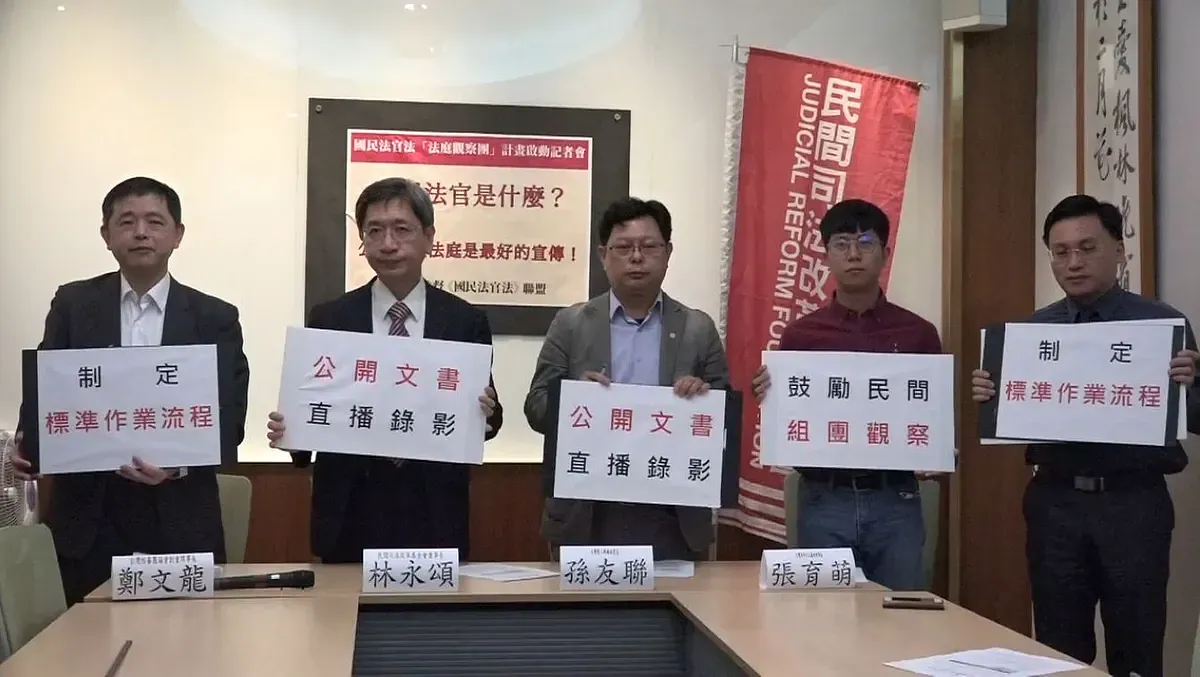
What Is a Citizen Judge? Open Mock Trials Are the Best Public Outreach - Launch of the Citizen Judges Act Court Observation Group
Last edited: 2026-08-29
Most people in Taiwan have never participated in a trial. Explaining what a "citizen judge" is-and how the new system will work-has therefore become one of the most important tasks in current judicial reform.
With the Citizen Judges Act scheduled to take effect in two years, the Judicial Yuan has budgeted substantial funds for public outreach and asked all 22 district courts to actively conduct mock trials. Coalition members who observed mock trials around Taiwan, however, found that the Judicial Yuan had not established adequate operating standards or procedural guidance, leaving individual courts to devise their own approaches. The most serious problem is that, without coordinated public outreach, open proceedings, or transparent information, the substantial personnel and resources invested by local courts in mock trials have produced only limited public-education value.
The Coalition therefore calls on the Judicial Yuan to use citizen-judge mock trials as an opportunity to engage the public and conduct meaningful outreach. We make the following recommendations:
-
Establish Standard Operating Procedures
District courts are moving quickly to organize mock trials, but without Judicial Yuan standards, procedures vary widely and can be confusing. In juror-selection procedures, for example, some courts allow public observation while others do not. There are also no clear standards for case selection, document formats, or evaluation procedures. The Judicial Yuan's current Sample Materials for Citizen Judge Mock Trials do not meet the practical needs of district courts conducting these exercises. The inconsistencies observed by Coalition members at the trial-court level stem in large part from the lack of operating standards and procedural planning.
-
Publish Court Documents and Make Proceedings Available by Livestream or Recording
The Constitutional Court already publishes litigation documents online, livestreams hearings, and posts courtroom recordings. The Supreme Court's Grand Chambers likewise publish documents and make courtroom audio available, providing valuable resources for rule-of-law education. District-court mock trials involve fictional cases rather than real disputes, so the confidentiality concerns that can limit public access in actual cases are largely absent. The Coalition therefore urges mock trials to follow the same approach: publish litigation documents online, livestream hearings and deliberations in full, or post video recordings afterward. This would help the public understand how the Citizen Judges Act will work in practice, bring more people into the reform process, advance rule-of-law education and public oversight, and allow courts to learn from one another.
-
Encourage Civil-Society Court Observation Groups
Public interest and participation are essential to the success of the Citizen Judges Act. The Judicial Yuan and district courts should encourage schools, civic groups, companies, and other organizations to organize court-observation activities, whether by attending in person or watching remotely and then discussing the experience together. Sharing the experience of actual participation is the best way to introduce the new citizen-judge system. The Coalition will bring together scholars, attorneys, students, and others concerned with the Citizen Judges Act to form court-observation groups, conduct field observation and surveys, and gradually build a body of practical knowledge that can support future monitoring and evaluation.
The Citizen Judges Act will take effect in two years, and district courts are already investing substantial effort in mock trials. Yet inconsistent practices make those exercises difficult to use as a basis for meaningful evaluation. To ensure that this work is not wasted-and to turn practical mock-trial experience into the best possible public introduction to the new system-the Judicial Yuan should promptly establish standard procedures, publish courtroom audiovisual materials and litigation documents online, and encourage civil-society court observation. With careful planning and adequate information, more civic resources can be brought into the process of realizing the public's right to participate in trials.
Attendees
Joseph Lin / Chairperson, Judicial Reform Foundation
Cheng Wen-Lung / Founding Chairperson, Taiwan Jury Association
Sun Yu-Lien / Secretary-General, Taiwan Labor Front
Chang Yu-Meng / Chairperson, Taiwan Youth Association for Democracy
Press Contact
Chen Yang, Legislative Researcher, Judicial Reform Foundation
This article is an AI-generated translation of the original Chinese text. In the event of any discrepancy, the Chinese version shall prevail.