
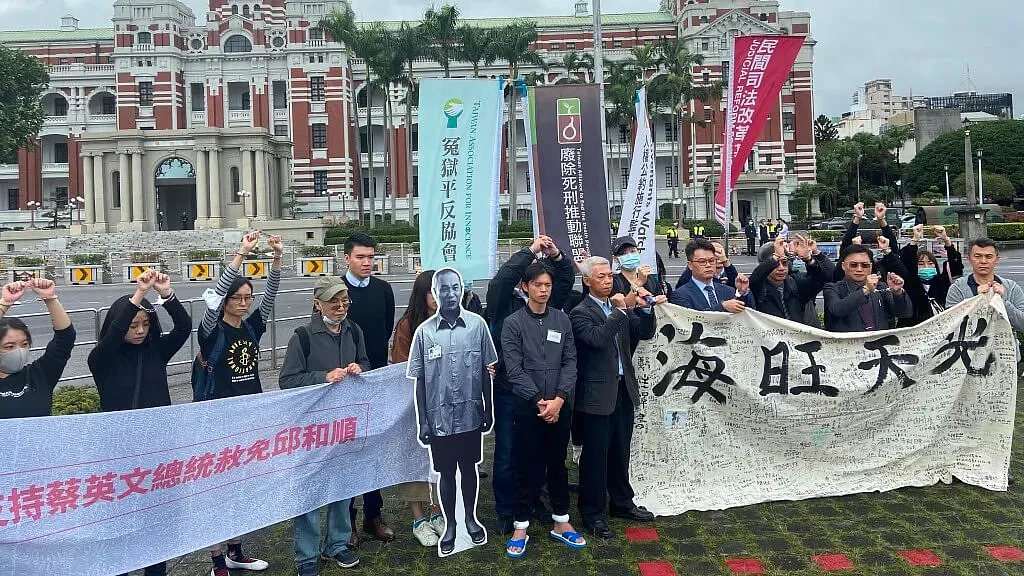
When Will Hai-Wang See Daybreak? Handcuffed in Solidarity on Human Rights Day, Calling on the President to Pardon Chiu Ho-Shun
Last edited: 2026-08-29
Thirty-two years have passed since Chiu Ho-Shun was falsely accused of masterminding the Lu Cheng and Ko Hung Yu-Lan cases. The courts imposed a death sentence based on as many as 288 mutually contradictory confessions obtained through torture. Although his legal team has repeatedly sought retrial and extraordinary appeal, the courts have rejected every attempt. After 32 years of wrongful imprisonment, Chiu still sees no viable path to judicial relief.
Thirty-two years of wrongful imprisonment have deprived Chiu Ho-Shun not only of his liberty, but also of ordinary social life, time with his family, and his health. Now 60, his health is far worse than that of most people his age. On Human Rights Day, judicial vindication may still seem painfully distant. Yet the support groups remain determined to secure his freedom, help him return to society, and ensure that he receives the medical care and protection of health to which he is entitled.
In April, Chiu Ho-Shun's pro bono legal team and support groups formally petitioned the President to pardon him. They later organized "Ride for Chiu Ho-Shun's Freedom," traveling from the Taipei Detention Center, where he is held, to the Presidential Office for a press conference calling attention to the importance of a pardon. Last month, the groups also held the exhibition "Hai-Wang's Daybreak ✸ Chiu Ho-Shun's Forgotten 32 Years." Many visitors joined us in learning more about his experience, and many asked: How is A-Shun doing now?
Regrettably, 248 days have passed since the legal team and support groups submitted the pardon petition. Despite repeated letters to the Presidential Office and an invitation for the President to visit the exhibition, they have received no response.
"Hai-Wang" is Chiu Ho-Shun's childhood nickname. Today, a participant portraying Hai-Wang will wear handcuffs, shackles, and a blindfold while circling the Presidential Office for 32 minutes, symbolizing Chiu's 32 years without freedom. Pro bono attorneys and support groups will join the silent march in handcuffs. When an innocent person is convicted, no one is truly free. The continuing injustice of Taiwan's judicial transition constrains society as a whole. Only when the judiciary genuinely reflects on past errors, clears the names of people wrongfully imprisoned, and carries out transitional justice within the justice system can society's freedom be protected.
The support groups chose Human Rights Day for this action because the United Nations adopted the Universal Declaration of Human Rights on December 10, 1948, and December 10 is observed each year as Human Rights Day. If the values President Tsai has consistently emphasized-human rights, the rule of law, and democracy-are indispensable to bringing Taiwan closer to its strategic partners and earning the trust of the international community, then the Chiu Ho-Shun case should have no reason to remain a forgotten stain on Taiwan's human-rights record.
On a previous Human Rights Day, the President pardoned Su Ping-Kun, who was later exonerated through judicial proceedings. If President Tsai Ing-Wen grants Chiu Ho-Shun a pardon, the decision would carry profound significance for Taiwan. It would show that the government is willing to confront justice delayed for 32 years, take seriously the Chiu Ho-Shun case-which the 2019 Mock Asian Human Rights Court found involved violations of human-rights protections-and begin removing from Taiwan's record the internationally known human-rights stain represented by the Chiu Ho-Shun case.
We therefore call on the President, who holds the power of pardon, to confront this past injustice on Human Rights Day, advance the unfinished work of judicial transitional justice, and pardon Chiu Ho-Shun as soon as possible-so that, like today's Hai-Wang, he can remove his handcuffs, shackles, and blindfold, regain his freedom, and finally see daybreak.
Attendees
Attorney Yu Po-Hsiang / Chiu Ho-Shun Pro Bono Legal Team
Attorney Lin Chun-Hung / Chiu Ho-Shun Pro Bono Legal Team
Attorney Lin Hung-Wen / Chiu Ho-Shun Pro Bono Legal Team
Chiu Hsien-Chih / Legislator
Hsu Tzu-Chiang / Exoneree
Cheng Hsing-Tse / Exoneree
Chiu I-Ling / Secretary-General, Amnesty International Taiwan
Chou Yu-Hsiu / Chairperson, Taiwan Association for Human Rights
Lin Hsin-I / Executive Director, Taiwan Alliance to End the Death Penalty
Wu Chia-Chen / Deputy Executive Director, Taiwan Alliance to End the Death Penalty
Wang Hao-Han / Executive Secretary, Taiwan Alliance to End the Death Penalty
Huang Sung-Li / Convener, Covenants Watch
Eva Huang / Executive Director, Covenants Watch
Chiang Meng-Chen / Office Director, Covenants Watch
Yang Kang / Researcher, Covenants Watch
Sun Hsing-Hsuan / Research and Advocacy Officer, Covenants Watch
Chung Yu-Jou / Research and Advocacy Officer, Covenants Watch
Joseph Lin / Chairperson, Judicial Reform Foundation
Hsiao I-Min / Office Director, Judicial Reform Foundation
Chang Chih / Deputy Director, Organization and Advocacy Department, Judicial Reform Foundation
Mido / Visual Designer, Judicial Reform Foundation
Ma Chien-Ya / Legal Specialist, Judicial Reform Foundation
Lin Chih-Fang / Legal Specialist, Judicial Reform Foundation
Ko Yun-Ching / Communications Director, Taiwan Innocence Project
Pan I / East Asia Program Director, International Federation for Human Rights
Li Chia-Hua / Director; Petitioner
Huang Wen-Hsiung / Petitioner
Press Contact
Mido, Designer, Judicial Reform Foundation
This article is an AI-generated translation of the original Chinese text. In the event of any discrepancy, the Chinese version shall prevail.