
JRF Newsletter
Watching the Judicial Reform Foundation Grow: An Interview with Attorney John C. Chen
Last edited: 2026-08-29
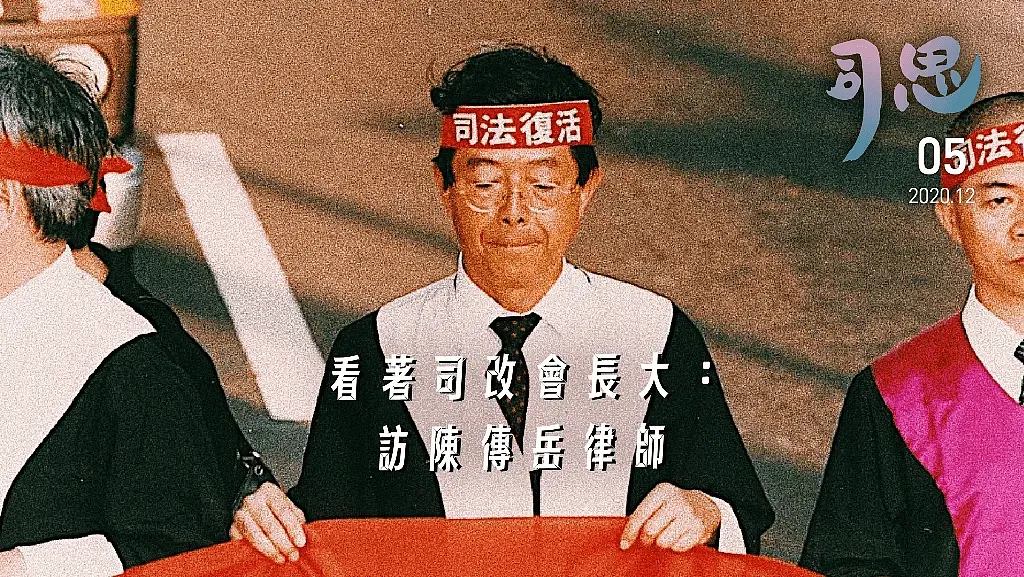
Photo / October 19, 1997: John C. Chen participates in the "Walk for the Revival of Judicature" march.
This year marks JRF's 25th anniversary. Even among today's staff, the name of Attorney John C. Chen comes up often. Whether at monthly executive meetings, annual planning meetings, or street sit-ins on major issues, Chen still shows up in person despite being over 80. Yet younger staff know surprisingly little about the history of judicial reform that this veteran reformer has lived through. On the occasion of JRF's 25th anniversary, we sat down with Chen to record his story and hear his hopes for JRF's future.
A Confucian Scholar Enters the Law
"My grandmother taught me from childhood to respect Confucius, so I grew up with a traditional Confucian outlook. From my first year of junior high through my last year of high school, my homeroom teachers were Chinese-language teachers who had come from mainland China and had deep foundations in classical Chinese learning. They influenced me greatly. Confucian thought shaped me in many ways-especially the ideal of governing the state and benefiting the people." John C. Chen placed first in the university entrance allocation to National Taiwan University's Department of Law, achieving his first choice.
Once he entered law school, however, Chen discovered a profound conceptual tension between Taiwan's Western-derived legal system and traditional Chinese Confucian thought. "In my first year, I felt an intense contradiction between Western legal culture and Chinese legal culture. No one could explain the conflict to me."
Fortunately, in his first-year political science class he met Professor Chao Tsai-Tien, who gradually helped him work through those doubts. A Peking University graduate with a deep grounding in Chinese intellectual traditions and Confucian thought, Chao became someone Chen could turn to. "He didn't know law, but later I went to talk with him, and we just talked and talked. I felt much more at ease, and we became good friends." For Chen, Professor Chao became both a mentor and a friend. Carrying that Confucian intellectual tradition with him, Chen gradually developed into a more mature legal professional.
Reflections on "Taiwan Consciousness"
Speaking about Confucian thought, Chen said that the collapse of a shared Confucian framework can leave people without a central set of values. "We need to build a new outlook on life for people-a sense of what it means to be human-and a social imagination of Taiwan as a community, so that we know where the country should go." For him, what matters most is that people in Taiwan are willing to work together for Taiwan's good and no longer feel embarrassed to tell foreigners, "I am Taiwanese." That, he believes, allows people gradually to recognize Taiwan's efforts and place in the international community.
To advance that ideal, Chen founded the Taiwan Forever Association, bringing together people from law and politics to promote the sustainable development of democracy, constitutional government, and the rule of law in Taiwan, with the hope of strengthening the country and earning international respect. "Many people in Taiwan now identify strongly with Taiwan, and that is the result of everyone's effort. Much of the world has also come to recognize the people of Taiwan, but the work is not complete. I hope everyone will contribute whatever they can." Coming from John C. Chen, the encouragement carried particular weight.
A Young Judicial Officer Unafraid to Push Back
Many people know that Chen once served as a judicial officer. We asked why he chose that path and whether the experience had anything to do with his later commitment to judicial reform.
"At the time I wasn't interested in becoming an attorney, because practicing law required connections. Being a judge seemed better: you could be impartial, pursue your ideals, and uphold justice." Soon after graduating from NTU Law, Chen passed the judicial officer examination, hoping to become a legal professional who could uphold fairness and justice.
Chen belonged to the sixth class of judicial officers, at a time when judges were still formally called tuishi (推事). Professor Chiu Lien-Kung was in the same cohort. Chen recalled that the judicial officer examination had not been held for three years and accepted only 19 people that year; just three were new university graduates, including him. The same year, he performed military service with an Air Force security brigade, serving as a military judge at brigade headquarters.
The military justice system then taking shape delivered the first shock of Chen's judicial career. Under the military criminal law in force at the time, a completed judgment had to be submitted to the commanding officer for review, and the commander had the power to return it once. For Chen, who had entered the profession to pursue fairness and justice, a system in which judges could not adjudicate independently was intolerable.
In 1965, Chen was assigned to the Taichung District Prosecutors Office, where he served as a prosecutor for two years. In October 1966, he was transferred to the Taipei District Court as a judge and remained there until leaving the judiciary in 1973.
Chen recalled that the "submission-for-review system" still operated at the time. After drafting a judgment, a judge had to submit it to the presiding judge and court president for review and comment before it could be pronounced. "In other words, a judge's decision had to pass through layer after layer of review by the presiding judge and others before it could be announced. That interfered with judicial independence."
The system also encouraged improper intervention. During his time at the Taipei District Court, Chen received a call from a senior division office asking him to give the defendant probation in a negligent-homicide case. What stayed with him was that the matter had supposedly been specially raised by the Presidential Office, yet the court president did not regard it as serious enough to speak with him personally. Chen immediately thought, "This is wrong," and decided to resist on principle. Although he was then the youngest judge in Taiwan, he did not shrink from the confrontation and sought out the senior presiding judge for help.
"Someone had told me that this presiding judge was learned and upright, and that I could go to him if I needed advice." Because the senior judge was also an NTU graduate, Chen initially regarded him as someone he could trust and spoke candidly. "He thought I was protesting against him," Chen recalled with some resignation. "So the two of us argued, and then I picked up my files and went back."
Soon the story that "John C. Chen refused pressure from the Presidential Office" had spread throughout the district court. To Chen, however, the issue went beyond ordinary influence-peddling. What his superiors had done amounted to pressure on a judge and an attack on independent adjudication. Before long, another message had spread through the Taipei District Court: "John C. Chen insists on judicial independence."
"At that point you know your career is going to be difficult. That's what being a judge was like." Faced with his superiors' displeasure and his own disappointment with the judicial environment, Chen realized that continuing as a judge would be an increasingly difficult path. The idea of leaving began to take root.
Seeing Every Side of Society-and Letting Go of the Judicial Career
His years as a judge had brought frustration, obstruction, and attempts to "express concern" about cases, including the clash with a senior colleague. At times he felt that inside the courts he "couldn't put his abilities to use and had to swallow too many indignities." Yet when we asked, "Did you like the work?" a faint smile appeared. "Being a judge was a very good experience." We often think of judges primarily as people with the power to condemn, even to decide questions of life and death. But judges also have the responsibility to clear the innocent. For a scholar steeped in traditional Confucian thought, that role embodied the ideal of governing society and benefiting the people-and, in a sense, the pursuit that would shape Chen's life.
Asked what serving as a judge had taught him, Chen answered candidly: "I saw every side of society." During nearly seven years on the bench from 1966 to 1973, he encountered worlds far removed from his previous experience-from judges who bent the law to vulnerable people waiting desperately for judicial relief. Perhaps that long panorama of society quietly planted the seeds of his later commitment to judicial reform.
Founding Formosa Transnational Attorneys at Law
In 1973, Chen formally left the bench. After working for a year at Tsar & Tsai Law Firm, he and three like-minded friends founded Formosa Transnational Attorneys at Law in 1974.
When he began talking about founding Formosa Transnational, the slightly stooped back of the 82-year-old Chen seemed to straighten, as though the confident, fearless young man he once was had reappeared.
"The idea of several of us forming a partnership was unprecedented!" Chen said, lifting his chin slightly. The lawyers already knew one another, most had backgrounds as judicial officers, and their abilities were comparable, which made collaboration easier. The firm adopted a case-assignment system modeled in part on the courts: matters were assigned one to five points according to difficulty, and each lawyer took cases according to capacity. If a problem arose, lawyers could ask one another for help. Among partners of comparable ability, the system created a workable division of labor and supported an equal-profit-sharing partnership rather than letting internal business disputes pull it apart. The structure allowed the lawyers to complement one another and work as a unified firm.
A Front Line of Judicial Reform: The Wenlian Group
If John C. Chen's experiences were turned into a comic, it might read like an energetic coming-of-age story, full of battles over the legal profession and judicial reform. During the turbulent period of the Wenlian Group, even internal bar-association contests could carry broader political significance. Alongside running his law firm, Chen remained deeply involved in public affairs, including power struggles within the Taipei Bar Association (TBA).
In the early years, Chen recalled, bar associations across Taiwan were dominated by lawyers who had relocated from mainland China. Because admission to the bar was extremely limited, locally trained Taiwanese lawyers were also at a numerical disadvantage, and elected seats on the Taipei Bar Association's governing bodies were largely held by that older group. "We even got into a physical fight at Zhongshan Hall once," Chen said. Decades later, some of the old fire was still evident as he told the story.
At the time, the Taipei Bar Association was sharply divided along lines of provincial origin, with locally trained lawyers in the weaker position. Lawyers who had graduated from regular civilian universities-what were colloquially called "wen schools"-therefore banded together to challenge the conservative establishment. Their group, later known as the Wenlian Group, had no especially formal organizational structure, but it gave a generation of young lawyers passionate about judicial issues a strong sense of solidarity. It remained influential even after the older mainland-lawyer bloc declined and a new conservative force emerged: former military judges who had entered private practice-the "wu," or military, counterpart to the "wen" group.
After repeated defeats, the Wenlian Group gradually began to see a path to victory. In one election, it expected the vote to be extremely close to the former military-judge faction and members even got into a physical altercation at Zhongshan Hall over the right to monitor the count. "When the results came out, we won only one board seat," Chen said with a laugh. Even that setback, however, laid groundwork for a later shift in power within the Taipei Bar Association.
If victory was becoming possible, Chen thought, they needed someone to run for chairperson. One person gradually came to mind: Attorney Lin Min-Sheng. Chen spoke of his old friend with evident affection. "He was very fair, and he treated people well. His ability to get things done-not just his legal ability-was genuinely excellent. He was a commercial lawyer, so he had very strong organizational skills." Chen paused, then added with a smile, "He was also quite good with money." By then Lin was already a leading figure in the legal profession and was living a relatively leisurely life, often playing golf. When Chen approached him about leading the Taipei Bar Association, Lin was not enthusiastic.
"He invited me and the others to a table at the Ambassador Hotel and told us he really didn't want to be bar chair," Chen recalled. But after thinking it through, the group could not identify anyone better suited than Lin, so they enlisted friends to ask him again and again. Chen joked that his efforts went well beyond the proverbial "three visits to the thatched cottage." Eventually Lin agreed to run. Then came the 1990 board election and a result that shook the legal community: against expectations, candidates backed by the Wenlian Group won more than 30 seats, while the former military-judge faction won only one. Lin Min-Sheng became chairperson of the Taipei Bar Association. And what was Chen's role? He described it vividly: Lin was unfamiliar with many of the association's internal affairs and did not know where to begin. "We told him, 'Don't worry.' I sat next to him and helped work out what to do. I just supplied the ideas." The election transformed the association and established locally examination-qualified lawyers as its principal governing force, setting the stage for the bar's later involvement in judicial reform.
After one term, Lin Min-Sheng decided not to seek another term as Taipei Bar Association chair. Around that time, the national bar organization-the Taiwan Bar Association-was preparing to elect its own chairperson, and the Taipei Bar Association nominated Lin. Votes in that election were allocated among local bar-association representatives in proportion to membership. Taipei had strength in numbers, but many associations in central and southern Taiwan remained led by conservative forces. The Taipei Bar Association therefore mobilized heavily to seek support from other local bars, and the race became extremely close.
John C. Chen was highly trusted within the Taipei Bar Association and had been selected as one of its representatives to the national association. "There was still a week before the election, but early Saturday morning I was supposed to fly to Salzburg to teach. Getting there required three flights. If I waited to vote first, I'd be too late. I calculated the numbers and thought the vote might be very close. If I didn't vote, Lin Min-Sheng might have killed me," he joked. "I struggled with it, but in the end I took leave, voted, and only then left." After arriving in Europe, he learned that Lin and his opponent had received exactly the same number of votes. Had Chen flown to Salzburg as originally planned, the direction of the legal profession might have been very different. A tie was resolved by drawing lots, and the winning slip ultimately went to Lin Min-Sheng. "You see how dramatic it was..." Chen's eyes still lit up as he retold the story.
The Birth of the Judicial Reform Foundation
 Photo / August 30, 1997: Founding of the Judicial Reform Foundation.
By then, reform-minded lawyers had clearly gained influence within the organized bar. As Chen and his colleagues looked for ways to push judicial reform further, the judiciary itself was also beginning to respond. Lin Min-Sheng became chairperson of the Taiwan Bar Association in 1993. In 1994, newly appointed Judicial Yuan President Shih Chi-Yang announced a judicial-reform initiative and established an official Judicial Reform Committee. Chen, by then active at the center of the national bar, had a thought: if the government was creating a committee, shouldn't the legal profession create one as well? That idea eventually helped give birth to the Judicial Reform Foundation and marked an unprecedented step in Taiwan's judicial-reform movement. The proposal won support, and Chen was selected as convener, with Joseph Lin as deputy convener. Both had long been deeply committed to judicial reform.
Once the conveners were in place, the next question was what form the new organization should take. Some argued that because the Taiwan Bar Association had initiated it, the group should simply remain within the bar's structure as a national platform for lawyers' views on judicial reform. That idea may sound reasonable today, but this was 1994, only a few years after the end of the Period of Mobilization for the Suppression of Communist Rebellion, and conservative forces remained powerful. Chen and his colleagues worried that if the organization were directly subordinate to the national bar, a later return of the former military-judge faction could wipe out the reform effort. They therefore decided to create an independent foundation devoted specifically to judicial reform. JRF was not yet fully formed, but the idea had begun to grow.
Operating independently required establishing a foundation, and that presented another major hurdle. At the time, a foundation needed NT$10 million in initial assets. From 1994 to 1995 the group raised a little over NT$5 million. Chen and his colleagues then organized fundraising banquets and raised more than NT$3 million more, but they were still over NT$1 million short. Lin Min-Sheng, then chairperson of the Taiwan Bar Association, stepped in and personally contributed the remaining amount. At last, after years of preparation, the Judicial Reform Foundation was ready to open its doors.
For Lin Min-Sheng - A Lawyer Who Fought for Judicial Reform
 Photo / Attorney Lin Min-Sheng
No one expected the health of Lin Min-Sheng-Chen's mentor, friend, and tireless partner in judicial reform-to deteriorate so quickly. "I could tell at the time that his skin didn't look right. By the time we finally learned he was ill, it was already terminal." Lin had a preexisting liver condition, and years of overwork worsened it until his life was in danger. As Chen spoke, his expression darkened and his eyes seemed to return to the friend he had lost.
In fact, this was the first story Chen told when the interviewers entered the room. "Lin Min-Sheng's wife blamed me. She said I was the one who worked him to death." Chen could now say it with a trace of acceptance, but the line also revealed how deeply Lin remained on his mind. "Remember to put that sentence a little later in the article," he reminded us, half joking. JRF was formally established in 1997. Lin, already ill, became its first chairperson; his condition then worsened rapidly, and he died later that same year.
Lin's sudden death was a profound blow to Chen and the others, but strengthening JRF was one of Lin's final hopes-and the organization had become an important way for legal professionals outside the judiciary to influence the justice system. With the support of his colleagues, John C. Chen became JRF's second chairperson and served for nearly a decade. Under his leadership, JRF pursued a series of reform campaigns. The best known was the October 19 "Walk for the Revival of Judicature," the first large-scale march in Taiwan led primarily by legal professionals and the first organized explicitly around judicial reform. It brought lawyers out of the traditional ivory tower and helped build momentum that later influenced the National Judicial Reform Conference.
We asked Chen, a lawyer whose role in Taiwan's judicial-reform history is difficult to overstate, whether he ever felt pressure. He answered lightly: "No pressure-because the right path is never solitary. If I were the only person taking these positions, of course I would feel alone. But JRF had so many executive committee members. Whenever something happened, even if a few people were cautious and did not want to join, another twenty or thirty would still step forward. Joseph Lin and I were steady as Mount Tai, so there was nothing to fear." The amiable elder spoke casually, but every sentence carried his deep commitment to reform. "I don't think I ever felt much pressure. JRF has grown stronger and earned recognition in society. We have done a lot of concrete work-helping people in individual cases, for example. Those are not small things. They are living examples of what reform means."
Twenty-Five Years On: Keep Going
 Photo / June 29, 2020: John C. Chen participates in the sit-in advocating a dual-track pilot of juries and lay assessors.
This year marks JRF's 25th anniversary. We asked how the veteran who had accompanied the organization through so many storms viewed what it had achieved. John C. Chen answered slowly and carefully: "Twenty-five years is not a short time. JRF is now very stable. Its foundations are in place, and some of the work we set out to do has produced results. That has also earned recognition from society. Those are reassuring things, and they are the result of everyone working together for judicial reform." He chose each word with care, speaking about JRF almost as gently as one would speak about a child.
At the end of the interview, we asked what he hoped for JRF's future. In the same measured tone, he said: "Judicial reform has many dimensions and is extremely complex. More than twenty years of effort have produced some contributions and some results, but none of us should become complacent. We should use these modest achievements to encourage ourselves, stay united, and keep working on judicial reform. Whether a contribution is large or only one small step at a time, it is meaningful."
This article is an AI-generated translation of the original Chinese text. In the event of any discrepancy, the Chinese version shall prevail.
