
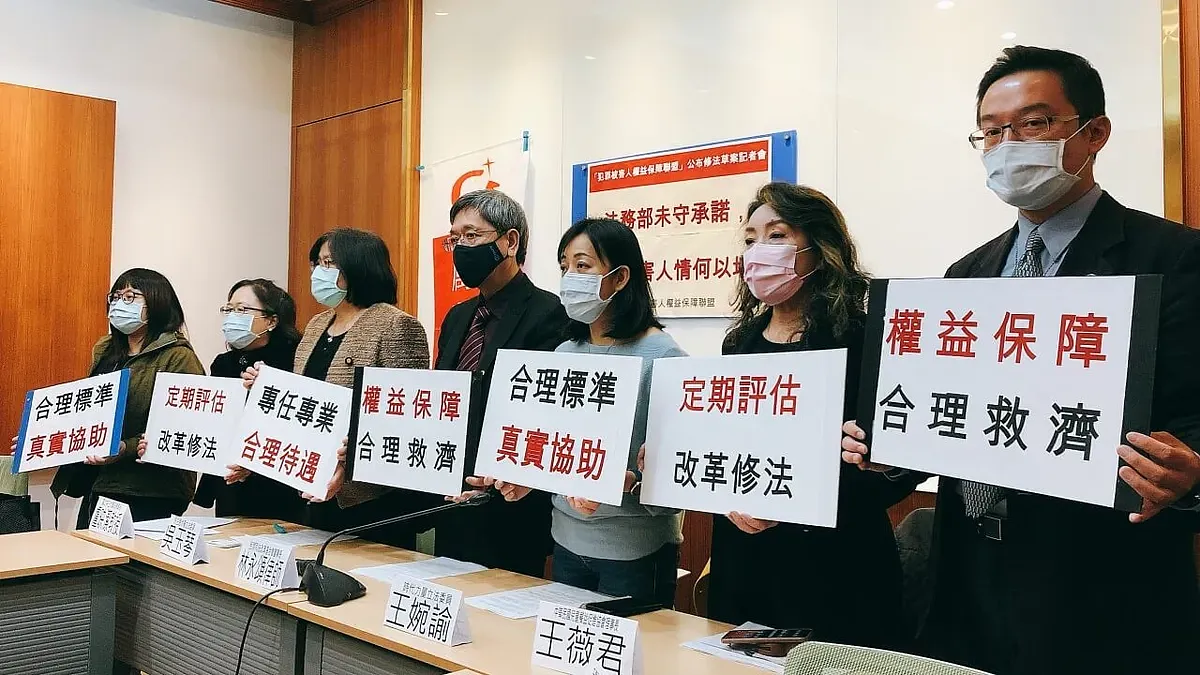
"The Ministry of Justice Has Not Kept Its Promise - How Long Must Crime Victims Wait?" - Press Conference by the Alliance for Crime Victims' Rights Protection
Last edited: 2026-08-29
At a March 26 Legislative Yuan public hearing, "Cries in the Dark - Who Will Care for Victims' Blood and Tears? Strengthening Crime Victim Protection Mechanisms," civil-society groups questioned the inadequate protection of rights under the Crime Victim Protection Act, the rigid services provided by the Association for Victims Support, and insufficient funding. In response, Deputy Minister of Justice Chang Tou-Hui publicly promised that the Ministry of Justice would produce its own draft amendments to the Crime Victim Protection Act before the end of the year. (A verbatim excerpt follows.)
Deputy Minister Chang Tou-Hui: "We hope to put forward the proposal this year. I would also like to report to the Chair that the amendments to the Crime Victim Protection Act are not being undertaken merely because legislators, the Legislative Yuan, or civil-society organizations raised the issue. The Ministry of Justice recognized the problem last year and initiated this round of amendments. We hope to conduct a comprehensive review of the Act."
Chair: "Deputy Minister, if I understand you correctly, are you saying that the Ministry will put forward the amendments before the end of this year?"
Deputy Minister Chang Tou-Hui: "We will put them forward before the end of this year."
Source: Legislative Yuan Judiciary and Organic Laws and Statutes Committee public-hearing record, March 26, 2020, p. 42.
Yet as of today, December 30, 2020, the Ministry of Justice has still not fulfilled that promise. It has failed to deliver a draft and disappointed the public's expectations for stronger protection of crime victims. This afternoon, the Alliance will meet with Minister of Justice Tsai Ching-Hsiang to present the civil-society draft Crime Victim Rights Protection Act and explain its legislative purposes and institutional design. We call on the Ministry to explain the difficulties it has encountered in preparing its own proposal and to use the civil-society draft as a reference so reform can move forward more quickly.
The civil-society draft Crime Victim Rights Protection Act was developed by the Alliance for Crime Victims' Rights Protection after more than a year of study and discussion. The draft will be made openly available for public use, and we welcome parties across the political spectrum to use it as a reference and move quickly to strengthen protection of crime victims' rights. The full draft is attached; its key features are summarized below.
-
Raise the Level of the Competent Authorities: Executive Yuan at the Central Level; Municipal and County/City Governments Locally
Resolution 1-2 of the First Subcommittee of the 2017 National Congress on Judicial Reform recognized that the administrative level of existing crime-victim protection agencies was too low. The civil-society draft therefore raises the institutional level of responsibility. The Executive Yuan would serve as the central competent authority, enabling effective coordination among ministries and agencies, while municipal and county/city governments would serve as local competent authorities and integrate local social-safety networks.
-
Replace "Serious Injury" with "Severe Trauma" and Create Emergency Assistance for Severe Trauma
"Serious injury" is a legal determination. When the offense charged and the ultimate judgment characterize the harm differently, crime victims may be required to repay compensation they have already received or may never be told that they are eligible to apply. Articles 10 and 11 of the Alliance draft therefore use the concept of "severe trauma," reducing the effect that differences between charging and adjudication can have on eligibility for crime-victim compensation. Article 8 also creates emergency assistance for severe trauma, with eligibility standards under Paragraph 2 tied to the Ministry of Health and Welfare's Injury Severity Score.
-
Add Periodic Payments Needed to Maintain Daily Living
After a crime, victims and their families often face serious financial hardship. To help them meet ordinary living expenses and rebuild their lives, Article 15 of the Alliance draft adds periodic payments needed to maintain daily living, in addition to existing compensation and victim-support services.
-
Create a Flexible, Professional, Government-Funded but Civil-Society-Operated Organization
Existing crime-victim protection organizations are heavily government-dominated, producing rigid services that cannot always respond proactively and flexibly to victims' needs. Because the current system falls under the Ministry of Justice, limited victim-protection budgets have also been used to support unrelated initiatives such as anti-drug and anti-vote-buying campaigns. Article 52 of the Alliance draft therefore establishes a government-funded but civil-society-operated foundation, with civil society responsible for service delivery and government providing oversight and support. The current system also relies too heavily on part-time personnel, undermining professional capacity and effectiveness. Article 89 would require full-time staff with backgrounds in law, psychology, counseling, social work, or related fields and provide reasonable compensation so that services can be both flexible and professional.
-
Shift from Discretionary Assistance to Rights Protection
When crime-victim compensation is tied to a victim's damages claim against the offender, compensation is treated as discretionary assistance rather than as protection of rights. The Alliance draft therefore deletes the existing rule requiring a victim who receives damages to repay compensation up to the amount recovered. By formally separating crime-victim compensation from the victim's damages claim against the offender, the draft gives effect to its core principle of rights protection.
-
Require Periodic Evaluation and Review
To improve protection of crime victims' rights on an ongoing basis, Article 94 of the Alliance draft requires the competent authority to issue an effectiveness evaluation report every four years and to use those evaluations to review and improve the law and related supporting measures.
As the Alliance releases its draft, we must also ask: if the Ministry of Justice truly considers this legislation a priority, why did it fail to keep its promise to submit a draft to the Executive Yuan before the end of the year? Crime victims should not be left waiting while legislation moves at a glacial pace. Alliance members expect Minister Tsai Ching-Hsiang to give the public a clear and reasonable explanation at this afternoon's meeting.
Attachment
Comparison Table: Civil-Society Draft Crime Victim Rights Protection Act and Current Provisions
Attendees
Joseph Lin / Chairperson, Judicial Reform Foundation
Wang Wei-Chun / Chairperson, Association for Rights Promotion of Children, R.O.C.
Sun Chih-Yu / Specialist, Garden of Hope Foundation
Hsu Cheng-Yin / Managing Attorney, Tian Feng Joint Law Firm
Lu Ying-Chieh / Professor, Department of Law, National Chung Cheng University
Wang Wan-Yu / Legislator, New Power Party
Wu Yu-Chin / Legislator, Democratic Progressive Party
Press Contact
Chen Yang / Legislative Researcher, Judicial Reform Foundation
This article is an AI-generated translation of the original Chinese text. In the event of any discrepancy, the Chinese version shall prevail.