
JRF Newsletter
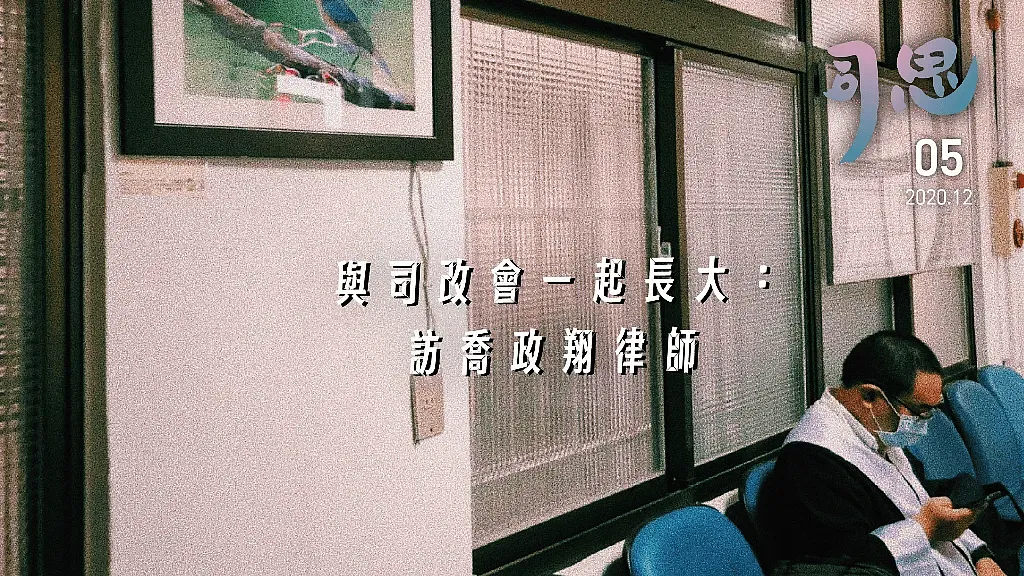
Growing Up with JRF: An Interview with Attorney Chiao Cheng-Hsiang
Last edited: 2026-08-29
For many law graduates, joining a law firm is the obvious dream. Chiao Cheng-Hsiang took a different route. He interned at JRF in the summer of 2012 and formed a lasting connection with the organization. After graduating from Chinese Culture University's Department of Law in 2013 and passing the attorney examination that same year, he returned to JRF as a Complaint Center specialist. Even after entering private practice, he continued working on JRF cases.
From intern to Complaint Center specialist, Chiao's work at JRF centered on screening cases and interviewing complainants. After becoming a practicing attorney, he remained deeply involved in JRF's individual-case advocacy, including the March 24 Executive Yuan eviction litigation, which he had first encountered near the end of his time on staff. Reform sometimes succeeds and sometimes runs into defeat. Chiao quietly stayed alongside JRF through both, growing with the organization over the years.
Flying Papers and the 2:00 p.m. Alarm
 Photo / January 11, 2014: Chiao Cheng-Hsiang attends JRF's annual planning meeting while serving as a Complaint Center specialist.
"I was looking for somewhere to intern. Because of my family background, I wasn't especially drawn to government agencies, so I chose a nonprofit instead. To be honest, I barely knew what JRF was at the time." His first impression was shock: enormous workloads and distant, difficult ideals were somehow being carried by a tiny office and only a handful of people.
JRF complaint files had reached No. 1315 by the time Chiao left the Complaint Center; today the numbering is well past 4000. He remembers spending his days buried in stacks of cases, sorting through facts and trying to understand each complainant's position. Although a case had to pass through several rounds of discussion before JRF formally took it on, the constant flow of new complaints meant the Complaint Center had to screen large numbers quickly, and most cases were effectively decided at that stage-whether they would be sent to volunteer attorneys for further review. "Basically, I thought I was someone who didn't understand anything," Chiao recalled. "Asking me to analyze cases and decide whether someone had been wrongfully convicted... JRF was pretty bold." Asked to compress those days into a single image, he laughed ruefully: "Papers flying over my head. A case would come in in the morning and by the afternoon I'd have to produce a briefing." That trial-by-fire turned rapid case reading into second nature.
Answering complaint calls was another part of the job. The people on the other end came from every corner of society. Through voice alone, Chiao began to piece together not just facts, but emotions and personalities, until each caller became a three-dimensional story. Asked who stayed with him most vividly, he mentioned Grandma Wu-Tsai Mei-Hsiang(Note 1), a woman seeking state compensation from prosecutors. "She called JRF every day at two in the afternoon. Eventually she became like an alarm clock-you knew the phone would ring when the time came." She would ask about the progress of her case, and Chiao would explain the disputed points and what JRF could and could not do. Twenty-minute conversations repeated day after day until he could keep working while talking with her. Years later, with no receiver in his hand, he remembers those calls not as interruptions but almost as a scheduled greeting: a patch of warm afternoon sunlight arriving at the same time each day.
At the time, JRF usually followed a telephone consultation with an in-person interview. "What people told you on the phone often turned out not to be quite the same once you met them. And there were many things they simply hadn't mentioned." Chiao is not especially talkative, but through repeated face-to-face conversations-with files and judgments spread across the table, stories revisited from different angles-he and JRF came a little closer to the people behind the cases.
From Specialist Chiao to Attorney Chiao
When Chiao worked in the Complaint Center, workloads were measured in "stacks." His supervisor at the time was Hsiao I-Min, now JRF's Office Director, who demanded a great deal of "Specialist Chiao." "He was a strict teacher to me. But because he taught me how to identify and organize legal issues, I was able to pass the attorney exam so quickly."
Chiao had begun at JRF as a university intern, then moved on to guiding younger students through case review and project work. When he sat for the attorney examination, he felt so underprepared that he did not even check the results. Passing came almost without warning. "I didn't think I would pass that time. I thought I'd just go in and practice writing the exam. Somehow I passed."
 Photo / Attorney Chiao assisting at a hearing in a minor-offense parole-revocation case.
That connection helps explain why, even after leaving JRF and opening his own firm, Chiao has continued to take on many cases pro bono for nearly a decade. "I suppose JRF did a lot for me-when I was in university and in helping me become a lawyer. So when they need help, I come back and help." He expects to keep doing so within the limits of his capacity. "Most of the cases I handle now without a fee are JRF cases."
One recent example is Judicial Yuan Interpretation No. 796 on parole revocation for minor offenses. Of JRF's 73 cases, Chiao personally assisted with 11, including the Chien Ho-Ping case that the Supreme Court used in referring the issue to its Grand Chamber. "JRF can influence judicial practice strongly enough to push constitutional interpretation to another level and prompt the Grand Justices to clarify the issue," he said. He now uses his professional status and the skills accumulated over the years to give back to JRF and the legal community, helping the organization continue to exert that influence.
The Donkey Still Wants to Keep Walking
 Photo / Attorney Chiao Cheng-Hsiang during the interview.
"Basically, when JRF asks whether I can take a case, I don't say no. If they're coming to me, it means they genuinely need someone to help." Over the years, he has continued pursuing reform alongside JRF in the hope of building a justice system the public can trust. The young man who once struggled through JRF cases without quite knowing what he was doing can now stand on his own as one of the organization's dependable frontline partners.
JRF's work has always depended on persistence over time, and its 25 years have unfolded alongside the growth of many people. If the day eventually comes when Chiao also steps away, he hopes to leave something useful behind. "So many things here started from zero. Leaving behind a way of handling them-an SOP, if you like-is much better than making the next person start over." JRF has spent 25 years clearing obstacles, advocating ideas, and working on cases, with no way to know how far the road still extends. "If JRF were an animal, it would probably be a donkey with a carrot hanging in front of it." In that sense, it resembles Chiao himself: the reason for continuing is simple, but it has survived the test of time.
Note 1 The Wu-Tsai Mei-Hsiang State Compensation Case
The Wu-Tsai Mei-Hsiang case involved state compensation paid by a prosecutors office to the family of a deceased person. Wu-Tsai Mei-Hsiang's daughter, Wu Ling-Ling, left home after leaving a note and was never heard from again. For one year and seven months, Wu-Tsai searched crowded places throughout greater Taipei holding handmade posters. Because of administrative negligence by the Shilin District Prosecutors Office, however, Wu Ling-Ling's body had already been buried as unidentified remains. When her mother discovered what had happened, she was devastated and sought state compensation to hold the authorities accountable. (Wikipedia: Wu-Tsai Mei-Hsiang State Compensation Case)
This article is an AI-generated translation of the original Chinese text. In the event of any discrepancy, the Chinese version shall prevail.
