
JRF Newsletter
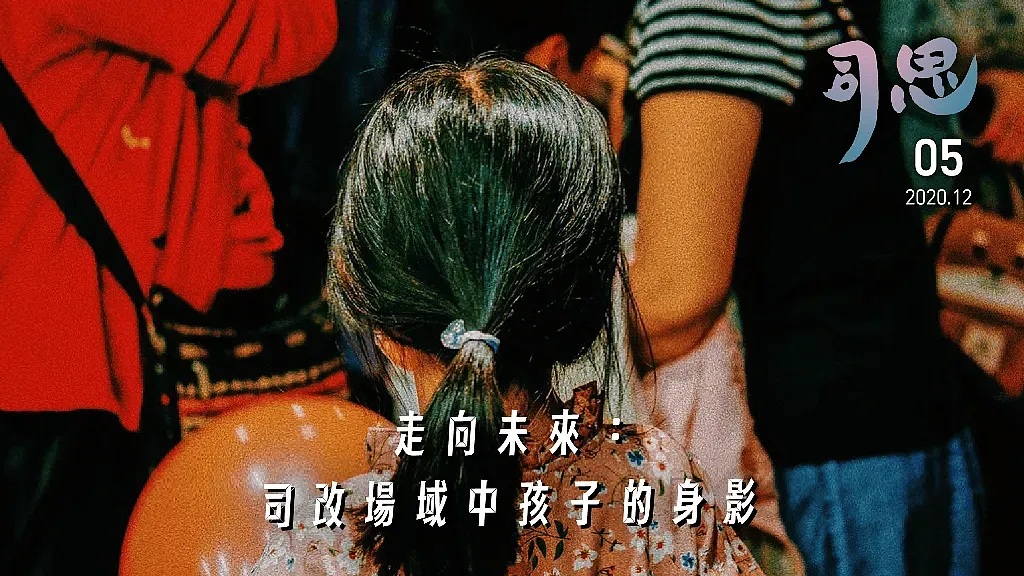
Looking Toward the Future: Children in the Spaces of Judicial Reform
Last edited: 2026-08-29
Photography | Tien
For the last piece in this issue of the newsletter, we wanted to make a little room for children. A people without history has no future. And if we look back at history for the sake of the future, then perhaps the children who appear in the spaces where judicial reform happens represent that future most directly.
The Children Who Show Up at JRF
I was once corrected for calling interns "kids." They are independent people with mature ideas, sharp judgment, and endless creativity; don't infantilize them.
So the children in this article really are, objectively speaking, very small human beings. They appear at our workplaces because their parents are helping JRF at night and on weekends, so they get brought along to fundraising banquets, annual planning meetings, and working-group meetings.
 Photo / The child of a Secretariat colleague, who has attended JRF's annual planning meeting every year since birth.
 Photo / A-Tang, child of Taiwan Association for Human Rights Secretary-General Shih Yi-Hsiang, once spontaneously drew a floor plan for the JRF office. (Why not the TAHR office? Maybe ours was simply in greater need of improvement...)
Parenting While Doing Judicial Reform
Parenting in this world of judicial reform takes many forms. An attorney leaves a meeting at nine at night to read a bedtime story to his daughter. A newly joined volunteer attorney replies that he is helping his son with homework while also reading the new Prison Act. A couple has to choose which one of them will attend a meeting while the other stays home with the children. One attorney's children treat the auction at JRF's fundraising banquet as their annual performance slot. Ask what they remember about the events their father brought them to and they say only, "There was a huge stage we could dance on." "Do you know what all the people below were doing?" "No." Fundraising banquets are usually stressful for everyone organizing them, but watching those children is a reminder that it is possible to be completely absorbed in your own world and perfectly happy. Being a kid looks pretty great.
 Photo / Now everyone knows whose child was dancing on the stage.
Most of the time, though, we are still not family-friendly enough to let parents balance caregiving with judicial-reform work. Evening meetings are the most common problem when children are too young to come along. This has long shaped who is able to participate, and we still have not found a sufficiently good solution.
One story from this year's fundraising banquet has already become part of JRF lore: the child of a standing executive committee member went straight to the chairperson and asked, "Could you please stop giving my mom so much work?" JRF's work is voluntary-no one can really force anyone else to do it-but lawyers and other participants do give up part of their family time, and no one knows that better than their children.
Adults and Children: How Do We Understand Each Other?
After I entered law school, I realized how many classmates came from legal families, with parents who were attorneys, judges, or prosecutors. You could sometimes sense a kind of sensitivity cultivated from childhood. Watching the children who appear around judicial-reform work, I began to wonder whether they too will absorb human-rights values almost by osmosis and develop an unusually early awareness of these questions.
So I asked several JRF standing executive committee members: How do you explain to your children what you do?
Even in an era when "communication" and "dialogue" dominate middle-class parenting discourse, not every parent is eager to teach children an explicit set of human-rights values. Different personalities produce very different instincts.
"Does your child know what you do?"
"I don't think I've ever explained it to her.""She'll probably ask soon, won't she?"
"Ugh. I kind of hope she doesn't get into this stuff.""That's usually how it works-the more you hope they won't, the more they head straight toward it."
"noooooooooooooo""Are you worried she won't be happy?"
"Yes."
Some parents cannot bear the idea of the hardships of human-rights work entering a child's life too early. Others actively explain ideas such as "a bad person is not necessarily a bad person" and "lawyers are there to help people like that." One parent has even written a short poem to read to a daughter not yet two years old. (The radical part, I should clarify, is writing the poem.)
"One day you'll understand: whether someone is called good or bad,
they are still just a person-like you, like Mom, like Dad."
(Excerpt)
"Family time matters. If you never let your children into your world, why would they let you into theirs when they grow up?" That is why one standing executive committee member, despite being questioned by leaders in the organization, has never been shy about bringing children to work-related events. When I actually asked several of these children what they thought was happening, their answers were still wonderfully simple: "Lawyers give speeches, work, and have meetings," or "At the evening event we tied ribbons and took pictures and listened to Dad's colleagues talk on stage, even though I didn't understand it." Each occasion, though, creates another opening for conversation-a way for parent and child to share a little more of each other's world.
Human-Rights Moments with Children Make Us Gentler-and Stronger
A few days ago, a colleague arrived at the office half an hour late. Her two-and-a-half-year-old daughter had been crying and refusing to leave the house. My colleague said something I have kept thinking about:
"I keep telling myself: this is a human-rights moment. She's so small that using force would be incredibly easy. But that creates other problems. I remind myself that her prefrontal cortex simply isn't fully developed yet."
At the beginning of education reform, many teachers asked, "How can we maintain discipline without corporal punishment?" When torture was first prohibited, police asked, "How are we supposed to get a confession if we can't hit people?" The same logic appears in dispersing protesters: if we don't use force, who will obey? Violence is seductive because it looks like a quick solution.
Human rights can sound abstract, but at their most basic they are about recognizing and respecting another person as a subject in their own right. A "human-rights moment" may often feel less like principle than like an exhausting test of parenting. But perhaps those moments make the world a little gentler. And more gentleness, I believe, can produce a deeper kind of strength.
This small piece is dedicated, with respect, to all the parents and children who share these spaces with us.
This article is an AI-generated translation of the original Chinese text. In the event of any discrepancy, the Chinese version shall prevail.
