
[Court Observation Notes] Supreme Court Oral Argument in 2020 Tai-Shang No. 3695 - March 23 Executive Yuan Occupation Case
Last edited: 2026-08-29
Background
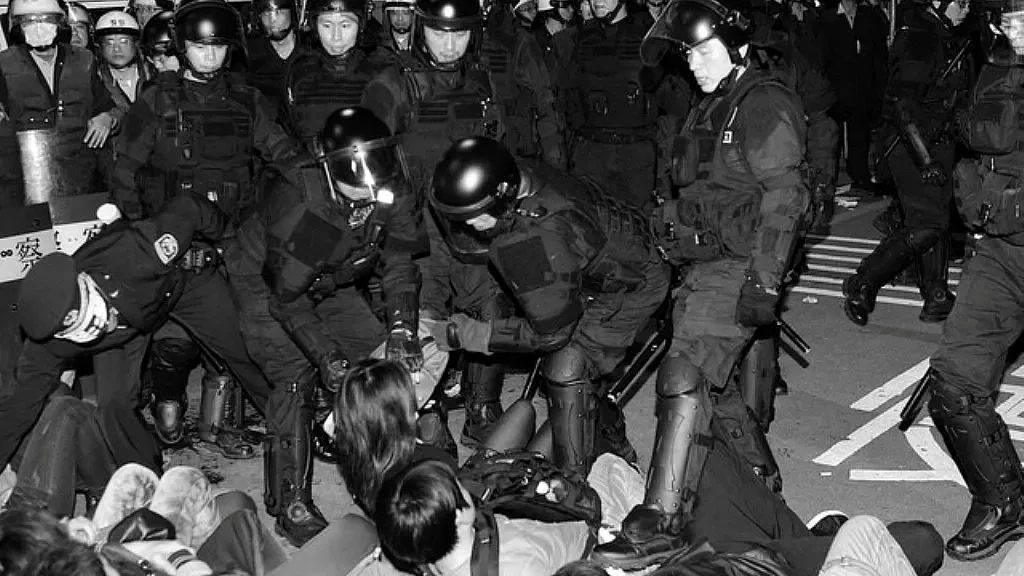
The March 23 Executive Yuan occupation took place about six years ago, when protesters entered the Executive Yuan compound and used an occupation to express their political position. In the early hours that followed, the state forcibly removed them with police equipment and water cannons. Even after the movement ended, litigation arising from the incident continued for nearly six years.
In April 2020, the Taiwan High Court reversed the first-instance acquittals of seven defendants charged with "inciting another to commit an offense" in the March 23 Executive Yuan Occupation Case and sentenced each to two months' imprisonment, commutable to a fine. The defendants and their pro bono defense team appealed to the Supreme Court in May and separately filed a motion to stay proceedings and petition for constitutional interpretation, as well as a motion requesting oral argument. After a preparatory proceeding in October, the Supreme Court scheduled oral argument for December 25, 2020.
Defense Arguments
The oral argument focused on two issues. The first concerned Article 153, Paragraph 1, Subparagraph 1 of the Criminal Code, which penalizes publicly inciting another to commit an offense. The defense argued that the statutory terms "incite" and "offense" are constitutionally suspect under the principles of legal certainty, proportionality, and equality. If the provision is unconstitutional, the lower court's conviction of the seven defendants under that provision would constitute a judgment contrary to law.
On the term "incite," the defense noted that the legislative explanation merely uses near-synonyms such as "agitate" and "mislead," which do little to define the concept or provide objective criteria. The defense also challenged the provision's underlying view of the public. People living in society are capable of independent thought and can decide for themselves whether conduct is unlawful; applying Article 153 as though hearing advocacy of unlawful conduct naturally causes listeners to commit crimes assumes an unrealistically passive public. Under prior Judicial Yuan interpretations, legal certainty requires a rule to be understandable, foreseeable, and judicially reviewable. Yet whether speech counts as "incitement" under Article 153 depends heavily on a judge's assessment and may be difficult for ordinary people to foresee. Given the broad reach of regulatory criminal law, a person may not even know that conduct being advocated is unlawful. The defense therefore argued that the offense fails the foreseeability requirement of the principle of legal certainty and is unconstitutional.
Defense attorney Yu Po-Hsiang also argued that, although it was not formally included among the issues for oral argument, the trespass conviction under Article 306 of the Criminal Code may likewise rest on an erroneous application of law. Article 306 appears in the chapter protecting individual legal interests, rather than social or state interests. On that structural reading, the "residence or building" protected by the provision should refer to premises used by private persons for residence or business, not government buildings; the defendants therefore should not have been convicted under Article 306 for entering the Executive Yuan.
The second issue concerned the right of resistance and civil disobedience. The defense argued that a constitutional right of resistance can be derived from Article 2 of the Constitution even though the Constitution does not expressly enumerate it. Where people resist an attempt to replace constitutional democracy with authoritarian rule, conduct that would otherwise violate criminal law may qualify for recognition as a justification. The defense also invoked John Rawls's conception of civil disobedience as peaceful, nonviolent action undertaken to communicate a political position. Although civil disobedience is not expressly guaranteed as a constitutional right, it is expressive conduct and may therefore fall within freedom-of-expression protections. The lower court, the defense argued, failed to investigate these issues and thus rendered a judgment contrary to law.
Related Links:[Event Report] Authoritarian Criminal Law and Transitional Justice: A Seminar on Incitement and Insulting a Public Office
Prosecution Arguments
The prosecution began by stating that it would not oppose the Supreme Court staying the proceedings to seek constitutional interpretation or referring relevant legal issues to the Grand Chamber. On the merits, however, it responded differently to the two issues. On Article 153, the prosecution argued that an indeterminate legal concept does not violate legal certainty so long as it remains subject to judicial review. It regarded Subparagraph 2 as constitutionally questionable, but maintained that Subparagraph 1 is constitutional because its elements are sufficiently clear and its penalty does not impose a disproportionate restriction on rights.
The prosecution nevertheless acknowledged a potential conflict with freedom of expression. Constitutional review of restrictions based on speech content is especially demanding where political speech is involved. Occupying the Executive Yuan to express a political position, it argued, is political expression; any restriction under Article 153 must therefore be narrowly construed. The prosecution proposed using a "clear and present danger" limitation: expressive conduct would fall outside constitutional protection only where the actor intends the incitement and the inciting conduct creates the required danger. It relied on a similarly restrictive interpretation advanced by National Taiwan University criminal-law professor Chou Yang-I, under which Article 153(1) should apply only when a clear and present danger exists.
On the second issue, the prosecution examined the right of resistance comparatively. Germany, Greece, and the Czech Republic expressly recognize such a right in their constitutions. In the prosecution's view, the right applies only where a democratic constitutional government uses formally lawful means to transform the constitutional order into authoritarian rule and lawful remedies are no longer available. Taiwan remained a constitutional democracy and was not facing that kind of crisis; foreign models likewise do not recognize a right of resistance based on an "imagined constitutional crisis." Because the prosecution also viewed the alleged incitement as creating a clear and present danger, it argued that the defendants could not invoke the right of resistance as a justification.
As for civil disobedience, the prosecution argued that it is not an expressly protected constitutional right and remains principally a concept discussed in philosophy and social theory rather than a formal doctrine of criminal law. It further argued that civil disobedience is peaceful and nonviolent and ordinarily entails a willingness to accept legal punishment; because the protesters who occupied the Executive Yuan had, in the prosecution's view, engaged in violence,
they should be subject to the ordinary criminal law and could not rely on civil disobedience as an extra-statutory justification or excuse.
Reflections and Observations
Both prosecution and defense agreed that constitutional clarification of Article 153 would be appropriate, underscoring how many difficult issues the case presents-more precisely, how it places constitutional rights and state interests in tension. On the first issue, the parties sharply disagreed over whether encouraging protesters to occupy the Executive Yuan amounted to "inciting another to commit an offense." Much therefore depended on whether the Supreme Court would seek constitutional interpretation or decide the case itself. Historically, many Article 153 cases involved incitement to gambling. Applying the provision instead to expressive conduct undertaken in defense of constitutional democracy raises a further question: is that use consistent with the social interests the offense was originally designed to protect? If defendants can be convicted under the vague terms "incite" and "offense," does that leave the government free to suppress unfavorable speech under standards that people cannot foresee, contrary to the freedom of expression protected by Article 11 of the Constitution?
The second issue asks whether the right of resistance and civil disobedience can operate as criminal-law justifications. Neither is expressly stated in Taiwan's Constitution, but their substance can arguably be derived from constitutional principles. Even if a court ultimately rejects them-or considers them difficult to incorporate into established doctrine-the lower court should at least have examined the arguments. Its failure to do so may itself have left a material legal issue unresolved. The Supreme Court should therefore consider carefully whether these concepts, despite their limited prior treatment in Taiwan's case law, can play a role in the analysis.
Judicial Yuan Interpretation No. 509 emphasizes the high level of constitutional protection afforded to freedom of expression. If people cannot speak and defend their political positions when they believe the constitutional order is in crisis, the rule-of-law system risks contradicting itself. The judiciary should not expand state power casually in ways that restrict freedom and undermine due process in a democracy.
Having studied law for only about two years, I found observing this Supreme Court hearing extraordinarily valuable. Even during the preparatory stage, the parties disputed matters such as the hearing date, the time allotted for argument, and the selection of academic experts; each required careful discussion before the court made a decision. At oral argument, both sides examined every detail of the legal issues closely. The experience showed me how much work, time, and judgment go into preparing a Supreme Court appeal. It also made me conscious of how much I still have to learn. I could not always follow the questions being debated among the judges, prosecutors, defense counsel, and scholars, and even after taking notes I needed considerable time to digest their positions. Understanding doctrine in a university classroom is one thing; using it flexibly in practice is another. I am grateful for the opportunity to see legal professionals working so intensely toward what they understood as fairness and justice.
This article is an AI-generated translation of the original Chinese text. In the event of any discrepancy, the Chinese version shall prevail.