
China's Opaque Trial of the 12 Hongkongers: Taiwan Should Upgrade Its Hong Kong Assistance Policy
Last edited: 2026-08-29
On December 30, a Chinese court sentenced 10 defendants in the "12 Hongkongers" case to terms ranging from six months to three years, all to be served in China before they return to Hong Kong. The 12 young Hong Kong protesters had attempted to reach Taiwan in August to seek refuge but were intercepted by the China Coast Guard and taken to Yantian, Shenzhen, where they were held incommunicado for months. Chinese authorities rejected lawyers retained by their families, kept the proceedings opaque, and prevented foreign diplomatic representatives and international media from observing the trial.
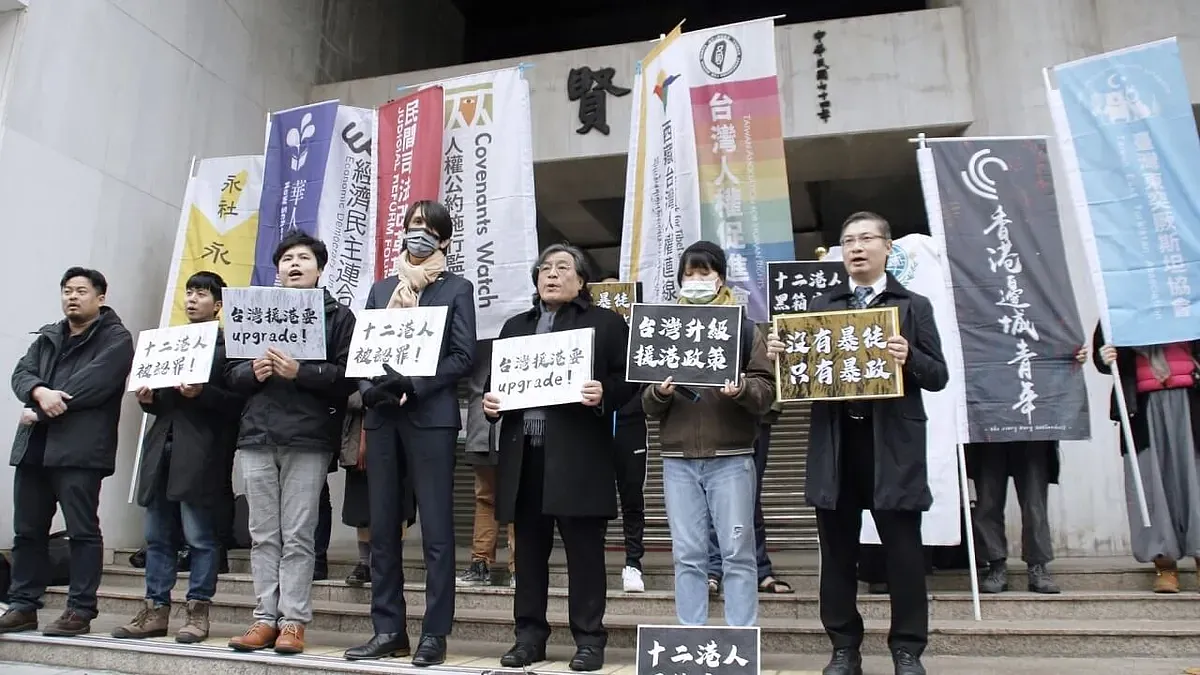
Taiwanese civil-society groups held a joint press conference on December 31 criticizing China for violating its own professed principle of "sunshine justice." They argued that the proceedings were secretive and opaque, and that the detainees were effectively forced to surrender their liberty and plead guilty merely to obtain such basic protections as medication and family visits.
Edwina Leung, chairperson of Hong Kong Outlanders, called on the Taiwan government to recognize that deterioration in Hong Kong has become a continuing reality and to develop a long-term response as soon as possible. Looking back at 2020, she said China used the COVID-19 pandemic as an opportunity to intensify repression in Hong Kong. Civil-society groups therefore planned to propose a new Article 60-1 of the Act Governing Relations with Hong Kong and Macau-a "Hong Kong Human Rights and Democracy Clause"-to strengthen Taiwan's Hong Kong assistance policy through an express statutory framework, drawing on measures adopted in the United States and Europe.
As Hong Kong Is Scorched, Taiwan Must Act
Wu Rwei-Ren, Associate Research Fellow at the Institute of Taiwan History, Academia Sinica, said that under the National Security Law and a new Cold War environment, Hong Kong was being subjected to a political "scorched-earth" campaign. Central and local authorities-including the National People's Congress, the Hong Kong and Macao Affairs Office, Beijing's Liaison Office, and the Hong Kong government-were using the National Security Law to carry out comprehensive repression and purge democratic and localist forces across society. Hong Kong's freedoms, rule of law, and remaining democratic institutions were disappearing rapidly as the city became increasingly "mainlandized."
Wu emphasized that the crackdown was carried out during the COVID-19 outbreak. Beijing and the Hong Kong government expanded state power in the name of pandemic control, suspended elections, and restricted assembly. Border closures in other countries also deprived many Hongkongers of routes to safety, leaving people trapped while the authorities pursued political retribution.
How, Wu asked, could the Chinese and Hong Kong governments claim that Hong Kong had "returned to normal" after destroying much of the city's political and social leadership and the prospects of a younger generation? Hong Kong remained full of contradictions: people lived in fear, anger and resentment were intense, and there was no mechanism for resolving those grievances. People might currently be forced into silence or exile, but conflict could erupt again when circumstances changed.
Wu therefore called on the Taiwan government to respond more actively to the rapidly worsening situation, especially the humanitarian consequences of persecution affecting democracy activists and ordinary citizens. National security concerns, he argued, should not become an excuse for passivity. Taiwan should not only relax immigration and education measures, but also strengthen assistance for people persecuted because of participation in the democracy movement and take clearer, more forceful steps to condemn and pressure the Chinese and Hong Kong governments.
China's Shifting Accounts and Poor Human-Rights Record
Attorney Sang Pu, chairperson of the Taiwan-Hong Kong Association, noted that families were not notified of the trial until three days beforehand, effectively preventing them from exercising any priority access to the courtroom. He described it as a "secret trial." Families were not told until the evening of December 29, through government-appointed lawyers, that 10 detainees had pleaded guilty. Although the court described the hearing as public, it then announced that all observation seats were full. Diplomatic representatives from several countries were unable to enter, and no defendant's family knew what had occurred in the courtroom.
Sang Pu called the proceedings a naked form of political persecution and said the case showed China's control over Hong Kong expanding further. Two minors were held for more than 130 days, seriously interfering with their personal liberty. "Ink-written lies cannot overcome history written in blood," he said. He also argued that the sentences were unusually harsh: for first-time defendants, the ordinary offenses of illegally crossing the border or organizing others to cross illegally would not normally result in penalties of this severity, yet the 12 Hongkongers received terms ranging from six months to three years.
Wang Lung-Kuan, convener of JRF's International Cooperation Group, said the case was absurd at its core. China treated the 12 Hongkongers as having violated its border-control regime by "illegally crossing the border." Yet, he argued, they were attempting to leave Hong Kong for Taiwan, not enter China. Apart from exceptional cases such as Causeway Bay Books shareholder Lee Bo's return to mainland China, it was difficult to understand how the detainees could have possessed an intent to "smuggle themselves into" China at all.
Whatever the underlying charge, Wang emphasized, people who are arrested and prosecuted are entitled at minimum to basic procedural rights. Chinese police detained the 12 on August 23, but authorities issued only an unclear Weibo statement three days later and did not formally acknowledge the detention until September 13, despite the notification requirements in China's Criminal Procedure Law. The detainees were then held for four months on relatively minor charges, their families could not visit them, lawyers retained by their families were excluded, and relatives could not observe the trial. For Wang, these facts illustrated both serious defects in China's justice system and the reasons Hongkongers had opposed extradition to China. He called on Taiwan to do more than condemn Beijing and to respond more actively to the difficult situation facing Hongkongers.
Supporting Hong Kong and Defending Taiwan in 2021
Chiang Min-Yen, a researcher at the Economic Democracy Union, said 2020 had been a precarious year for Taiwan: voters rejected Han Kuo-Yu's China-friendly political line and Taiwan successfully contained the pandemic. For Hong Kong, however, the year had been deeply pessimistic. The city had effectively entered a state resembling martial law. After the National Security Law, repression, arrests, and political reckoning against protesters were likely to become routine, while the pandemic gave Chinese authorities another opportunity to tighten control. More Hongkongers could be forced to leave or flee.
Chiang noted that since the anti-extradition movement began, the United States had adopted measures including the Hong Kong Human Rights and Democracy Act, the Hong Kong Autonomy Act, and other legislation supporting Hong Kong, substantially restructuring U.S.-Hong Kong relations. The European Parliament had also adopted resolutions responding to the National Security Law, including calls to consider sanctions against Chinese officials and to develop "lifeboat" programs for Hongkongers.
Taiwan, Chiang argued, could not afford to underestimate developments in 2021: after suppressing Hong Kong, China would turn its pressure toward Taiwan. Taiwan therefore needed concrete policies and closer cooperation with the international community. Although President Tsai Ing-Wen established a dedicated office in July 2020 to provide humanitarian assistance to Hong Kong protesters, continued deterioration required Taiwan to plan ahead-upgrading its Hong Kong assistance policy, reconsidering Taiwan-Hong Kong relations, and strengthening democratic resilience.
Chiang said civil-society groups planned to propose a "Hong Kong Human Rights and Democracy Clause" as a new Article 60-1 of the Act Governing Relations with Hong Kong and Macau. The provision would require the Executive Yuan, at least annually, to report on democracy and human rights in Hong Kong, the status of its autonomy, and implementation of Article 18, and then develop policy responses on that basis. President Tsai had previously said that Article 60 could be invoked to suspend part or all of the Act if conditions in Hong Kong changed. Chiang argued that this broad statement lacked concrete criteria; a statutory annual assessment would clarify when conditions had changed and require the government to upgrade its response.
Legislator Hung Sun-Han said the Chinese Communist Party was using the trial of the 12 Hongkongers to signal its intention to crush resistance in Hong Kong. Even under intense pressure, however, many Hongkongers remained dissatisfied and continued to resist. Taiwan, as Hong Kong's friend, should keep considering how to strengthen assistance through both executive and legislative action. Hung said he would do what he could from the Legislative Yuan to stand with Hongkongers.
Supporting Hong Kong and Defending Democracy Are Both Essential
Chang Yu-Meng, chairperson of the Taiwan Youth Association for Democracy, said the transfer of the 12 Hongkongers into Chinese custody not only undermined Hong Kong's judicial independence but also exposed an effort to eliminate an entire generation of young Hong Kong activists. Chinese and Hong Kong authorities arrested young people attempting to escape repression and did not spare even two minors, he argued, in fundamental tension with the Convention on the Rights of the Child.
Chang said this was also the right time to reassess Hong Kong's special status and preferential treatment for Hong Kong capital. Taiwan should conduct regular assessments of conditions in Hong Kong and adjust policy accordingly. He also argued that Taiwan's response should include sanctions against responsible Chinese officials as a clear political signal.
Wang Hsi, Legal Director of the Taiwan Association for Human Rights, said the 12 Hongkongers case was the first in which people seeking refuge were subjected to Chinese criminal proceedings for doing so, demonstrating that fears of judicial persecution by authoritarian governments were not hypothetical. Although she welcomed President Tsai Ing-Wen's support for the anti-extradition movement, Taiwan's legal framework for protection and asylum still needed substantial improvement.
The 12 Hongkongers had been heading for Taiwan, Wang noted. Had they reached Taiwan successfully, it remained uncertain whether the government could have provided them adequate assistance. Existing protesters may receive support through special programs, but Taiwan still lacks a comprehensive asylum framework. After case-specific review, people often have to enter ordinary residence procedures, while insufficient statutory authorization and fragmented administrative planning make it difficult to address education, employment, and other practical needs. If worsening conditions in Hong Kong eventually trigger Article 60's suspension mechanism before Taiwan has established a legal asylum framework, these weaknesses will become even more serious.
Whether Taiwan follows the draft Refugee Act proposed by the Taiwan Association for Human Rights or other countries' refugee laws, Wang said, basic refugee protections should be expressly authorized by statute: a transparent application process, basic living support while an application is pending, and clear procedures for review and appeal. Only then can administrative agencies provide comprehensive support that enables Hong Kong protesters to establish independent lives in Taiwan. Any serious upgrade of Taiwan's Hong Kong assistance policy should address these issues.
Speakers
Wu Rwei-Ren|Associate Research Fellow, Institute of Taiwan History, Academia Sinica
Sang Pu|Chairperson, Taiwan-Hong Kong Association; Attorney
Chiang Min-Yen|Researcher, Economic Democracy Union
Chang Yu-Meng|Chairperson, Taiwan Youth Association for Democracy
Wang Hsi|Legal Director, Taiwan Association for Human Rights
Wang Lung-Kuan|Convener, International Cooperation Group, Judicial Reform Foundation
Hung Sun-Han|Legislator
Participating Organizations
Economic Democracy Union
Taiwan Citizen Front
Taiwan-Hong Kong Association
Taiwan Association for Human Rights
Hong Kong Outlanders
Taiwan Youth Association for Democracy
New School for Democracy
Covenants Watch
Judicial Reform Foundation
Human Rights Network for Tibet and Taiwan
Taiwan Forever Association
Taiwan Aid Hong Kong Association
Press Contacts
Edwina Leung; Chiang Min-Yen
This article is an AI-generated translation of the original Chinese text. In the event of any discrepancy, the Chinese version shall prevail.