
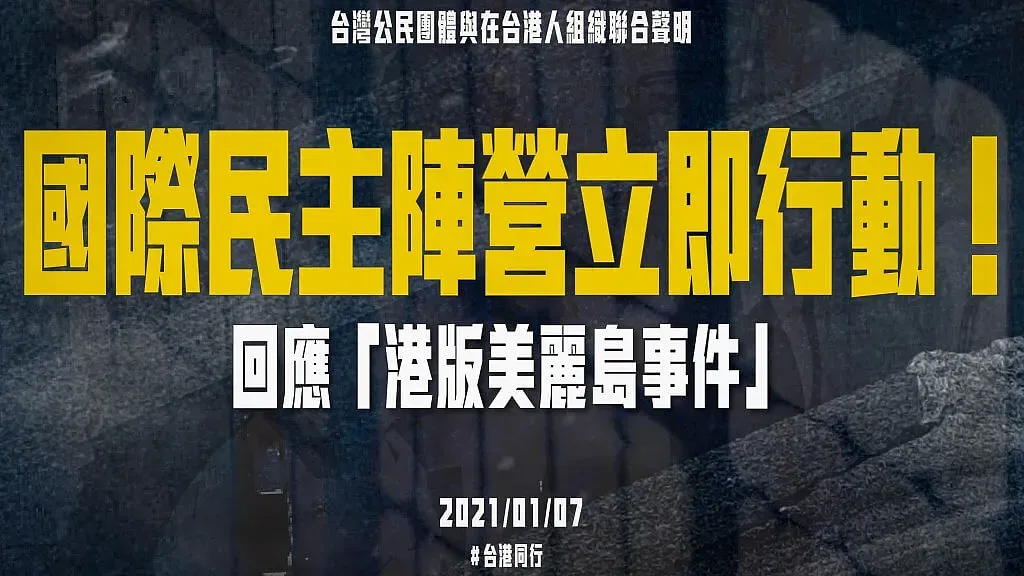
International Democratic Community Must Act Now: Responding to Hong Kong's "Kaohsiung Incident"
Last edited: 2026-08-29
On January 6, China launched an unprecedented wave of arrests in Hong Kong, evoking for the authors Taiwan's Kaohsiung Incident during the martial-law era. Nearly the entire leadership of Hong Kong's democratic opposition was swept up. Beginning early in the morning, around a thousand Hong Kong police officers invoked the National Security Law to arrest 53 people involved in the July 2020 "35+" pro-democracy Legislative Council primaries. Police also searched the headquarters of the Hong Kong Public Opinion Research Institute and, under court production orders, required Stand News, InMedia, Apple Daily, Next Digital, and other media outlets to turn over materials within seven days. Those arrested included U.S. attorney John Clancey, whose firm, Ho, Tse, Wai & Partners, was also searched.
China has disregarded international condemnation and used a "legal blitzkrieg" to suppress political opposition in Hong Kong and cut local civil society off from outside connections. Since the National Security Law took effect, as many as 93 people had been arrested and several prosecuted, including Tong Ying-Kit, who displayed a "Liberate Hong Kong, Revolution of Our Times" flag; former Studentlocalism member Tony Chung; activist Ma Chun-Man; and Apple Daily founder Jimmy Lai. The South China Morning Post also reported that more than 30 Hongkongers overseas were wanted under the law, forming an effective blacklist of exiles, while political and professional organizations in Hong Kong were dissolving under political pressure.
In the foreseeable future, repeated political purges and repression may become routine, forcing more Hongkongers into arrest, persecution, or exile. The National Security Law is vague and extraordinarily broad, threatening personal liberty, freedom of expression, freedom of assembly and association, electoral rights, and due process. The COVID-19 pandemic further slowed protest activity while international border closures left many Hongkongers with fewer routes to safety.
China had already been under pressure from trade and technology conflicts, while Hong Kong's anti-extradition movement generated substantial international opposition to Beijing and prompted legislation and policy measures supporting Hong Kong democracy and responding to human-rights abuses. More recently, however, the United States was undergoing a change of administration and the incoming government's China policy remained uncertain. At the same time, the European Union and China reached agreement in principle on the Comprehensive Agreement on Investment, covering sectors including communications, cloud services, biotechnology, and transportation. The international democratic coalition that had supported Hong Kong appeared at risk of fragmentation.
The authors argue that reduced international pressure has given China an opportunity to intensify repression in Hong Kong. Beijing has progressively regained control over the city's political direction, narrowed civic space, tolerated greater police abuse, and pursued political arrests. At a moment when China is attempting to reverse international resistance by eliminating Hong Kong's opposition, they call for sustained attention and coordinated international action.
We therefore make the following three demands:
-
The Chinese and Hong Kong Governments Should Repeal the National Security Law and Release Everyone Prosecuted or Detained Under It
On July 9, 2015, during the "709 Crackdown," more than one hundred Chinese human-rights lawyers and civil-rights advocates were arrested or disappeared. The mass arrest of pro-democracy figures in Hong Kong follows a similar logic: targeting individuals in order to intimidate society as a whole. Using people themselves as instruments of political terror is unacceptable.
The Chinese and Hong Kong governments, whose human-rights records have been widely criticized, should reverse course immediately, repeal the National Security Law and other legal instruments of persecution incompatible with modern rule-of-law principles, and release local residents and foreign nationals arrested under them.
-
The European Union and European Parliament Should Suspend and Reassess the EU-China Comprehensive Agreement on Investment in Light of the Risks Posed by the Hong Kong National Security Law
The European Union has said the investment agreement would be consistent with the European Council's earlier concern about human rights in Hong Kong and would incorporate labor commitments relevant to forced labor in Xinjiang. Yet the agreement contains no clear response to the Hong Kong National Security Law or to the wave of arrests and repression carried out under it. Developments in Hong Kong have shown, the authors argue, that without strong international pressure China will continue tightening its restrictions on the city's democracy and freedoms. Continuing economic engagement without addressing those abuses risks undermining the human-rights values the EU has long emphasized.
Concluding the agreement too readily would send the message that continued human-rights abuses carry no meaningful cost to China's diplomatic and economic interests. The EU should therefore reconsider the cooperation arrangement, and the European Parliament should suspend approval while reassessing the agreement. Negotiations should proceed only after concrete improvements in human rights and implementation of commitments to Hong Kong's autonomy, with necessary human-rights protections incorporated so that economic gains do not come at the expense of fundamental rights.
-
Taiwan Should Enact a "Hong Kong Human Rights and Democracy Clause" to Upgrade Its Hong Kong Assistance Policy Through a Clear Legal Framework
Taiwan has a particular responsibility to support Hong Kong: it confronts many of the same pressures from China and is geographically the nearest democracy. Although civil society and government agencies have already developed measures to assist Hongkongers, rapidly deteriorating conditions and continuing pandemic uncertainty require Taiwan to build greater capacity, develop a comprehensive mechanism, and prepare administrative agencies for urgent needs when borders reopen. Taiwan should also consider participating in sanctions adopted by democratic partners.
The United States revoked Hong Kong's special treatment in July 2020, adopted multiple sanctions, and used the Hong Kong Human Rights and Democracy Act to restrict entry by officials implicated in human-rights abuses. The EU also adopted its Action Plan on Human Rights and Democracy. Taiwan, the authors argue, should follow these international developments by building its own statutory framework for Hong Kong human rights and democracy.
President Tsai Ing-Wen said in May 2020 that, if conditions in Hong Kong continued to deteriorate, Taiwan could invoke Article 60 of the Act Governing Relations with Hong Kong and Macau to suspend part or all of the Act. Yet precisely because the situation was worsening, support and assistance for Hongkongers had become even more important. Taiwanese civil-society and Hong Kong organizations therefore planned to propose a new Article 60-1-the "Hong Kong Human Rights and Democracy Clause"-requiring the Executive Yuan to issue an annual assessment of conditions in Hong Kong and formulate corresponding measures, creating an express legal mechanism for progressively strengthening Taiwan's Hong Kong assistance policy.
Organizing Groups
Hong Kong Outlanders
Taiwan Association for Human Rights
Economic Democracy Union
Taiwan Citizen Front
Taiwan-Hong Kong Association
New School for Democracy
Taiwan Youth Association for Democracy
Covenants Watch
Judicial Reform Foundation
Press Contacts
Chiang Min-Yen / Secretary-General, Taiwan Citizen Front
Edwina Leung / Chairperson, Hong Kong Outlanders
This article is an AI-generated translation of the original Chinese text. In the event of any discrepancy, the Chinese version shall prevail.