
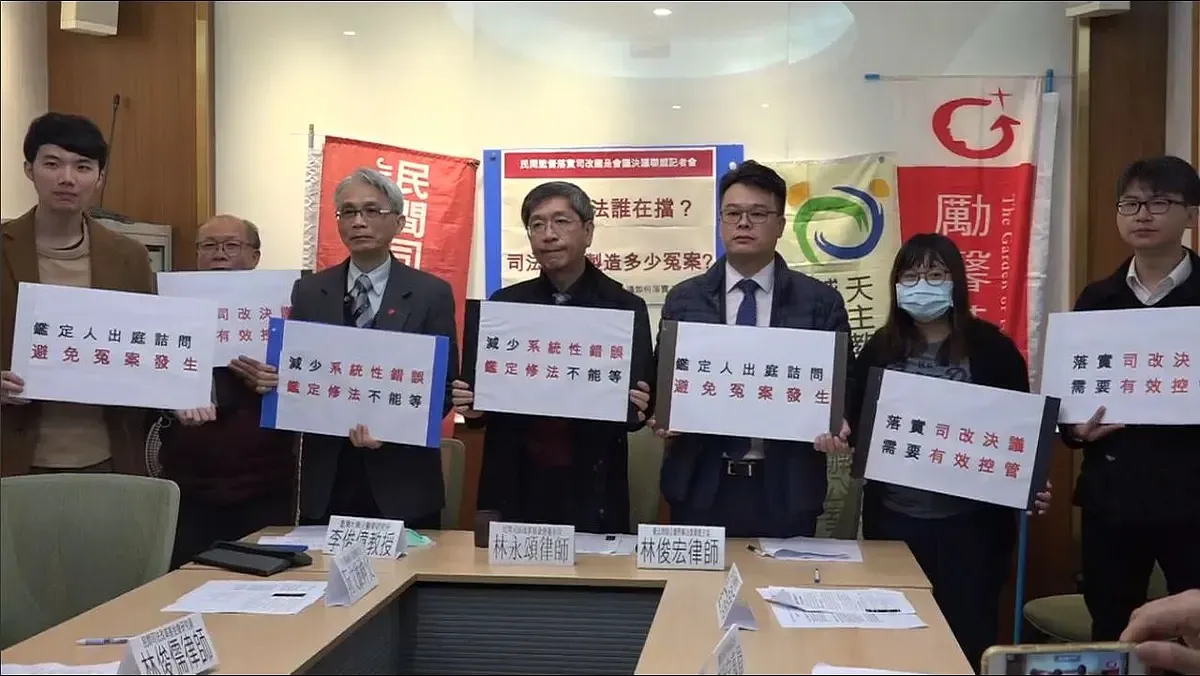
Who Is Blocking Reform of Expert Evidence? How Many More Wrongful Convictions Will the Justice System Produce? - Press Conference on Implementing Judicial Reform Resolutions
Last edited: 2026-08-29
To implement resolutions of the National Conference on Judicial Reform, the Judicial Yuan's draft amendments to the Code of Criminal Procedure on expert examination were jointly submitted to the Executive Yuan more than a year and a half ago, yet no progress had been made. Many other Conference resolutions were similarly stalled, exposing serious deficiencies in monitoring implementation. The civil-society coalition called on President Tsai Ing-Wen to review the status of all judicial-reform resolutions immediately and actively secure passage of the expert-examination amendments, addressing systemic errors that contribute to wrongful convictions.
-
Ministry of Justice Blocks Expert-Examination Reform in the Name of "Further Study"
The National Conference on Judicial Reform resolved to "study the establishment and improvement of an expert-witness system while also reviewing the deficiencies of the existing expert-examination system and whether it should be retained." The Judicial Yuan Council approved draft amendments to the Code of Criminal Procedure on May 30, 2019 and jointly submitted them to the Executive Yuan on June 5. Because the Executive Yuan did not move the bill forward, the coalition met with President Tsai Ing-Wen on March 27, 2020 to convey civil-society concerns, and the President instructed that the joint review be completed promptly. Another nine months passed without any indication of when the Executive Yuan would approve the bill.
The coalition received a Ministry of Justice letter the previous month stating that the Ministry agreed with the reform direction of strengthening procedural safeguards for expert examination, but had raised different views on certain provisions in order to improve the rules and establish a workable system, and that the matter remained "under study" (Ministry of Justice Letter dated December 7, 2020). The Judicial Yuan had already invited the Ministry of Justice to participate while the amendments were being drafted. The coalition therefore regarded the Ministry's continued reliance on "further study" as an obstruction of the reform.
-
Requiring Expert Witnesses to Appear for Cross-Examination Is Essential to Preventing Wrongful Convictions
Wrongful-Conviction Case
Chiang Kuo-Ching Case
Su Chien-Ho Case
Hsu Tzu-Chiang Case
Cheng Hsing-Tse Case
Hsieh Chih-Hung Case
Original Judgment
Death penalty
Death penalty
Death penalty
Death penalty
Death penalty
Original Expert Finding
Semen reported in testing of bloodstains on tissue paper
Knife marks on skeletal remains said to show the use of three or more bladed weapons
Body said to have been doused with sulfuric acid and then covered with soil
Two-stage shooting theory based on shots allegedly fired from different directions
Direction of the wounds said to indicate two perpetrators
Error Identified
A blood-testing reagent was incorrectly used to test for semen
The number of weapons could not be inferred from knife marks alone; the inference was inconsistent with biomechanics
Concentrated sulfuric acid would be expected to char tissue rapidly
Gunshot-residue trajectory analysis was incorrect and bullet trajectories could not be reconstructed
The number of perpetrators could not be inferred backward from the number or pattern of weapon wounds
Criminal Compensation
NT$103,185,000
NT$15,840,000
NT$28,120,000
NT$17,280,000
NT$23,190,000
Erroneous expert findings are among the most common causes of wrongful convictions. In the five exonerated death-penalty cases listed above, defendants, the justice system, and the state all paid a severe price for expert error. Each exoneration depended in part on bringing expert witnesses into court for cross-examination so that errors could be exposed and the facts tested through adversarial procedure.
The Hsu Tzu-Chiang case illustrates the point. Forensic pathologist Hsiao Kai-Ping reviewed crime-scene photographs and concluded that a large quantity of sulfuric acid had been poured over the body. Only when he appeared during the seventh retrial and defense counsel asked why the skin shown in the photographs remained intact did he answer that concentrated sulfuric acid would need prolonged soaking before damaging skin. That response revealed a serious misunderstanding of the chemical effect of concentrated sulfuric acid, which rapidly chars organic tissue. The court ultimately declined to accept his photographic assessment and made findings favorable to Hsu Tzu-Chiang. The episode shows why expert witnesses must be subject to cross-examination in court.
The draft amendments encountered substantial resistance within the Executive Yuan. According to the coalition, the central obstacle was opposition from expert personnel in administrative agencies-including forensic pathologists, laboratory examiners, and forensic specialists in police and investigative agencies-to requirements that the person responsible be identified by name in an expert report and appear in court for cross-examination. If the justice system is to stop repeating wrongful convictions, the entrenched practice of allowing experts to avoid courtroom examination must be changed.
-
Expert-Examination Reform Cannot Be Delayed if Systemic Judicial Error Is to Be Reduced
The proposed amendments are a comprehensive response to lessons learned from wrongful convictions and are intended to reduce the risk of systemic error. The principal reforms are:
(1) Polygraph results may not be used as evidence.
(2) Expert-witness qualifications and conflicts of interest must be disclosed.
(3) Prosecutors may commission expert examinations during investigation, and parties may retain their own experts at trial.
(4) Participants in the proceedings must be given an opportunity to state their views before an expert witness is selected.
(5) The required contents of oral expert explanations and written expert reports must be specified.
(6) Written expert reports must identify the responsible expert by name, and the expert witness must appear in court to explain the opinion orally.
(7) Courts may appoint scholars or other specialists to provide opinions on professional legal questions, adding another mechanism for improving the treatment of expert issues.
The Citizen Judges Act was also scheduled to take effect in 2023. In the coalition's experience observing mock trials under the new system, professional judges were often accustomed to relying on written expert reports, while citizen judges generally wanted the expert witness to appear personally, explain the analysis, and answer questions so that the professional opinion could be understood accurately. The expert-examination amendments were therefore an important supporting reform. The coalition called on the Executive Yuan to move the bill forward quickly; otherwise, the Citizen Judges Act could begin operating without adequate safeguards against expert error.
-
President Tsai Must Effectively Monitor Implementation of the National Conference on Judicial Reform
On November 13 of the previous year, theJudicial Reform Progress Tracking Platformpublished a Judicial Yuan and Executive Yuan statement titledExplanation of Changes to the Format of Judicial Reform Progress Reports, announcing that the semiannual judicial-reform progress reports would be discontinued.
The coalition nevertheless continued sending formal inquiries to monitor implementation of the National Conference on Judicial Reform and had begun receiving written responses (see attachments). In the coalition's view, however, the Judicial Yuan, Executive Yuan, and responsible ministries and agencies still gave vague answers to several questions:
Issue
Status
Environmental Law
No consensus on whether burden-of-proof rules should be adjusted through the Civil Code, Code of Civil Procedure, or Public Nuisance Dispute Mediation Act
Court Interpreting
No clear progress on implementing parties' ability to select interpreters or on plans to translate litigation documents
Forensic Science
No forensic-science commission established; expert-examination amendments remain delayed; legislation governing chain of custody for physical evidence remains distant
Children, Youth, and Gender
No concrete plan for replacing criminal punishment with services in consensual sexual-conduct cases involving similarly aged minors, or for implementing abortion-consent rights for vulnerable married women and pregnant minors
Confidentiality of Investigations
Police and prosecutors continued to violate investigation-confidentiality rules after the new system took effect, with no clear corrective measures
The coalition said it would continue sending formal inquiries and meeting with ministries and agencies to monitor implementation of the Conference resolutions. Three and a half years had passed since the National Conference on Judicial Reform, yet many resolutions remained poorly implemented. Even the expert-examination amendments-already close to completion-had been delayed for an extended period. With systemic causes of wrongful convictions still unresolved and the Citizen Judges Act approaching implementation, the public could no longer simply wait. The coalition called on President Tsai Ing-Wen to facilitate coordination among the branches and ministries, complete the legislation promptly, and take stock of the implementation of all Conference resolutions in order to fulfill reform commitments and protect people's rights.
Attachments
- Judicial Yuan Response
- Executive Yuan Response
- Environmental Protection Administration Response
- National Immigration Agency Response
- Ministry of Justice Response
- Ministry of Health and Welfare Response
Attendees
Joseph Lin / Chairperson, Judicial Reform Foundation
Lin Chun-Hung / Chair, Criminal Law Committee, Taipei Bar Association
Lo Shih-Hsiang / Executive Director, Taiwan Innocence Project
Li Chun-I / Professor, Graduate Institute of Forensic Medicine, National Taiwan University
Father Nguyễn Văn Hùng / Vietnamese Migrant Workers and Immigrants Office, Catholic Diocese of Hsinchu
Sun Chih-Yu / Specialist, Garden of Hope Foundation
Lin Chun-Ju / Researcher and Attorney, Judicial Reform Foundation
Press Contact
Lin Chun-Ju / Judicial Reform Foundation
This article is an AI-generated translation of the original Chinese text. In the event of any discrepancy, the Chinese version shall prevail.