
Court Observation Notes: Supreme Court Oral Argument in the March 23 Executive Yuan Occupation Case - 2020 Tai-Shang No. 3695
Last edited: 2026-08-29
Background
The Cross-Strait Service Trade Agreement (CSSTA) had major political and economic implications, yet the government's negotiations lacked transparency. Legislator Chang Ching-Chung's hurried handling of the legislative review further triggered widespread protest. The most influential response was the Sunflower Movement, whose participants called for the government to establish a cross-strait agreement oversight mechanism before conducting substantive review of the CSSTA. The agreement has remained stalled ever since.
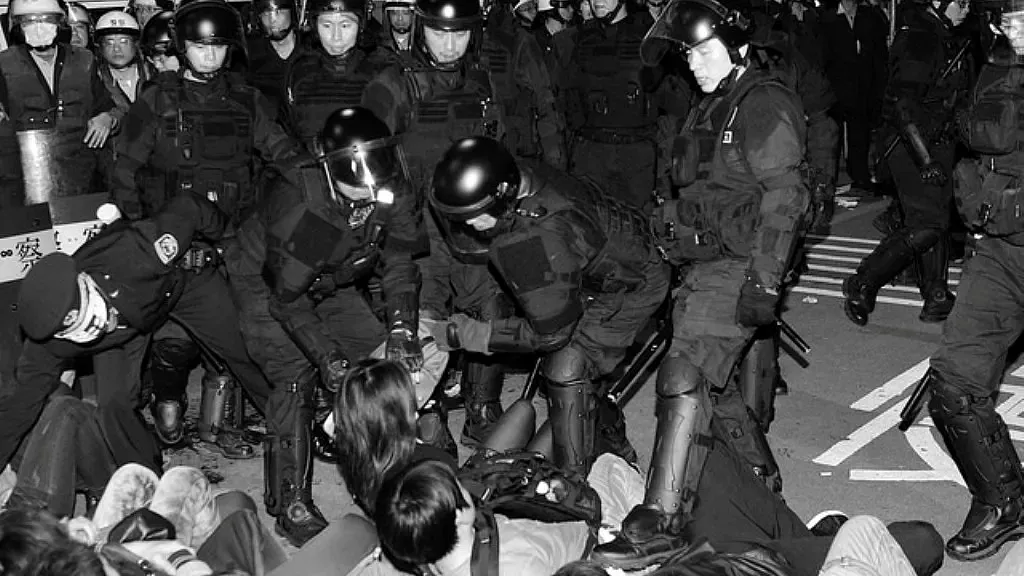
After the movement ended, participants in both the March 18 occupation of the Legislative Yuan and the March 23 occupation of the Executive Yuan faced criminal proceedings. The March 18 defendants were acquitted at both the first and second instances. In the March 23 case, charges against many participants were withdrawn; 11 defendants were convicted at first instance, and on appeal seven defendants who had initially been acquitted were convicted of inciting another to commit an offense and trespass. The case then reached the Supreme Court.
On December 25, 2020, the Supreme Court heard oral argument in the March 23 Executive Yuan Occupation Case and invited academic experts to present their views. Judgment was scheduled for 10:00 a.m. on January 18, 2021.
Defense Arguments
The defense argued that Article 153 of the Criminal Code could not survive constitutional review under the principles of legal certainty, proportionality, and equality.
-
On legal certainty, the defense argued that Article 153 uses terms whose boundaries are unclear. What degree of "incitement" is required before speech is capable of misleading others? Criminal prohibitions must be understandable and foreseeable to those subject to them. Yet people have independent judgment, making it difficult to establish an objective and uniform enforcement standard for when speech actually produces an inciting effect. Attorney Yu Po-Hsiang also noted that law students spend years studying the concept of a criminal offense; for members of the general public, "offense" is not necessarily a self-defining term.
-
On proportionality, the defense argued that a criminal prohibition must protect a specific legal interest consistent with constitutional values. Article 153 is said to protect public order. Drawing on Professor Hsu Wei-Chuan's account of the provision's legislative history, however, the defense argued that the "public order" at issue was historically less about peaceful relations among individuals than about preserving the absolute operation of state power-an authoritarian objective in tension with democratic constitutionalism.
-
On equality, the defense pointed to situations in which inciting another to commit an offense may carry a punishment of up to two years' imprisonment even though the offense ultimately committed by the person incited is punished less severely. Incitement to gambling was offered as one example of this potential disproportionality.
The defense also challenged the lower court's application of Criminal Code Article 306. Because the trespass provision appears in the chapter protecting individual legal interests, the defense argued that a government office such as the Executive Yuan is not the kind of premises the provision was designed to protect. The Executive Yuan also has police powers available to protect government premises, making application of Article 306 unnecessary in the defense's view.
The defense further argued that the right of resistance can be derived from Article 2 of the Constitution and from popular sovereignty, and need not be expressly written into the Constitution before it can operate as a justification. At the time of the incident, the defense said, executive and legislative power had effectively converged and the constitutional democratic system had seriously malfunctioned, creating the objective circumstances for resistance. Civil disobedience, although developed in political theory, had likewise entered legal discussion because it is a distinctive form of expression and assembly.
Prosecution Arguments
On legal certainty, the prosecution relied on Judicial Yuan interpretations holding that an indeterminate legal concept is constitutionally permissible if ordinary people can understand it through textual or purposive interpretation and if courts can review its application. In the prosecution's view, the elements of Article 153, Subparagraph 1 are sufficiently clear. The prosecution also defended the Article 306 trespass conviction, arguing that the protected interest is control over premises and that unauthorized entry into government buildings is not excluded merely because the offense appears in a chapter protecting individual legal interests.
On the boundary between incitement and freedom of expression, the prosecution argued that expression may fall outside constitutional protection where it creates a clear and present danger. Given the number of protesters gathered during the movement, the prosecution maintained that the conduct created such a danger to government institutions and therefore could not be immunized simply by invoking freedom of expression.
On the right of resistance, the prosecution relied on Article 20 of the German Basic Law. It argued that resistance is available only when the constitutional order itself is being destroyed and no other legal remedies remain. The CSSTA, in the prosecution's view, involved an allegedly improper or unlawful policy measure rather than destruction of the constitutional system, while avenues such as referendums, constitutional review, and legislative scrutiny remained available.
As for civil disobedience, the prosecution characterized it as a concept primarily of political science and sociology rather than a formal criminal-law doctrine. It also emphasized the conventional understanding of civil disobedience as nonviolent action undertaken with a willingness to accept legal consequences, and argued that it should not operate here as a justification.
Views of the Academic Experts
The Supreme Court invited four academic experts to address the legal issues in the case. After each presentation, both prosecution and defense counsel questioned the expert.
-
Is Criminal Code Article 153, Subparagraph 1 Unconstitutional?
-
Professor Chou Yang-I:
-
Professor Chou distinguished two possible understandings of the legal interest protected by the incitement offense. If liability under Article 153 depends on the legal interest protected by the offense being incited-a model he described as "derivative"-the provision cannot survive constitutional review. If Article 153 instead protects an independent interest in public order, however, strict purposive interpretation of that interest may allow the provision to be applied constitutionally.
Professor Chou attempted to define the substantive content of public order as stability in the public's perception of social security. For a constitutionally narrow interpretation, he proposed three linked elements: communication of information advocating crime, the creation of a genuine association with criminal conduct, and destabilization of the public's perception of social security. If any link in that chain of influence is missing, the incitement element should not be satisfied.
-
Professor Hsu Wei-Chuan:
-
Using German law comparatively, Professor Hsu traced Article 153 to Sections 110 and 111 of the German Imperial Criminal Code, which were placed in a chapter concerning resistance to state authority. In his view, this history suggests that the "public order" protected by the offense was aimed at preserving the absolute operation of state power rather than peaceful coexistence among individuals. A criminal provision designed broadly to protect state power in that way is difficult to reconcile with popular sovereignty in a constitutional democracy.
Professor Hsu also argued that Article 153 violates legal certainty, proportionality, and equality. On legal certainty, he noted that the provision potentially reaches incitement relating to "all offenses, laws, and lawful orders," an extraordinarily broad field, while providing no workable boundary between punishable and non-punishable conduct.
Professor Hsu did not believe a restrictive interpretation could cure the problem. Concepts such as the "public" character or "common interest" embodied in public order are themselves too abstract to identify a concrete protected interest and therefore cannot provide a reliable limiting principle for the offense.
He therefore concluded that both the provision's legislative purpose and its elements raise constitutional problems and cannot be made constitutional merely through restrictive interpretation.
-
-
What Are the Requirements for the Right of Resistance and Civil Disobedience, and Can Either Justify Conduct or Mitigate Criminal Liability in an Individual Case?
-
Professor Chang Chia-Yin:
-
Professor Chang considered the protest conduct to go beyond conventional civil disobedience and argued that the constitutional right of resistance was the more appropriate framework. He identified three requirements for exercising that right:
- An urgent constitutional crisis, including an imminent constitutional crisis;
- No other available means of relief, making resistance necessary; and
- Resistance may involve otherwise unlawful means, but those means remain subject to proportionality.
Even if the March 23 occupation were treated as an exercise of the right of resistance, Professor Chang argued, it would still have to satisfy constitutional proportionality under Article 23, including examination of how serious and urgent the injustice being resisted was. He proposed a concept of a "micro-right of resistance," under which the movement could be understood as symbolic expression protected by freedom of expression, freedom of assembly, constitutional justification, and emergency self-defense, reducing the degree of unlawfulness and potentially excluding criminal liability.
-
Professor Hsu Chia-Hsin:
-
Professor Hsu did not take a position on the proper outcome of the case. He cited John Rawls's definition of civil disobedience as a public, nonviolent, conscientious, yet political act contrary to law, ordinarily undertaken to bring about a change in law or government policy. That definition presupposes a general duty to obey law, including laws regarded as unjust; civil disobedience is therefore directed at laws or policies that seriously and manifestly infringe basic liberty or equality.
On the means used in civil disobedience, Professor Hsu drew on Ronald Dworkin's discussion of coercive strategies-creating obstacles to implementation of a law or policy in order to force the government to retreat. Because such pressure bypasses ordinary channels of democratic deliberation, it is difficult to justify. Judicial practice therefore rarely accepts civil disobedience itself as a justification, although the degree of substantive unlawfulness may still affect liability. Professor Hsu did not expressly state whether he agreed with that approach.
On the right of resistance, Professor Hsu agreed that it is grounded in popular sovereignty and can exist without express constitutional text, but emphasized that its requirements are strict. An individual unconstitutional law or measure does not by itself create the emergency required for resistance. If an actor mistakenly believes those requirements are satisfied, the issue may instead be treated as a mistake as to unlawfulness, potentially mitigating or excluding criminal responsibility.
-
Reflections
On the Supreme Court's Management of the Hearing
As a third-year university student who had already begun studying criminal procedure, I was surprised by the presiding judge's case management at the outset. The judge said he hoped to finish the entire hearing that afternoon. Yet, as the defense clarified on the record, the pre-hearing notice had scheduled the academic experts' presentations for January 4, so several defense attorneys and experts had not kept that afternoon free. The prosecution even suggested that one defense attorney could remain as a representative. Attorney Yu responded that, with other attorneys absent, there was no basis to select a single representative, and the proceeding was ultimately able to continue.
What Is "Public Order"?
Before the Supreme Court hearing, I watched several documentaries about the anti-CSSTA movement to better understand the background to the Sunflower Movement. In 2014 I was still in junior high school. I did not understand the movement in depth and knew little about the contents of the trade agreement, but the news was filled with protests and government responses, so I was at least aware that something major was happening. At the time, however, I felt little personal connection to the consequences of the agreement and viewed it largely from a distance.
I had also never encountered Criminal Code Article 153 in my substantive criminal-law courses. Preparing for this court observation led me to search for related materials, and I found relatively little scholarship on the offense of inciting another to commit an offense. Most of the sustained discussion appeared only after the Sunflower Movement and focused, unsurprisingly, on the legal interest protected by the offense and its legislative purpose.
What, then, does the incitement offense actually protect? Professor Chou's attempt to define "public order" left the strongest impression on me. He described the protected interest as stability in the public's perception of social security. But Attorney Yu had earlier argued that, because people have independent judgment, it is difficult to create an objective enforcement standard for determining when speech actually incites others. If the same concern is applied to the public's perception of social stability, how is a court to determine when anxiety about social order reaches a level that affects people's willingness to interact with one another? To me, the explanation remained abstract.
During oral argument, Attorney Yu raised a related question. If the protected interest is the public's sense that social security and the criminal-law order are functioning effectively, then every crime arguably shakes public confidence in that order. Would that mean every criminal act could potentially implicate the incitement offense?
Professor Chou responded that the incitement offense operates doctrinally as a "protective norm" that supports the effectiveness of primary criminal prohibitions, but through a different pathway of harm. Primary prohibitions address physical forms of infringement such as homicide, assault, or theft; a protective norm such as the incitement offense operates through communicative effects on the public-for example, advocacy of killing that causes fear. Even so, I was not fully persuaded that defining the protected interest as the public's sense of social security avoids an excessively broad scope.
The Clash of Arguments
The exchanges among the bench, prosecution, and defense produced a genuinely engaging debate over the limits of state power and its relationship to individual rights. I hope to observe-and perhaps one day take part in-more discussions of this kind.
This article is an AI-generated translation of the original Chinese text. In the event of any discrepancy, the Chinese version shall prevail.