
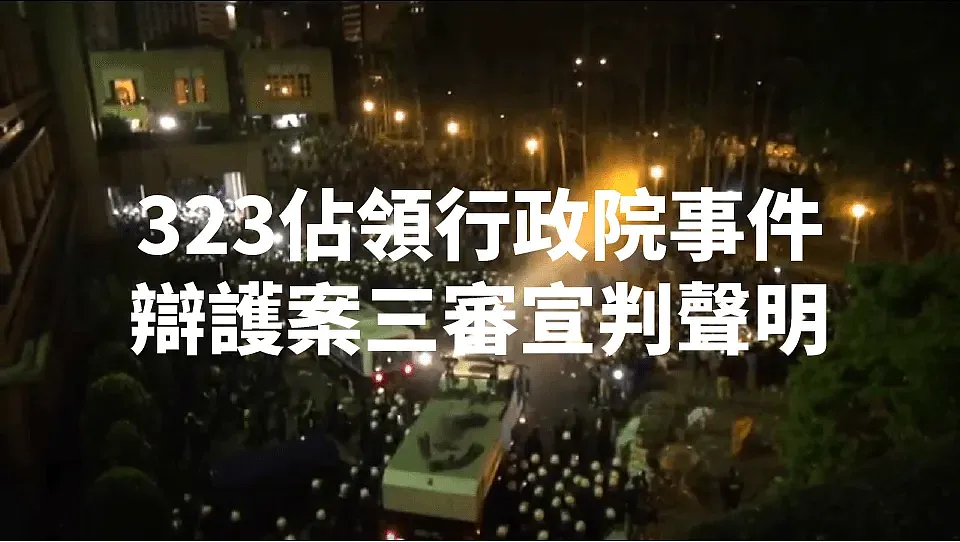
Statement on the Supreme Court Judgment in the March 23 Executive Yuan Occupation Case
Last edited: 2026-08-29
Today, the Criminal Division of Taiwan's Supreme Court delivered its third-instance verdict on the March 23 Executive Yuan Occupation case. The Supreme Court decided to revoke the original judgment and remand the case to the High Court for retrial.
The defense team affirms the Supreme Court's willingness to squarely face the complexity of the legal issues involved in this case, to grant the defendants' request for oral argument in court, and to allow four experts the opportunity to appear before the Supreme Court to provide professional legal opinions regarding the crime of incitement, civil disobedience, and the right of resistance, respectively.
However, the pro bono defense team expresses regret that the Supreme Court did not accept the defense's submission to suspend the trial and petition the Judicial Yuan Grand Justices for a constitutional interpretation regarding Article 153 of the Criminal Code concerning the crime of inciting others to commit offenses. This case could have served as a prime opportunity, more than thirty years after Taiwan's democratization, to look back and review the authoritarian remnants lingering in our Criminal Code. Whether considering Article 153 of the Criminal Code—"the crime of inciting others to commit offenses"—in light of the defense team's citations of numerous Judicial Yuan interpretations pointing out how this provision violates the principle of clarity, the principle of proportionality, and the principle of equality, or through the experts' comparative law research discovering that this offense fundamentally protects the absoluteness of state power functions, it is clear that the unconstitutionality of this offense is manifest. Even the prosecutor from the Supreme Prosecutor's Office present at the hearing urged the collegiate bench during oral argument to suspend the trial and petition for a constitutional interpretation. Yet, the Supreme Court merely opted for a constitutional interpretation rather than petitioning for one. While the defendants in this case still have the opportunity to assert their rights in the High Court, this offense has missed a fundamental opportunity to review the justification of its existence, which is deeply regrettable.
Nearly seven years have passed since the March 23 Executive Yuan Occupation event. Through the litigation of these past years, the defendants and the defense team have sought to carve out more space for Taiwan's democracy and rule of law. As this case is still ongoing, we hope that the High Court will squarely face the significance of this case in constitutional and legal history, and interpret and apply the provisions concerning the crime of inciteful acts, civil disobedience, and the right of resistance in a manner consistent with constitutional intent.
The defense team will continue to accompany the defendants through this long and arduous road. We sincerely hope that Taiwan can continue to move toward a sounder and deeper democratic state governed by the rule of law.
Verdict List
| Charged Offense | Name | First-Instance Verdict | Second-Instance Verdict | Third-Instance Verdict |
| Damaging Property Entrusted to a Public Official | Li Kuan-Ling | Imprisonment for 4 months, commutative to a fine | Appeal dismissed | All revoked and remanded |
| Hsu Shun-Chih | Imprisonment for 4 months, commutative to a fine | Imprisonment for 2 months for the incitement portion, commutative to a fine (to be executed concurrently with the offense of damaging property entrusted to a public official for a total of 5 months) | ||
| Inciting Others to Commit Offenses | Wei Yang | Not guilty | Imprisonment for 4 months, commutative to a fine | |
| Chen Ting-Hao | Not guilty | Imprisonment for 4 months, commutative to a fine | ||
| Chiang Ping-lun | Not guilty | Imprisonment for 3 months, commutative to a fine | ||
| Liu Ching-Wen | Not guilty | Imprisonment for 2 months, commutative to a fine | ||
| Lin Chien-Hsing | Not guilty | Imprisonment for 3 months, commutative to a fine | ||
| Ko Ting-Yu | Not guilty | Imprisonment for 2 months, commutative to a fine |
Attachments
Press Contact
Attorney Li Ming-ju, Staff Attorney, Judicial Reform Foundation
Today, the Criminal Division of the Supreme Court delivered judgment in the third-instance proceedings arising from the March 23 Executive Yuan occupation. The Supreme Court vacated the lower-court judgment and remanded the case to the Taiwan High Court.
The defense team welcomes the Supreme Court's willingness to confront the complexity of the legal issues, grant the defendants' request for oral argument, and hear four academic experts address the incitement offense, civil disobedience, and the right of resistance.
At the same time, the pro bono defense team regrets that the Supreme Court declined to stay the proceedings and seek a constitutional interpretation of Criminal Code Article 153, which punishes inciting another to commit an offense. More than 30 years after Taiwan's democratization, this case offered an important opportunity to reexamine an authoritarian-era remnant in the Criminal Code. The defense relied on multiple Judicial Yuan interpretations to argue that Article 153 violates legal certainty, proportionality, and equality; comparative-law analysis presented by experts likewise suggested that the offense historically protected the absolute operation of state power. Even the prosecutor from the Supreme Prosecutors Office urged the panel at oral argument to stay the case and seek constitutional review. The Supreme Court instead adopted a constitutionally conforming interpretation without referring the question to the Grand Justices. Although the defendants may continue asserting their rights after remand, the opportunity for a fundamental review of the offense's constitutional legitimacy has been missed, which the defense team deeply regrets.
Nearly seven years have passed since the March 23 Executive Yuan occupation. Through years of litigation, the defendants and defense team have sought to create greater space for democracy and the rule of law in Taiwan. Because the case remains pending, we hope the Taiwan High Court will confront its significance in Taiwan's constitutional and legal history and interpret the incitement offense, civil disobedience, and the right of resistance consistently with constitutional principles.
The defense team will continue to stand with the defendants through the remainder of this long process. We hope Taiwan will continue moving toward a stronger and deeper constitutional democracy governed by the rule of law.
Disposition by Defendant
| Charge | Defendant | First Instance | Second Instance | Third Instance |
| Damaging Property Entrusted to a Public Official | Li Kuan-Ling | Four months' imprisonment, commutable to a fine | Appeal dismissed | All challenged portions vacated and remanded |
| Hsu Shun-Chih | Four months' imprisonment, commutable to a fine | Two months' imprisonment for the incitement offense, commutable to a fine; combined with the property-damage offense for an aggregate sentence of five months | ||
| Inciting Another to Commit an Offense | Wei Yang | Not guilty | Four months' imprisonment, commutable to a fine | |
| Chen Ting-Hao | Not guilty | Four months' imprisonment, commutable to a fine | ||
| Chiang Ping-Lun | Not guilty | Three months' imprisonment, commutable to a fine | ||
| Liu Ching-Wen | Not guilty | Two months' imprisonment, commutable to a fine | ||
| Lin Chien-Hsing | Not guilty | Three months' imprisonment, commutable to a fine | ||
| Ko Ting-Yu | Not guilty | Two months' imprisonment, commutable to a fine |
Attachment
Press Contact
Lee Ming-Ju / Staff Attorney, Judicial Reform Foundation
This article is an AI-generated translation of the original Chinese text. In the event of any discrepancy, the Chinese version shall prevail.