
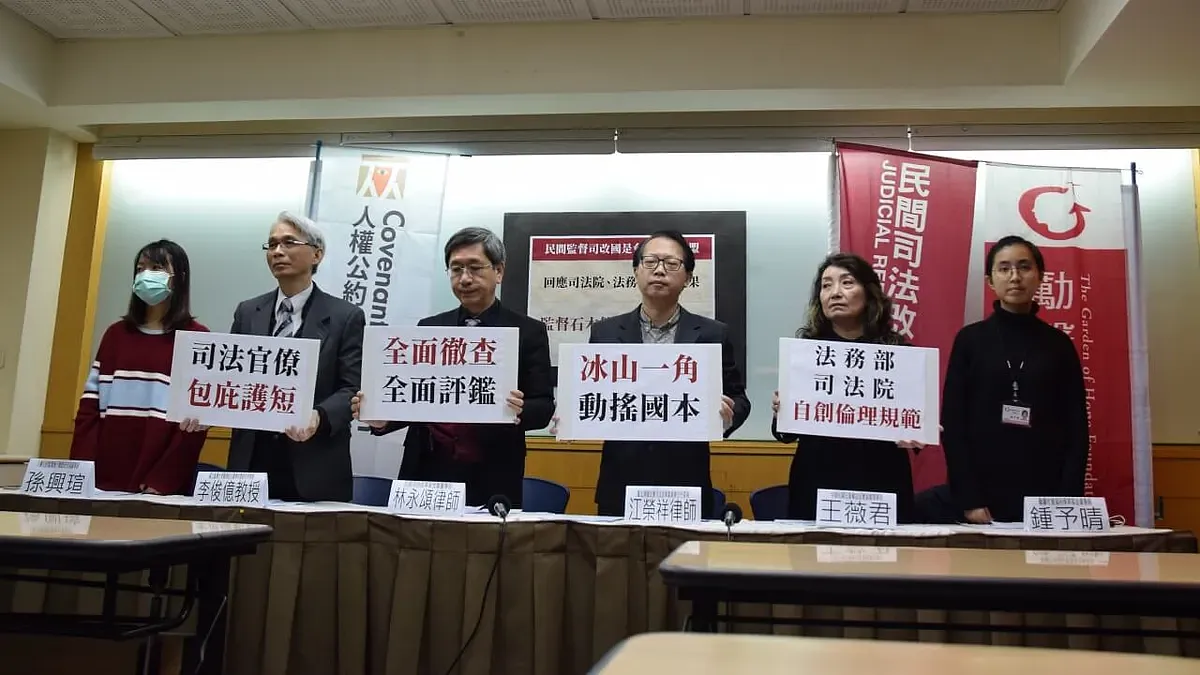
The Tip of the Iceberg: Comprehensive Investigation and Evaluation Needed - Shih Mu-Chin Monitoring Press Conference III
Last edited: 2026-08-29
The Judicial Yuan and Ministry of Justice today released their second administrative investigation reports on the Shih Mu-Chin case, exposing serious problems involving improper ties between members of the judiciary and powerful business interests. Everyone understands that what has emerged is only the tip of the iceberg-and that it does not mean every member of the judiciary is untrustworthy. But unless the government manages the crisis responsibly and undertakes forceful reform, the public confidence in the judiciary that had gradually recovered after President Tsai Ing-Wen convened the 2017 National Conference on Judicial Reform could collapse again.
To restore public confidence in the judiciary, the coalition makes the following demands:
-
The President of the Judicial Yuan and the Minister of Justice should publicly apologize both to the public and to conscientious judicial personnel who have faithfully performed their duties, and explain how the judiciary will strengthen professional supervision and ethical self-regulation.
-
The Judicial Yuan and Ministry of Justice should turn over to the Control Yuan all evidence and case files from the two "Ta" investigation dockets, together with all 27 notebooks, for a comprehensive investigation focusing on the following questions:
- Did the individuals who purchased shares in companies associated with Weng Mao-Chung actually pay for those shares?
- Did anyone involved in judicial cases concerning Weng Mao-Chung accept bribes or render judgments contrary to law?
- Beyond the 20 people investigated by the Judicial Yuan and the 20 investigated by the Ministry of Justice, did other individuals recorded in the notebooks violate applicable ethical rules?
-
The Legislative Yuan should promptly amend the Judges Act, drawing on international standards to establish a comprehensive evaluation mechanism for judges and prosecutors and strengthen external oversight.
The judicial crisis triggered by the Shih Mu-Chin case is both a threat to judicial reform and an opportunity for it. The coalition will continue monitoring implementation of the National Conference on Judicial Reform and pressing for a judiciary worthy of public trust.
Post-Press-Conference Release
At 2:30 p.m. today, the Civil Society Coalition for Monitoring Implementation of the National Conference on Judicial Reform held the third press conference in its Shih Mu-Chin monitoring series at the National Taiwan University Alumni Club, responding to the investigation reports released by the Ministry of Justice and Judicial Yuan.
Joseph Lin, Chairperson of the Judicial Reform Foundation, said the reports released today by the Judicial Yuan and Ministry of Justice reveal only the tip of the iceberg. More than 50 judges and prosecutors appear in the reports, many of them senior officials who previously enjoyed strong professional reputations. The extent of the misconduct makes it difficult for the public to maintain confidence in the judiciary. Lin argued that today's press releases and press conferences minimized numerous issues and showed little commitment to meaningful reform, relying instead on earlier legislative amendments as a response. The National Police Agency, Ministry of the Interior, had not released any investigation report at all. Lin therefore made the following calls:
- Compared with the 2010 corruption scandal involving six court presidents that led to the resignation of the President of the Judicial Yuan, this case involves more than 50 senior officials and is even more serious. The President of the Judicial Yuan and Minister of Justice should apologize to the public and to diligent rank-and-file judicial personnel, rather than treating the matter as lightly as they did at today's press conference.
- During pending litigation, a wealthy businessman could meet directly with a presiding judge of an administrative court or dine at a chief prosecutor's home. That necessarily raises questions: were the benefits connected to cases those officials were handling? Was there criminal liability? Had limitation periods expired? Even if they had, should administrative discipline be more severe? The Judicial Yuan and Ministry of Justice have not explained how these cases will be reinvestigated. They should not allow potential misconduct simply to be written off.
- When the Control Yuan investigated the Shih Mu-Chin case, it did not receive all 27 of Weng's notebooks; it received only the material concerning Shih Mu-Chin. Without those notebooks, much of this conduct would never have come to light. The Taipei District Prosecutors Office holds more than 130 volumes in two "Ta" investigation dockets, but the Control Yuan did not review all of them in its earlier investigation. The coalition asks the Control Yuan to require the prosecutors office to turn over the complete record for a thorough investigation.
- The National Police Agency should publish its investigation report and conduct a comprehensive investigation.
Joseph Lin noted that when JRF was founded 25 years ago, one of its earliest slogans was "Against Corruption, Against Interference, Against Slipshod Adjudication." Having to call for anti-corruption reform again 25 years later is a painful irony. When the coalition met President Tsai Ing-Wen on March 27 of the previous year, the President emphasized that if the judiciary cannot deal properly with internal discipline and misconduct-and problems instead come to light only through outside evaluations or Control Yuan impeachment-then no amount of judicial-reform legislation will persuade the public that reform is real.
Attorney Chiang Jung-Hsiang, Chair of the Judicial Reform Committee of the Taipei Bar Association, warned that if the Judicial Yuan and Ministry of Justice create overly lenient standards or use limitation periods to dispose of misconduct casually, the last line of defense for judicial ethics will keep retreating. Proceedings against Shih Mu-Chin before the Court of the Judiciary were then closed to the public, making their progress difficult to understand. Chiang called on the Court of the Judiciary to exercise its authority to open the proceedings. Although the Control Yuan, as a party, had no expressly stated statutory right to demand an open hearing, a request for openness should at least require the Court to assess whether public proceedings are necessary under a clear standard. Given the gravity and public importance of the Shih Mu-Chin case, it should be examined in the sunlight if public confidence in the judiciary is to be restored.
Professor Li Chun-I of National Taiwan University's Graduate Institute of Forensic Medicine likewise expressed dismay. Many names disclosed by the Ministry of Justice belonged to people once regarded as outstanding members of the profession. "Even elementary-school students know they shouldn't accept entertainment or gifts, yet these people did so again and again," he said. "I'm not a lawyer, so I looked at the Constitution. Article 16 says the people have the right of litigation. How can the government assure people that judicial officers who accepted this kind of hospitality can still adjudicate impartially?" Li recalled that, as a member of the first group of the National Conference on Judicial Reform, he had worked on improving forensic science so that scientific evidence could prevent wrongful convictions and strengthen confidence in adjudication. The current scandal made those reform efforts feel hollow. He criticized the Ministry of Justice report for treating fewer than five instances of entertainment as essentially inconsequential. Because most judicial personnel work conscientiously, he argued, Taiwan needs both a comprehensive evaluation mechanism and systematic ethics education capable of identifying the small number who seriously undermine the institution.
Wang Wei-Chun, Chairperson of the Association for Rights Promotion of Children, R.O.C., said that in her work supporting crime victims, clients sometimes asked whether judges failed to take their cases seriously because no money had changed hands. She had always reassured them that this belonged to the judiciary of the past. "It turns out I have to take that back-things can still be this outrageous. How unfair is that to all the judicial officers who work conscientiously and follow the rules?" She called on the President and the Control Yuan to scrutinize the officials involved under the strictest standards.
Every major judicial-integrity scandal seriously damages public confidence. If the aftermath consists of officials protecting one another or declining to investigate fully, the resulting harm is compounded. Rank-and-file judicial personnel already work under heavy caseloads and intense public scrutiny. It is unacceptable for them to face even greater suspicion because of ethical failures by senior officials while the Judicial Yuan and Ministry of Justice appear to avoid the most serious issues.
The coalition therefore calls for a comprehensive evaluation system capable of identifying serious misconduct more effectively and will continue monitoring the investigation and subsequent handling of this case.
Attendees
Joseph Lin / Chairperson, Judicial Reform Foundation
Chiang Jung-Hsiang / Chair, Judicial Reform Committee, Taipei Bar Association
Li Chun-I / Professor, Graduate Institute of Forensic Medicine, National Taiwan University
Wang Wei-Chun / Chairperson, Association for Rights Promotion of Children, R.O.C.
Sun Hsing-Hsuan / Specialist, Covenants Watch
Sun Chih-Yu / Specialist, Garden of Hope Foundation
Chung Yu-Ching / Specialist, Garden of Hope Foundation
Press Contact
Hsiao I-Min / Office Director, Judicial Reform Foundation
This article is an AI-generated translation of the original Chinese text. In the event of any discrepancy, the Chinese version shall prevail.