
Briefing Paper on Parallel Pilots of the Lay-Judge and Jury Systems (Archived)
Last edited: 2026-08-29
Much of Taiwan's current Code of Criminal Procedure was designed on the assumption that professional judges conduct criminal trials, and judges, prosecutors, and defense counsel are accustomed to operating within that framework. Whether Taiwan adopts a lay-judge system or a jury system, bringing ordinary citizens into criminal adjudication will therefore raise many questions. Some can be informed by experience abroad; others can be answered only through local pilots, evaluation, and adjustment.
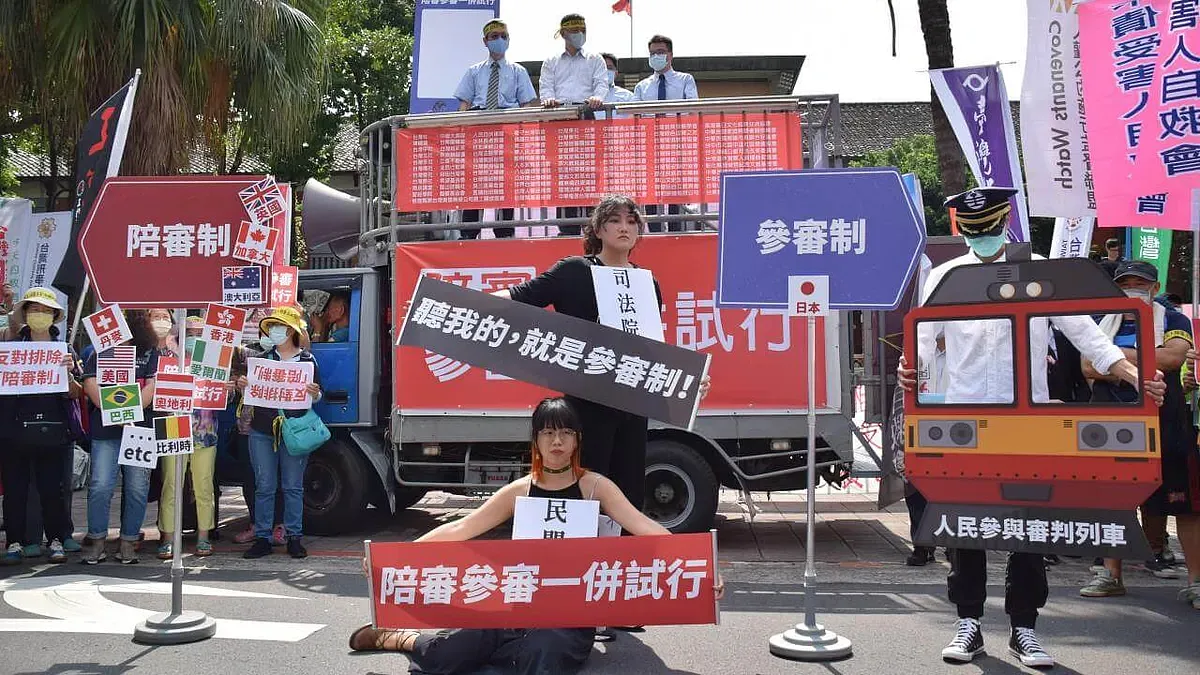
Around 2010, the Judicial Yuan strongly promoted the "citizen observer" system (觀審制)-criticized as "you can watch, but you cannot decide" and "you may speak, but your view does not count." JRF opposed the argument that Taiwan should simply "get something in place first and improve it later." Public participation in trials was unfamiliar to Taiwan; if the first pilot were seriously flawed or ill-suited to local conditions, the public might lose confidence in the reform altogether. The problematic observer system was ultimately stopped.
The space Taiwan has today to debate either a lay-judge system or a jury system was created through sustained civil-society advocacy in the face of official resistance. The goal is to change a judicial structure in which professional judges have historically monopolized adjudicative power, give citizens a meaningful role in deciding cases, protect liberty, and deepen democracy.
-
The Judicial Yuan's Draft Act on Citizen Participation in Criminal Trials Lacks Local Empirical Support
The lay-judge and jury models have long had substantial support, with opinion polls and discussions at the National Conference on Judicial Reform showing no decisive consensus. Jury supporters worry that adopting only the Japanese-style lay-judge model favored by the Judicial Yuan would leave citizen judges vulnerable to deference to judicial authority in Taiwan's highly hierarchical judicial culture. Supporters of the lay-judge model, by contrast, worry that the jury system's simplified form of verdict could complicate appeals. Neither system is perfect, and without local empirical experience Taiwan cannot know which model is better suited to its own conditions.
The Legislative Yuan's extraordinary session was scheduled from June 29 through July 22, with the Act on Citizen Participation in Criminal Trials set for review even though more than one-quarter of its key provisions remained unresolved. At this institutional crossroads, the Judicial Yuan's draft contemplated a six-year effectiveness-evaluation period. Because the lay-judge and jury systems each have strengths and weaknesses, piloting both for the same six years would create a meaningful comparison and provide evidence for deciding how the system should be revised afterward.
Taiwan has too often selected legal institutions by following the countries where influential scholars happened to study rather than by relying on empirical evidence. The choice of a public-participation model for criminal trials deserves a more careful approach.
-
Problems with the Judicial Yuan's Draft Act on Citizen Participation in Criminal Trials
Civil-society groups were concerned that addressing legislation of this magnitude during an extraordinary legislative session was excessively rushed. The Judicial Yuan's draft largely followed the Japanese lay-judge model and, in the coalition's view, created several serious problems. The following discussion proceeds in the order of the criminal trial process:
Figure / Procedure for Criminal Trials with Citizen Participation- Preparation: the judge, prosecutor, and defense identify the charges, disputed issues, and evidence that will be presented at trial.
- Selection: the judge, prosecutor, and defense question candidate citizen judges and select the people who will serve.
- Pretrial Instructions: the judge explains the trial procedure and relevant legal concepts to the citizen judges.
- Opening Statements and Defense: the prosecution explains why it believes the defendant is guilty, and the defense explains why it believes the defendant is not guilty.
- Presentation of Evidence: physical and documentary evidence is introduced, relevant witnesses are called, and prosecution and defense counsel question them in turn.
- Oral Argument: prosecution and defense counsel address the evidence and witness testimony.
- Final Statement: before deliberation, the defendant is given an opportunity to speak.
- Deliberation
- Lay-Judge Model: professional judges and citizen judges deliberate together on guilt, acquittal, and sentencing.
- Jury Model: the judge gives legal instructions before deliberation; jurors then deliberate independently on guilt or acquittal. If the defendant is found guilty, the judge determines the sentence.
- Pronouncement of Judgment
Scope of Application
Issue 1: The Judicial Yuan's Draft Covers Too Few Cases to Achieve the Purpose of Citizen Participation
The Judicial Yuan's draft defined the lay-judge system's scope primarily by statutory penalty. Limiting citizen-participation trials to offenses carrying a minimum statutory sentence of at least ten years' imprisonment would produce only about 600 cases per year based on historical court statistics-roughly two or three cases per court each month. The scope could therefore be expanded so that Taiwan could accumulate enough local experience to evaluate the system meaningfully.
A central purpose of public participation in trials is to strengthen public confidence in the judiciary. Yet many cases that have generated the greatest controversy or distrust involve political sensitivity-such as corruption, vote-buying, or assembly-and-procession cases-or otherwise serious criminal exposure. If such cases remain exclusively within the lay-judge model, the coalition argued, proceedings may still be strongly shaped by judicial authority and may fail to achieve the reform's intended purpose.
Comparison of Provisions on Scope of Application Civil Society Proposal Judicial Yuan and Executive Yuan Proposals Article 5 (Lay-Judge System) Except for juvenile criminal cases and offenses under the Narcotics Hazard Prevention Act, the following first-instance cases prosecuted by a prosecutor and under the jurisdiction of the district court shall be subject to trials with citizen participation:
1. Offenses with a minimum statutory penalty of seven years or more of imprisonment.
2. In addition to the circumstances in the preceding subparagraph, intentional crimes resulting in death.
The offenses referred to in the preceding paragraph shall be determined by the criminal facts and statutory provisions recorded in the indictment.
If a prosecutor does not prosecute an offense specified in the first paragraph, but the court, prior to the first trial date, deems that the statutory provisions should be changed to an offense under the first paragraph, it shall rule to conduct a trial with citizen participation.
The provisions of Article 265 of the Code of Criminal Procedure shall not apply to cases undergoing citizen participation trials.
For cases subject to citizen participation trials where the defendant has not retained a defense counsel, the presiding judge shall appoint a public defender or attorney.Article 5-1 (Jury System) Where a prosecutor charges any of the following offenses, the case shall be tried under the jury system: (2019 district-court case statistics)
1. Paragraph 1 of Article 271 and Paragraph 1 of Article 272 of the Criminal Code
2. Anti-Corruption Act
3. Article 135 of the Criminal Code on Offenses against Public Functionaries
4. Articles 29 to 31 of the Assembly and Procession Act
5. Chapter on Offenses against Elections and Referendums of the Public Officers Election and Recall Act
6. Chapters on Offenses of Internal and External Security of the Criminal Code and the Anti-Infiltration Act
If a case falls within both the preceding paragraph and the scope of the lay-judge system, the jury system shall apply.
The offenses under the first paragraph shall be determined by the criminal facts and statutory provisions stated in the indictment. If the prosecutor has not charged an offense listed in the first paragraph but, before the first trial date, the court concludes that the applicable statutory provision should be changed to one listed there, the court shall order the case to proceed as a jury-model citizen-participation trial. Articles 163(2), 265, 267, and 300 of the Code of Criminal Procedure shall not apply to jury-model citizen-participation trials. If the defendant has not retained counsel, the presiding judge shall appoint a public defender or attorney.Article 5 Except for juvenile criminal cases and offenses under the Narcotics Hazard Prevention Act, the following first-instance cases prosecuted by a prosecutor and under the jurisdiction of the district court shall be subject to trials with citizen participation:
1. Offenses with a minimum statutory penalty of ten years or more of imprisonment.
2. In addition to the circumstances in the preceding subparagraph, intentional crimes resulting in death.
The offenses in the preceding paragraph shall be based on the criminal facts and statutory provisions recorded in the indictment. If a prosecutor does not prosecute under the cases specified in the first paragraph, and the court, prior to the first trial date, deems that the statutory provisions should be changed to an offense under the first paragraph, it shall rule to conduct a citizen participation trial.
The provisions of Article 265 of the Code of Criminal Procedure shall not apply to cases undergoing citizen participation trials.
For cases subject to citizen participation trials where the defendant has not retained a defense counsel, the presiding judge shall appoint a public defender or attorney.
(The Executive Yuan holds a different opinion)Selection Stage
Issue 2: The Procedure for Selecting Citizen Judges and Alternates Is Not Rigorous Enough and May Affect Trial Quality
First, the official draft did not require trial to begin immediately after citizen judges were selected. In practice, an undefined interval between selection and trial could expose citizen judges to media coverage or other outside information that affects their views of the case.
Second, the civil-society proposal would select only the combined number of citizen judges and alternates at the outset, without identifying who is an alternate; alternates would be drawn only after closing argument. Under the Judicial Yuan draft, by contrast, alternates would know their status before trial. That knowledge could reduce attentiveness, creating serious concerns if an alternate later had to replace a citizen judge and participate in deliberations.
Comparison of Provisions on Selection of Alternate Citizen Judges Civil Society Proposal Judicial Yuan and Executive Yuan Proposals Article 29 After carrying out the procedures of the preceding two articles, the court shall draw lots from among the candidate citizen judges who appear in court and have not been subject to a non-selection ruling to select the total number of citizen judges and alternate citizen judges based on either the lay-judge system or jury system.
After the close of oral arguments and prior to deliberations, the court shall draw lots to select alternate citizen judges and assign their replacement sequence numbers.Article 29 After carrying out the procedures of the preceding two articles, the court shall draw lots from among the candidate citizen judges who appear in court and have not been subject to a non-selection ruling to select six citizen judges and the required number of alternate citizen judges. After alternate citizen judges are selected, their replacement sequence numbers shall be assigned. Evidence Stage
Issue 3: Without Adequate Rules for Documentary Evidence, the Principle of Immediacy Cannot Be Realized and the Defendant's Right of Defense Is Put at Risk
In criminal trials, documentary evidence includes materials such as investigative interview records, medical injury certificates, and expert reports. As a general rule, statements recorded during investigation should be tested by calling the declarant to court for cross-examination, while an expert report should ordinarily be tested by calling the expert witness. The way documentary evidence is examined is therefore central to fact-finding and a fair trial.
The Judicial Yuan draft, however, still relied largely on "presenting" documents and "stating their gist." In practical terms, reading an investigative record aloud or orally summarizing the gist of an expert report to citizen judges could count as completing the evidentiary examination.
The failure to implement the principle of immediacy in trials before professional judges had already been identified as one cause of wrongful convictions. With citizen judges who have less courtroom experience, relying on indirect presentation of investigative records and expert reports would create an even greater risk of undermining the defendant's right of defense.
Comparison of Provisions on Documentary Evidence Civil Society Proposal Judicial Yuan and Executive Yuan Proposals Article 66 For the examination of physical evidence, the parties shall request that the maker, holder, expert witness, or other relevant person connected to the evidence be summoned to court for cross-examination.
Physical evidence whose investigation is applied for by a party or defense counsel shall be presented by the applicant to the citizen participation trial court, opposing party, defense counsel, or assistant for recognition.
Physical evidence investigated ex officio by the court shall be presented by the presiding judge to the citizen participation trial court, parties, defense counsel, or assistant for recognition.
If the physical evidence referred to in the preceding two paragraphs is a document and a party or defense counsel does not understand its meaning, the applicant or presiding judge shall also inform them of the gist.Article 73 Physical evidence whose investigation is applied for by a party or defense counsel shall be presented by the applicant to the citizen participation trial court, opposing party, defense counsel, or assistant for recognition.
Physical evidence investigated ex officio by the court shall be presented by the presiding judge to the citizen participation trial court, parties, defense counsel, or assistant for recognition.
If the physical evidence referred to in the preceding two paragraphs is a document and a party or defense counsel does not understand its meaning, the applicant or presiding judge shall also inform them of the gist.Article 67 Except for Article 159-3 and Article 159-5, Paragraph 1 of the Code of Criminal Procedure, both parties shall apply for the summoning of the declarants of transcripts during investigation-including the defendant, co-defendant, witness, informant, victim, and interested persons-to accept cross-examination in court.
Investigative transcripts under Article 159-3 and Article 159-5, Paragraph 1 of the Code of Criminal Procedure shall be read aloud or notified of their gist in court by the applicant.
For the examination of expert reports and other documents, the parties shall request that the maker, holder, expert witness, or other relevant person connected to the report or document be summoned to court for cross-examination.Article 74 Transcripts and other documents that can serve as evidence whose investigation is applied for by a party or defense counsel shall be read aloud by the applicant to the citizen participation trial court, opposing party, defense counsel, or assistant. Where such documents are investigated ex officio by the court, the presiding judge shall read them aloud to the citizen participation trial court, parties, defense counsel, or assistant. In the circumstances of the preceding two paragraphs, after consulting the opinions of the parties and defense counsel and deeming it appropriate, the presiding judge may solely inform them of the gist. Documents under the first and second paragraphs concerning public morals, public safety, or carrying a risk of damaging others' reputations shall be made available for review by the citizen participation trial court, parties, defense counsel, or assistant, and shall not be read aloud; if a party or defense counsel does not understand their meaning, the applicant or presiding judge shall also inform them of the gist. Interim Discussion Stage
Issue 4: Importing Japan's Interim-Discussion Procedure Risks Allowing Judicial Authority to Shape Citizen Judges' Views
In a jury system, judges and jurors-and jurors among themselves-do not discuss the merits before deliberations begin. The purpose is to preserve each juror's independent judgment. The Judicial Yuan draft, drawing on the Japanese lay-judge model, retained an interim-discussion procedure. Because those discussions can involve factual findings and application of law to fact and may occur behind closed doors, they create a substantial risk that citizen judges' views will be shaped by the authority of professional judges, undermining the purpose of citizen participation.
Deliberation Stage
Issue 5: Deliberation Is Especially Vulnerable to the Authority Effect, and Professional Judges Have Incentives to Steer Citizen Judges Toward Their Own Conclusions
The central difference between the jury and lay-judge models is that jurors deliberate independently on whether the defendant committed the offense, without judges participating in that discussion. Under the lay-judge model, professional judges and citizen judges deliberate together on guilt and sentencing. The principal concern is that citizen judges may defer to professional judges' legal authority rather than exercise genuinely independent judgment.
The same risk exists during deliberation as during interim discussions. Under the Judicial Yuan draft, professional judges would also remain responsible for writing the judgment, creating an additional incentive to steer deliberations toward the judges' own conclusions so that the written judgment is easier to prepare. The coalition therefore regarded deliberation quality as a particularly serious concern.
Effectiveness Evaluation Stage
Issue 6: An Evaluation Committee Dominated by Legal Professionals Cannot Adequately Incorporate Non-Lawyer Perspectives
Under the Judicial Yuan draft, representatives of the Judicial Yuan, Ministry of Justice, judges, and prosecutors alone would account for more than half of the committee charged with evaluating the citizen-participation system. The remaining seats would largely consist of scholars, experts, and public representatives selected through legal-professional channels, without any guaranteed proportion of genuinely non-legal participants. Such a structure risks excluding diverse perspectives and insulating conservative judicial assumptions from challenge.
Citizen participation is supposed to make the judiciary more accessible and build public confidence. Yet the body evaluating whether the system succeeds would have no comparison group and would still be dominated by legal professionals and government officials, without a mechanism deliberately designed to bring in outside perspectives. That makes it difficult to see how the evaluation itself could advance the goals of accessibility and trust.
Comparison of Provisions on the Composition of the Effectiveness Evaluation Committee Civil Society Proposal Judicial Yuan and Executive Yuan Proposals Article 98 The Effectiveness Evaluation Committee shall consist of 17 members, comprising 2 representatives from the Judicial Yuan, 1 representative from the Ministry of Justice, 1 judge representative, 1 prosecutor representative, 2 attorney representatives, 1 representative from each political party caucus in the Legislative Yuan, 4 legal professional scholars and experts, and 4 socially impartial figures without a legal professional background; the chairperson shall be elected mutually among the members.
Members of the Effectiveness Evaluation Committee shall serve on a pro bono basis and, except for the President of the Judicial Yuan, shall be generated prior to the enforcement date of this Act in the following manners:
1. Judicial Yuan representatives shall be designated concurrently from among its personnel by the President of the Judicial Yuan and shall step down or advance with their official positions.
2. Ministry of Justice representatives shall be designated concurrently from among its personnel by the Minister of Justice and shall step down or advance with their official positions.
3. Judge, prosecutor, and attorney representatives shall be separately nominated by the Judicial Yuan, the Ministry of Justice, and Taiwan Bar Association respectively.
4. Representatives of legal background scholars and experts and non-legal background socially impartial figures shall be recommended by civil organizations to each political party caucus of the Legislative Yuan, and each political party caucus shall independently determine one legal background scholar/expert representative and one non-legal background socially impartial figure representative.
When a committee seat becomes vacant, the President of the Judicial Yuan, Judicial Yuan representative, Ministry of Justice representative, and judge, prosecutor, and attorney representatives shall fill the vacancy according to the original generation method, while scholar/expert and socially impartial figure representatives shall be filled by joint election among current members.Article 106 The Effectiveness Evaluation Committee shall consist of 15 members, with the President of the Judicial Yuan serving ex officio as a member and chairperson, together with 2 Judicial Yuan representatives, 1 Ministry of Justice representative, 2 representatives each from judges, prosecutors, and attorneys, and a total of 5 scholars, experts, and socially impartial figures.
The scholars, experts, and socially impartial figures in the preceding paragraph shall include a total of 3 scholars and experts with legal and non-legal professional backgrounds, and 2 socially impartial figures of other backgrounds.
Members of the Effectiveness Evaluation Committee shall serve on a pro bono basis and, except for the President of the Judicial Yuan, shall be generated prior to the enforcement date of this Act in the following manners:
1. Judicial Yuan representatives shall be designated concurrently from among its personnel by the President of the Judicial Yuan and shall step down or advance with their official positions.
2. Ministry of Justice representatives shall be designated concurrently from among its personnel by the Minister of Justice and shall step down or advance with their official positions.
3. Judge, prosecutor, and attorney representatives shall be separately nominated by the Judicial Yuan, the Ministry of Justice, and Taiwan Bar Association respectively.
4. Scholar, expert, and socially impartial figure representatives shall be jointly elected by the President of the Judicial Yuan, the Judicial Yuan and Ministry of Justice representatives, and the judge, prosecutor, and attorney representatives of the preceding subparagraph.
When a committee seat becomes vacant, the President of the Judicial Yuan, Judicial Yuan representative, Ministry of Justice representative, and judge, prosecutor, and attorney representatives shall fill the vacancy according to the original generation method, while scholar/expert and socially impartial figure representatives shall be filled by joint election among current members.In short, the Judicial Yuan draft raised several concerns for the coalition. Beyond their immediate impact on the rights of parties, the way the Act on Citizen Participation in Criminal Trials operated would determine whether citizen participation could take root successfully in Taiwan.
During a parallel pilot, the central question would be whether each model delivers a fair trial. Relevant indicators could include whether jurors, following judicial instructions, conduct structured deliberations without departing from the principle that findings must be based on evidence; and, under the lay-judge model, whether professional judges refrain from dominating deliberations or moving outside evidence-based reasoning in ways that influence citizen judges.
The pilot period could also be used to develop methods for jury instructions and ultimately a Taiwan-specific instruction manual. Judges need to understand where jurors tend to lose focus, focus on the wrong issue, or make improper associations, and then learn how to instruct them about inferences they should avoid. The same empirical record could show what kinds of questions produce what kinds of reactions. Parallel pilots would therefore do more than create a comparison; they would accumulate operational experience for both systems and provide a basis for adjustment.
Without a comparison group, the relative strengths and weaknesses reflected in these observations will be difficult to identify. Accumulating and evaluating empirical evidence in a real-world rather than controlled environment is inherently difficult, but a reform as important as citizen participation in criminal trials should be based on as much empirical evidence as possible.
If, after six years, the lay-judge system is evaluated through an overly conservative lens and the conclusion is that Taiwan is simply unsuited for citizen participation in trials, the space for public participation that civil society spent nearly a decade creating could disappear. The coalition does not want to see that kind of regression.
-
Only Parallel Pilots Can Show Which Model Best Fits Taiwan
Piloting both systems is not a fanciful proposal. During negotiations, civil-society attorneys repeatedly revised their draft in response to official criticisms and produced complete statutory language.
The civil-society draft addresses many official concerns about piloting the jury system alongside the lay-judge model. Some remaining objections, in the coalition's view, are not persuasive:
Concern 1 Without a Traditional Written Judgment, How Can a Party Appeal or Seek a Retrial?
Article 80-4 When an acquittal is pronounced, the presiding judge's written instructions to the citizen judges and the verdict form shall serve as the judgment of acquittal.
When a conviction is pronounced, the judgment of conviction shall include the written instructions, verdict form, and the transcript of sentencing reasons referred to in the preceding paragraph.
Article 81 Prosecutors may not appeal a unanimous verdict of acquittal rendered by citizen judges under the jury system against a defendant. However, this shall not apply under any of the following circumstances:
1. There are concrete and material circumstances of legal violations in the presiding judge's trial proceedings.
2. Citizen judges have concrete illegal circumstances.
3. Citizen judges lack the qualifications prescribed in Article 12, Paragraph 1, or fall under the circumstances prescribed in Article 13 or Article 14.
When a defendant appeals pursuant to the provisions of the Code of Criminal Procedure, the third subparagraph of the preceding paragraph may also serve as a ground for appeal.- Civil-Society Draft
Article 85 After a judgment becomes final, in addition to applying for a retrial pursuant to the provisions of the Code of Criminal Procedure, if a citizen judge participating in the judgment has been proven to have committed an official crime regarding that case which is sufficient to affect the original judgment, an application for a retrial may also be filed.
- Civil-Society Draft
The civil-society draft already answers many of these concerns. A jury-model conviction would include the judge's written instructions, the verdict form, and the record of sentencing reasons, allowing readers to see the conclusions and reasoning on the elements of the offense. Attorney Yu Po-Hsiang has also written that the European Court of Human Rights recognizes that a jury system's simplified reasons-or absence of a traditional reasoned judgment-does not by itself violate the right to a fair trial.
More fundamentally, lengthy judicial opinions are already understandable to only a small portion of the public. People's concern about written judgments, appeals, and retrial often reflects dissatisfaction with and distrust of trial quality rather than attachment to any particular format of judicial writing.
If fact-finding at trial is rigorous and different appellate thresholds are properly designed so that the criminal justice system forms a pyramidal structure, a smaller number of cases at higher levels is a natural consequence. The central question is therefore how to make trial proceedings substantive, thorough, and consistent with fair-trial guarantees.
Concern 2 What If a Jury Cannot Reach a Verdict (a Hung Jury) and Detention Approaches the Time Limits Under the Speedy Criminal Trials Act?
Article 80-5 If a jury fails to reach a verdict within three days, the jury foreman shall report to the presiding judge, and the presiding judge shall rule to order the jury to continue deliberations or declare that the jury has failed to reach a verdict.
Where the presiding judge declares that the jury has failed to reach a verdict, it shall be done in open court, and an immediate ruling shall be made to discharge all citizen judges.
If the prosecutor does not apply in writing within 30 days after the aforementioned declaration to re-execute the citizen participation judge selection procedure and renew the trial proceedings, the judge shall release the defendant in detention.
When the prosecutor makes the aforementioned application, the detention time limit for the detained defendant shall be recalculated pursuant to Article 5, Paragraph 2 of the Speedy Criminal Trials Act.
If the prosecutor fails to submit the application under the third paragraph within one year, it shall be deemed a withdrawal of prosecution.- Civil-Society Draft
A hung jury means the citizen jurors cannot reach a firm consensus that the defendant is guilty. Cases in which the facts remain uncertain are precisely those that most directly test whether criminal adjudication respects the presumption of innocence. If the jury cannot reach the required consensus for guilt, continued detention cannot simply be treated as the default.
Even putting that point aside, the Speedy Criminal Trials Act reflects a policy of limiting the duration of proceedings at each level. The civil-society draft therefore created a mechanism to restart the detention period if the prosecutor seeks a new citizen-judge selection process, treating the renewed proceeding as a new trial stage while attempting to protect the defendant's personal liberty.
Concern 3
Would Allowing Defendants to Choose the Procedure Violate Equality-for Example, If Co-Defendants Chose Different Systems and One Was Convicted While Another Was Acquitted?
The civil-society draft did not actually leave co-defendants free to select different procedures. Article 5 defined the lay-judge model by statutory penalty and separately identified offenses for jury trial, while expressly providing that the jury system controls where the two scopes overlap. Co-defendants in the same case would therefore proceed under the same procedure.
Moreover, several reforms previously promoted by the Judicial Yuan to reduce judicial workload-including summary procedure, plea bargaining, and deferred prosecution-already depend on a defendant's willingness to use a particular procedure. In that respect, allowing procedural choice would not be unprecedented.
Concern 4 Is a Parallel Pilot Feasible, or Would It Create Too Many Cases?
Judicial statistics suggested that the case categories covered by the Judicial Yuan draft-such as offenses carrying a minimum statutory sentence of at least ten years-would amount to about 600 cases per year.
Even if parallel pilots doubled the number, distributing the cases among courts nationwide would produce an average of roughly five cases per court per month. Spread among the judges of each court, an individual judge might not receive even one such case in a month. The overall volume would therefore remain manageable.
The two models also use largely the same preparation, citizen-judge selection, and trial procedures. With a two-year preparation period, the coalition did not believe Taiwan's judges, prosecutors, and attorneys lacked the capacity to learn both systems.
Draft Bills
- New Power Party: Draft Criminal Jury Act
- Judicial Yuan: Negotiated Draft for Parallel Pilots of the Two Systems
- JRF: Draft Act for Pilot Criminal Trials with Citizen Participation
FAQ
Level 1 Introduction
The prosecutor files an indictment. The judge examines evidence on the applications of the defendant, defense counsel, and prosecutor. The prosecution and defense present argument. After argument, the judge determines whether the defendant committed the offense. The judge determines the sentence. The judge writes the judgment.
Under the current system, criminal cases are decided by professional judges. Most enter the judiciary by passing the judicial officers examination; a smaller number transfer from practice as attorneys, prosecutors, or legal scholars.
Taiwan's professional judges are not selected through democratic processes such as elections or legislative confirmation. Citizen participation allows members of the public to enter the courtroom and share responsibility for deciding whether a defendant committed an offense, giving concrete effect to popular sovereignty.
Citizen participation would also drive supporting reforms in the legal system:
-
Plain-Language Legal Communication: If people without legal training are to participate meaningfully, legal rules and procedures must be explained in language they can understand.
-
Reform of the Rules of Evidence: Taiwan's current evidentiary rules remain underdeveloped in important respects. If citizen judges or jurors are expected to determine guilt, the rules of evidence must be improved and made understandable to non-lawyers.
-
No Transfer of Case Files and Evidence (Indictment-Only System): To reduce prejudgment before trial, prosecutors should not provide the case file and evidence to citizen judges or jurors in advance. Instead, the evidence should be presented directly in court through witness testimony and other trial procedures.
-
Lay-Judge System: people without legal training participate in the criminal trial together with professional judges. Citizen judges take part in the evidentiary and argument stages, and professional and citizen judges jointly decide guilt and sentencing.
-
Jury System: people without legal training also participate in the criminal trial, but the judge explains the relevant law and does not discuss the facts of the case with jurors during the evidentiary and argument stages. After closing argument, the jurors decide guilt. If the defendant is found guilty, the judge determines the sentence.
Who Decides the Case?
- Lay-Judge System: professional judges and citizen judges deliberate and vote together on guilt and sentencing.
- Jury System: jurors alone decide guilt, without judges participating in the deliberation. If the defendant is convicted, the judge determines the sentence.
What Roles Do Judges and Citizens Play During the Evidentiary and Argument Stages?
- Lay-Judge System: because professional judges and citizen judges jointly decide both guilt and sentencing, they participate together during the evidentiary and argument stages. Judges explain the relevant law and may also discuss the substance of the case with citizen judges.
- Jury System: because judges do not participate in deciding guilt, they primarily manage the courtroom during the evidentiary and argument stages. Judges explain the relevant law to jurors but do not discuss the substance of the case with them.
In short, the critical distinction is that jurors deliberate independently on whether the defendant committed the offense and judges do not join that discussion. Under the lay-judge model, professional judges and citizen judges deliberate together on guilt and sentencing.
- Members of the public may be called to serve as citizen judges or jurors and can gain a deeper understanding of judicial procedure and law through participation.
- Professional judges necessarily have limited personal backgrounds and life experience. Citizens with different experiences, knowledge, and expertise can introduce more diverse perspectives into adjudication.
- Citizen participation can help reduce bias, perfunctory adjudication, or inappropriate courtroom attitudes by professional judges.
Level 2 Advanced
Under the Judicial Yuan's lay-judge model, judges may discuss the facts with citizen judges during the evidentiary and argument stages. Because professional judges possess much greater legal knowledge and courtroom experience-and institutional authority-citizen judges' understanding of the facts may be strongly influenced by them.
The same authority effect can arise after closing argument when professional judges and citizen judges deliberate jointly on guilt. Professional judges are not necessarily better fact-finders simply because they are legally trained; a group of citizens with diverse backgrounds, experiences, and knowledge may in some cases be better positioned to evaluate contested facts.
In a jury system, the judge has a duty to explain the relevant law and courtroom procedure-for example, the difference between robbery and snatching, the presumption of innocence, and principles for evaluating evidence. These are the judge's instructions to the jury.
During a judge-managed trial, jurors encounter documentary evidence, physical evidence, and witness testimony. After the evidentiary and argument stages conclude, nine or twelve jurors deliberate together on whether the defendant is guilty.
Taiwan's current professional-judge system produces written judgments, yet the public often cannot understand them and may remain unconvinced by their reasoning. What ultimately matters is whether the trial process is fair and whether the result is correct.
Some jury jurisdictions require juries to provide brief responses on key disputed questions, helping the parties understand the basis of the verdict. JRF's parallel-pilot draft adopts that approach.
In the United States, prosecutors generally cannot appeal a jury acquittal. Some other jury jurisdictions permit prosecution appeals on limited grounds. A defendant convicted by a jury, however, may appeal.
In jury jurisdictions, acquittal rates are generally higher than in trials by professional judges. In Japan's lay-judge system, by contrast, the acquittal rate was approximately the same as for professional judges-only about 0.5%.
Neither the lay-judge nor jury model had been genuinely implemented in Taiwan. Without local empirical evidence, Taiwan could not know which system better suited its conditions. Both models had substantial support, with prior polling and discussions at the National Conference on Judicial Reform showing no decisive consensus.
If Taiwan adopted only the Judicial Yuan's Japanese-style lay-judge model, the coalition feared that Taiwan's hierarchical judicial culture would make the authority effect difficult to overcome. Because the Judicial Yuan draft contemplated a six-year effectiveness-evaluation period, piloting both systems for those six years would create a comparison group and provide evidence for deciding how to revise the system afterward.
The Judicial Yuan's proposal did not contemplate trying the lay-judge model for six years and then considering a jury system. It strongly excluded the jury model from the outset. If the lay-judge system produced an authority effect and citizens came to see participation as merely endorsing professional judges' views, enthusiasm for citizen participation could decline and a later move toward juries could become even harder.
Piloting both systems for six years, evaluating their results, and revising them in light of Taiwan's own empirical experience would better reflect the idea of putting a system in place first and improving it over time.
Austria and, historically, France used juries for more serious offenses and mixed lay-judge courts for less serious offenses, illustrating that both models can coexist. Countries that use citizen participation also adapt their systems to local culture and institutional conditions, so jury and lay-judge arrangements differ across jurisdictions.
There are many possible ways to pilot both models: different systems could apply to serious and less serious offenses, different courts could use different systems, or defendants could be given a role in selecting the procedure.
Japanese lay-judge trials and U.S. jury trials use broadly similar selection procedures and similar evidentiary and argument stages. Their principal difference lies in deliberation: under the lay-judge model, professional judges and citizen judges decide guilt and sentencing together; under the jury model, jurors decide guilt without judges participating, and the judge determines the sentence after a guilty verdict. Because the two systems share much of the same trial structure, the coalition argued that piloting them in parallel would be administratively feasible.
Apart from deliberation, the Japanese-style lay-judge model favored by the Judicial Yuan and the U.S.-style jury model share much of the same structure. Running parallel pilots would increase training costs for judges, prosecutors, and attorneys and would require additional public education, but the increase should be limited-and teaching the two systems together could help the public understand precisely how they differ.
This article is an AI-generated translation of the original Chinese text. In the event of any discrepancy, the Chinese version shall prevail.
