
Post-Event Press Release | Hai-Wang's Daybreak - Chiu Ho-Shun's Forgotten 32 Years: Zhunan Special Exhibition
Last edited: 2026-08-29
In 2020, the year Chiu Ho-Shun turned 60, support organizations held the Taipei edition of "Hai-Wang's Daybreak ✸ Chiu Ho-Shun's Forgotten 32 Years" from November 5 to November 18, inviting the public to learn his story through art and cultural experiences and to confront the cruelty of wrongful conviction.
This year, the "Hai-Wang's Daybreak" curatorial team brought that story back to A-Shun's hometown of Zhunan Township, Miaoli County. This is where Chiu Ho-Shun lived the first 28 years of his life, and where two homicide cases remain deeply embedded in local memory. While many residents once believed Chiu and his co-defendants were the perpetrators, the exhibition tells a different story: Chiu Ho-Shun is innocent, and the real perpetrators have never been found. He is now 60 and has spent 32 years maintaining his innocence.
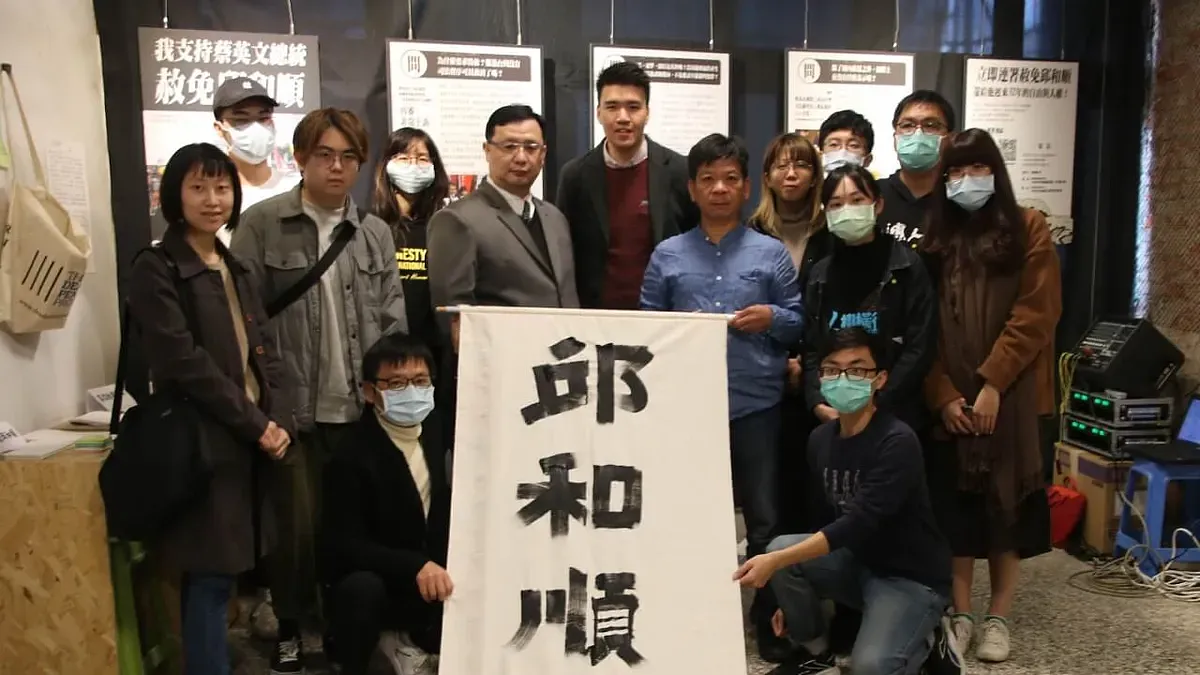
At the opening, Cheng Hsing-Tse-an exoneree and fellow Miaoli native-wrote the calligraphy "Chiu Ho-Shun Is Innocent." Performing artists Liang Yen-Yi, Sung Wei-Chieh, and Yu Yu-Hsin presented the dance "Reaching Shore," opening the exhibition through movement. Through calligraphy and performance, they used their own artistic languages to speak for Chiu Ho-Shun. Supporters, members of the pro bono legal team, and representatives of support organizations also spoke at the opening press conference.
Lin Hung-Wen, Member of the Chiu Ho-Shun Pro Bono Legal Team:
The Chiu Ho-Shun case is extraordinary because the evidence of torture is so clear. The police officers responsible were impeached by the Control Yuan and convicted by the courts, and even after those convictions became final, retired officers were willing to testify that torture had occurred. Yet despite substantial evidence supporting Chiu's innocence, the present justice system has made exoneration extraordinarily difficult. The legal team has raised numerous serious doubts that courts have repeatedly overlooked. Fingerprints recovered from the ransom note, for example, did not match any of the 12 defendants. The voice on the ransom tape was attributed to one defendant, but when the legal team sought a new expert examination, the tape itself had disappeared. The judgment stated that the victim's family should not bear the consequences of that loss-which is understandable. But should Chiu Ho-Shun bear them instead? If evidence used to convict a person can disappear, how can the state still rely on it to sustain guilt? The legal team finds that deeply troubling. The courts also treated the torture evidence piecemeal, excluding only confessions that could be directly linked to recorded acts of torture while failing to confront the broader fear and loss of free will that torture imposed on the defendants.
The attorneys urged the public to continue following the case and to examine the record for themselves: does the evidence truly show that Chiu committed these crimes? If not, they asked people to continue supporting efforts to correct this wrongful conviction. The case concerns not only one person's life, but the justice and integrity of the judicial system as a whole.
Tsai Meng-Chu, Head of the Curatorial Team:
"Hai-Wang's Daybreak" is jointly organized by the groups and volunteers supporting Chiu Ho-Shun. For the Zhunan exhibition, the team retained the Taipei exhibits and added two new sections: a reconstructed "Detention Center Cell" and a "Chiu Ho-Shun Case Map." Exoneree Hsu Tzu-Chiang drew on his own experience to recreate the detention-center cell so visitors could see the kind of space in which Chiu has been confined. The case map uses the geography of Hsinchu and Zhunan, Miaoli to illustrate the implausibilities in the courts' findings concerning the Lu Cheng and Ko Hung Yu-Lan cases.
Sixty-one years ago, Longfeng Harbor-about a ten-minute drive from here-had an unusually abundant catch. Chiu Ho-Shun was born that year, which is how he received the childhood nickname "Hai-Wang." Yet the storms of his later life have kept him from returning home ever since.
Today we have brought the exhibition back to his birthplace. We sincerely hope that Hai-Wang will soon see daybreak-and the day when his innocence is finally recognized.
Shih Yi-Hsiang, Secretary-General, Taiwan Association for Human Rights:
The Taiwan Association for Human Rights began supporting Chiu Ho-Shun as early as 1993. A press notice dated May 25 of that year recorded that TAHR President Chen Chu, Vice President and attorney Chang Ping-Huang, defense attorney Lee Sheng-Hsiung, and several women members of the National Assembly would accompany the defendants' families to petition the Control Yuan on May 27, demanding an investigation into torture and coerced confessions during the police and prosecutorial investigation. The Control Yuan member who received the petition was attorney Wang Ching-Feng.
Nearly 28 years later, Chen Chu-who once stood outside the Control Yuan on behalf of a civil-society human-rights organization-is now President of the Control Yuan and Chairperson of the National Human Rights Commission. As TAHR's current Secretary-General, I call on President Chen not to forget the commitment she showed 28 years ago. Please bring the same determination to securing Chiu Ho-Shun's freedom as soon as possible, so that he can come home and enjoy a bowl of bawan.
Chung Yu-Jou, Research and Advocacy Officer, Covenants Watch:
We invite President Tsai and members of the National Human Rights Commission to come to Chiu Ho-Shun's hometown of Zhunan, Miaoli and see the exhibition. Covenants Watch also makes three demands:
First, given the suffering caused by Chiu Ho-Shun's prolonged confinement and his current poor physical and mental condition, reopening the trial process cannot provide sufficiently urgent relief. We therefore again call on President Tsai to pardon Chiu Ho-Shun as soon as possible.
Second, reopening judicial proceedings is still necessary, because only a fair trial can truly clear Chiu Ho-Shun's name. We therefore call on the Prosecutor-General to file an extraordinary appeal, or on prosecutors to use the investigation report prepared by Kao Yung-Cheng-now a member of the National Human Rights Commission, and previously a Control Yuan member-as a basis for seeking retrial.
Third, the National Human Rights Commission should launch a systemic investigation into the human-rights violations exposed by this case and examine what features of the current system continue to create risks of rights violations.
Ultimately, we hope A-Shun can return to Zhunan as a free man as soon as possible, and that the violations he suffered can be examined one by one and meaningfully remedied.
Chiu I-Ling, Secretary-General, Amnesty International Taiwan:
Amnesty International has supported Chiu Ho-Shun since 2011, and it is deeply painful that he still has not been exonerated. The Taipei exhibition drew many legislators and ministers without portfolio; I cannot help wondering what they thought after seeing it.
Since last year, support organizations have held a series of activities for Chiu, including "Ride for Chiu Ho-Shun's Freedom" and numerous press conferences. Bringing the exhibition to Zhunan is another way to continue the conversation with society.
Since last year, the Judicial Reform Foundation and Amnesty International have both launched petitions. Together, the petitions have gathered more than 100,000 signatures, yet even that has not moved President Tsai Ing-Wen to act.
Amnesty International hopes the exhibition will bring still more signatures. But Chiu I-Ling also asked how many signatures it will take before political leaders are willing to make the decision to grant a pardon.
Amnesty International sections around the world have also taken action for Chiu Ho-Shun. The French and Belgian sections, for example, have sent letters of support for President Tsai. After compiling the messages, Amnesty International Taiwan will forward letters from around the world to President Tsai Ing-Wen in the hope that justice for Chiu Ho-Shun will finally be realized.
Tseng Wen-Hsueh, Miaoli County Councilor:
One distinctive feature of the Zhunan exhibition is the case map. It makes the implausibilities of the Chiu Ho-Shun case visible: the alleged body-disposal locations and routes simply do not make sense when placed on a map. Returning to the actual locations gives the history a different immediacy. When I handle constituent petitions, I also make a point of visiting the scene because seeing a place directly changes how you understand it. After the exhibition, I hope visitors will also go to Longfeng Temple and Longfeng Harbor, places A-Shun has long missed. And I hope he can come home soon, eat bawan with everyone, and see the sea again.
Chen Pin-An, Miaoli County Councilor:
While viewing the exhibition, I saw an old report about a religious ceremony held by the former Taiwan Provincial Assembly in Miaoli to prevent vote-buying. It gives some sense of how strange the institutional environment of that era could be. As both an attorney and an elected representative, I find A-Shun's case deeply painful. He became a victim of a wrongful conviction under that historical system and remains in detention waiting for his innocence to be recognized. Cheng Hsing-Tse-another person wrongfully convicted-is from our own Yuanli Township. I hope A-Shun can return to Zhunan soon as well.
Through this exhibition, we will continue the dialogue with people in Zhunan. We hope society will give Chiu Ho-Shun a just answer and that, together with everyone who cares about his case, we can stand between him and the state's gun and bring "Hai-Wang" the clearing skies and daybreak he has waited 32 years to see.
Supporters in Attendance
Hsu Tzu-Chiang (Exoneree)
Cheng Hsing-Tse (Exoneree)
Tseng Wen-Hsueh (Miaoli County Councilor)
Chen Pin-An (Miaoli County Councilor)
Sung Kuo-Ting (Miaoli County Councilor)
Lin Hung-Wen (Member, Chiu Ho-Shun Pro Bono Legal Team)
Chiu I-Ling (Secretary-General, Amnesty International Taiwan)
Shih Yi-Hsiang (Secretary-General, Taiwan Association for Human Rights)
Wu Ting-Chen (Media and Marketing Specialist, Taiwan Association for Human Rights)
Chung Yu-Jou (Covenants Watch)
Tsai Meng-Chu (Designer, Judicial Reform Foundation)
Chang Chih (Deputy Director, Advocacy Department, Judicial Reform Foundation)
Press Contact
Chang Chih, Deputy Director, Advocacy Department, Judicial Reform Foundation
About "Hai-Wang's Daybreak - Chiu Ho-Shun's Forgotten 32 Years: Zhunan Special Exhibition"
The exhibition presents Chiu Ho-Shun's 32 years under state violence through several themes and a range of media, allowing visitors to trace the violence, absurdity, and helplessness that have shaped the second half of his life.
Theme I "Blood Before Confinement" uses projections and evidentiary materials from the case to recreate, as closely as possible, the circumstances in which Chiu Ho-Shun and others were tortured during interrogation. The aim is to help visitors feel the torture endured by Chiu, then only in his twenties, and the despair, pain, and absurdity it represented.
Theme II "Daybreak Through the Bars" and "A-Shun, How Have You Been?" invite visitors into Chiu Ho-Shun's memories through his letters. A simulated detention-center telephone also lets visitors hear the singing voice of Chiu, who loves to sing, and his own expressions of what he has felt.
Theme III "The Game of Life" lets visitors step into Chiu Ho-Shun's place, moving along squares on the floor, making choices, and reenacting the opportunities, turns of fate, and helplessness that have shaped his life.
Theme IV The "Timeline" and "Questions in the Case" wall present more than 30 years of major events together with the case's many unreasonable and unusual features, allowing visitors to see its central problems and injustices.
Theme V "Ten Forgotten Stories" introduces other wrongful-conviction cases in Taiwan. Some have ended in exoneration, some ended with executions carried out by the state, and others still await assistance. The wall invites visitors to see these stories and continue paying attention to wrongful convictions in Taiwan.
Theme VI The "Case Map" combines maps of Hsinchu and Miaoli with three-dimensional markers and route diagrams to show the body-disposal routes and locations found by the courts in the Ko Hung Yu-Lan and Lu Cheng cases. Through maps and explanatory text, visitors can see how implausible many of those judicially accepted routes actually are.
This article is an AI-generated translation of the original Chinese text. In the event of any discrepancy, the Chinese version shall prevail.