
Sidelights | Seeing What Goes Unseen - Hai-Wang's Daybreak Lecture Series
Last edited: 2026-08-29
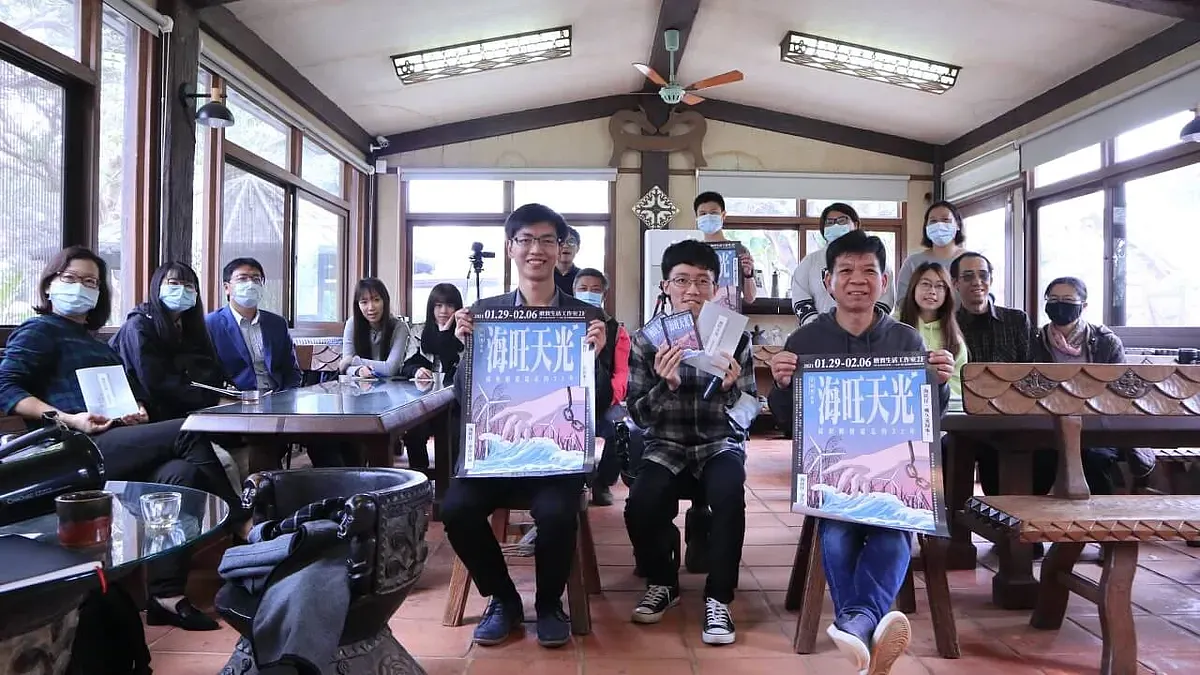
Before "Hai-Wang's Daybreak - Chiu Ho-Shun's Forgotten 32 Years" opened in A-Shun's hometown of Zhunan, we invited exoneree Cheng Hsing-Tse to speak. Having been sentenced to death multiple times and lived for years under the fear that he could be executed at any moment, Cheng hoped to use his own experience to give voice to the painful reality of detention that Chiu continues to endure. Attorney Tsai Meng-Han, a senior editor at Plain Law Movement, also joined the event to discuss how online media can use accessible writing to help the public understand wrongful convictions and bring more attention to Chiu's case.
The first pre-exhibition talk in the Zhunan "Hai-Wang's Daybreak" series was opened by Wang Yu-Hsiang, an intern with the Taiwan Alliance to End the Death Penalty. Wang noted that litigation is only one part of wrongful-conviction advocacy. Another task is helping the public see the injustice and join efforts outside the courtroom. Harder still is persuading courts to recognize the weaknesses in a case and seriously reconsider the possibility that an earlier judgment was wrong.
Once a judgment is handed down, public attention often stops. Wang pointed out that a person sentenced to death is not necessarily executed soon after the judgment becomes final and may remain in a detention center for years or even decades. Compared with the lives of ordinary sentenced prisoners, these years on death row are largely invisible to the public.
"People tend to believe that the law is fair-that the amount of evidence determines the punishment. But there are many blind spots that people never see. In the Lu Cheng case, for example, Chiu Ho-Shun's death sentence became final even though no body was ever found. The justice system is simply not that ideal."
- Cheng Hsing-Tse, Exoneree
Cheng Hsing-Tse was sentenced to death multiple times. He said that while awaiting execution, the public cannot see the darkness of detention-center life or understand what people on death row face after years or even decades in confinement. Cells of less than two ping-about 6.6 square meters-may hold two or more people. Those detained face financial hardship because they cannot work in prison workshops, severe discomfort from wearing shackles, and discriminatory treatment from other detainees. Cheng said that, compared with a single gunshot, living year after year under such inhumane conditions can feel like the real punishment. Some people have even written to the Minister of Justice asking to be executed sooner simply to escape a world to which they feel they have nothing left to hold on.
Because Cheng's case involved the death of a police officer, it unfolded under enormous public pressure and the time limits of the Speedy Criminal Trials Act. The courts repeatedly refused to credit evidence favorable to the defense, while prosecutors sought the death penalty from the beginning. A case that demanded extraordinary care became final in just over four years. Cheng said that he pursued many avenues for relief, and the Control Yuan eventually issued a report identifying defects in the investigation. But without media coverage, the public could not see the wrongful conviction or understand the humiliation he endured in detention.
When courts disregard evidence favorable to a defendant, Cheng said, the sense of despair only deepens. Whatever a judgment says carries legal force; once the Minister of Justice signs an execution order, a person can be put to death almost overnight without ever clearing his name. Even today, whenever Cheng hears that someone has been executed, he remembers how he used to imagine over and over what it would be like to be taken to the execution ground. "No exoneration comes easily," he said. "It takes not only lawyers, but advocacy groups and student volunteers working so that more people can see. I was once on death row myself, so I want more people to understand Chiu Ho-Shun's life-and the things no one sees."
"To most people, wrongful convictions are like extraterrestrial life. Most believe they probably exist, but no one expects one to appear in their own life. We are like a UFO research society: first we have to make people recognize that the phenomenon is real."
- Tsai Meng-Han, Senior Editor, Plain Law Movement
Attorney Tsai Meng-Han explained that adjudication involves both finding facts and applying law, and that fact-finding is often the harder task. People tend to focus on the shocking act alleged in a case without understanding the defendant's circumstances before and after it; that decontextualized view can contribute to wrongful convictions. Applying legal doctrine is comparatively more familiar territory for judges, but criminal punishment is an exercise of the state's coercive authority. Courts therefore need evidence that leaves no reasonable doubt and must rigorously observe the presumption of innocence. Yet even today, advocates continue working in every possible way to draw attention to A-Shun's case.
Turning to social media, Tsai said Plain Law Movement tries to help the public understand both "what the law is" and "what the law ought to be." Its earlier popular content often explained how law operates in everyday life. Once readers became comfortable with that material and the platform built an audience, it increasingly introduced issues that invited deeper reflection and debate. Tsai believes this helps people see that an issue has multiple dimensions rather than a single flat answer. The most promising starting point is being able to hold one's own position while remaining willing to hear a different perspective.
Wrongful convictions often feel distant. People know they can happen, but when a major crime is reported, they are more likely to assume the defendant is guilty than to consider that the case itself may be wrongful. Most people can imagine becoming a victim of crime; fewer imagine becoming a victim of the justice system. Supporters of people alleging wrongful conviction are therefore sometimes treated as outsiders who inexplicably want to help "bad people." Yet the public does have sympathy for wrongful convictions. The real challenge is turning that latent sympathy into a willingness, when confronted with a concrete case, to recognize the possibility of error and act.
Approaching the issue as a senior editor and media advocate, Tsai said the first task is to help people understand that wrongful convictions genuinely exist. From there, media can draw more attention to individual cases and connect people who want to help correct them. Whether through litigation or support outside the courtroom, those efforts can help people wrongfully convicted return to their lives sooner. "A social-media platform has to keep sharing," he said, "and keep explaining to people in different fields that wrongful convictions are real and continuing. First people have to believe the problem exists; only then can we think about how to communicate it more widely. That is the most important thing."
This article is an AI-generated translation of the original Chinese text. In the event of any discrepancy, the Chinese version shall prevail.