
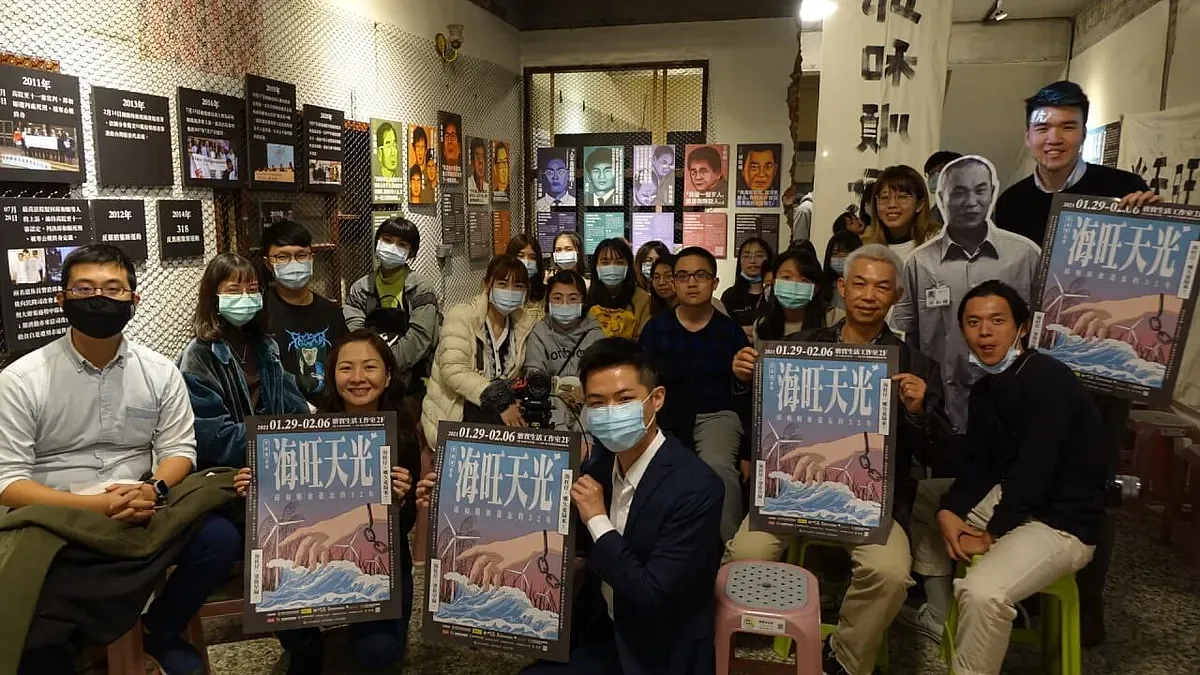
Sidelights | Can You Hear Our Voice? From the Laid-Off Workers Case and the Yuanli Anti-Wind Turbine Movement to the Chiu Ho-Shun Case - Hai-Wang's Daybreak Lecture Series
Last edited: 2026-08-29
The third "Hai-Wang's Daybreak" lecture was held on January 30. "Can You Hear Our Voice? - From the Laid-Off Workers Case and the Yuanli Anti-Wind Turbine Movement to the Chiu Ho-Shun Case" featured attorney Yu Po-Hsiang, convener of the Chiu Ho-Shun pro bono legal team; Miaoli County Councilor Sung Kuo-Ting, who had represented the laid-off workers; and Miaoli County Councilor Chen Pin-An, who had represented residents in the Yuanli anti-wind-turbine movement.
The title was inspired by "Can You Hear the People Sing?" from Les Misérables. The song was later adapted into Taiwanese and became an anthem of the White Shirt Movement after the Hung Chung-Chiu incident, echoing along Ketagalan Boulevard. The story of Les Misérables is set against a republican uprising in France that develops into collective resistance by disadvantaged people-an apt connection to a lecture centered on the voices of people with less power.
Taiwan has seen protests large and small in which people with little power confront much larger institutions. In the face of the state apparatus, protesters are almost always the weaker party. Lawyers have often been present in those struggles. These three lawyers chose to remain alongside the people involved until, eventually, their voices were heard.
"Once a person is caught in the machinery of criminal prosecution, most defendants are the weaker party in the courtroom. People often criticize the Code of Criminal Procedure for giving defendants too many protections, without realizing that defendants are given those rights precisely because they are in the weaker position in criminal proceedings."
- Yu Po-Hsiang, Pro Bono Attorney for Chiu Ho-Shun
Yu Po-Hsiang is the convener of Chiu Ho-Shun's pro bono legal team, but he acknowledged that he initially took the case simply because it fell within his area of practice and treated it as one case among many. Once he seriously read the record, however, he found far too many doubts. The wrongful nature of the case became clear to him, while the courts themselves repeatedly moved between guilty and not-guilty outcomes without bringing the matter to a convincing resolution.
In higher-profile cases, defendants can be stigmatized before they ever enter the courtroom. Yu argued that the criminal-prosecution process itself marks a person as an "other." He compared this to Lu Xun's story of people eating buns dipped in human blood as a cure: society can wrap a barbaric impulse in ritual and sacrifice particular people so that everyone else can feel safe.
Democracy is not majority violence, and it does not end when the ballots are counted; dialogue and deliberation before the vote matter just as much. The rule of law is not simply "law and order," and it is not a ritual of blood sacrifice. People may knowingly challenge the legal order and accept consequences in order to protest institutional injustice, but the fact that a majority disagrees does not mean those people necessarily must be punished. Yu asked: if institutional reform can happen only when someone offers themself up as a sacrifice, how different is that society from the one in Lu Xun's story? If every advance requires someone to pay that price, is that really the society we want?
Yu said the legal team he convenes broadly shares that conviction. That is why they have continued despite mainstream skepticism. Asked whether he had ever thought of giving up on the Chiu Ho-Shun case, he described himself as stubborn. He had never truly considered quitting, although the previous year there was a period when he genuinely did not know what path remained. The difficulties have not disappeared, but the responsibility he feels as defense counsel-and the many people still willing to keep walking with the team-has kept him going.
"Change the angle and anyone in society can become an obstacle. When society does not truly see people, they have to use different means to force society to look. I do not believe protesters enjoy standing in the cold being condemned from all sides. They take those actions because they have run into a wall."
- Sung Kuo-Ting, Miaoli County Councilor
Sung Kuo-Ting joined the collective litigation for laid-off factory workers in his first year of legal practice. Miaoli was one of the principal battlegrounds, but there were far too few lawyers to help. The Council of Labor Affairs initially offered a compromise. Nearly half of the workers no longer wanted to fight the government, while the rest still could not accept being ordered to repay money. Sung said that if the remaining workers had not stood together, they would never have attracted legal assistance or wider public attention.
The laid-off workers were already a relatively disadvantaged group. When they confronted the state, the justice system often failed to hear what they were actually saying. Sung repeatedly emphasized that if legal analysis cannot look beyond the papers in a case file to the purpose and context behind them, the voices of less powerful people never truly enter the courtroom. Wrongful-conviction cases reveal a related problem: a supposedly rigorous judicial process can move through repeated retrials, alternating between guilt and innocence, use the full power of the state to produce a possibly false account of the facts, and then force advocates to spend years explaining why the judgment was wrong. The person at the center of the case absorbs blow after blow.
Sung also urged the audience to think differently about protest. In wrongful-conviction advocacy, the clearest goal is getting the person out. A social movement does not always have one best solution. Self-help groups develop internal tensions, and legal teams can disagree. Sung said he did not always know how those obstacles should be resolved. He also cautioned against treating a decision to stop as moral failure: litigants face pressures and interests outsiders may not understand. People who are not living through those consequences should be careful about judging the choices they make.
"Whether you are a lawyer or an elected representative, you will encounter resistance. But once you understand how determined the people involved are, the resistance stops being merely an obstacle. It becomes a reason to keep going and can make the group even more united."
- Chen Pin-An, Miaoli County Councilor
Chen Pin-An has assisted in numerous environmental cases and has personally participated in many protest actions, at times being arrested alongside local residents and becoming a criminal defendant herself. When the Yuanli anti-wind-turbine movement began, she had only recently qualified as an attorney and happened to pass residents who were on hunger strike. A hunger strike is an extreme and uncommon form of protest. She asked herself what kind of development project could lead people to put their lives at risk in a confrontation with a corporation. After learning more, she decided to become involved. Developers, she said, often use strategic lawsuits to criminalize residents who protest, even when the residents are only asking for construction to slow down long enough to allow more negotiation.
Chen said no protester wants to be arrested. She also asked why actions that looked like ordinary petitions, assemblies, and marches in Taipei could turn people into defendants charged with coercion in Miaoli. Shouldn't the law be the same across Taiwan? During one protest, police even told residents-and Chen, despite her legal background-"Don't talk to me about the law. I am the law." For her, it was shocking that protesting, exercising freedom of expression, and trying to protect one's community could lead to that kind of encounter.
Protests are intense and decisions often have to be made within minutes. Participants therefore need a high degree of mutual trust, especially when companies are using every available tactic-including unlawful ones-to disrupt and pressure them. People inevitably begin questioning whether their decisions were correct. Collective trust can be what allows them to keep moving. If someone ultimately chooses to stop, Chen said, the lawyer must respect that decision because the lawyer is not the person who has to live the consequences. In both the laid-off workers case and the Yuanli anti-wind-turbine movement, however, the participants persisted to the end, and that persistence was what made hope visible.
"When we confront arbitrary violence by the state, choosing silence means ignoring the existence of that violence."
- Chang Chih, Deputy Director, Advocacy Department, Judicial Reform Foundation
Moderator Chang Chih closed with one sentence: "When an innocent person is convicted, no one is free." When the state uses arbitrary violence, remaining silent means refusing to see it. The word "vulnerable" can carry different connotations, but in the face of state power protesters are almost always the weaker side. Whether one small voice or many, they confront judicial indifference and arrogance, corporate exploitation, public blame, and even self-doubt. Every protest has a reason. The question is whether we are willing to look closely enough to understand it.
This article is an AI-generated translation of the original Chinese text. In the event of any discrepancy, the Chinese version shall prevail.