
The Road Home - Reflections on "Hai-Wang's Daybreak" in Zhunan
Last edited: 2026-08-29
I had heard Chiu Ho-Shun's name many times before, but I carried a quiet prejudice: perhaps these "wrongful-conviction cases" were simply cases where the evidence was insufficient, which did not necessarily mean the defendants had not committed the crimes. Because of that assumption, I never made an effort to understand his case in depth.
"Hai-Wang's Daybreak" changed much of the way I think about wrongful convictions.
As I moved through the exhibition, I began seriously confronting the many problems in the case and found myself asking in disbelief: how could Chiu Ho-Shun have been sentenced to death on evidence with so many serious defects?
The moment that affected me most came in the simulated visitation room. I heard Chiu Ho-Shun singing through the telephone, then encountered recordings and reconstructed footage of the torture he had suffered. The guide told us, "Chiu Ho-Shun's parents died while he was incarcerated. His greatest wish is to be able to go out one day and burn incense for them."
My eyes filled with tears. For the first time, I felt I was beginning to understand how painful that must be: to be wrongfully accused, to lose your freedom, and not even be able to see your parents one last time. Thinking about his parents dying while still waiting for their son to come home free was heartbreaking.
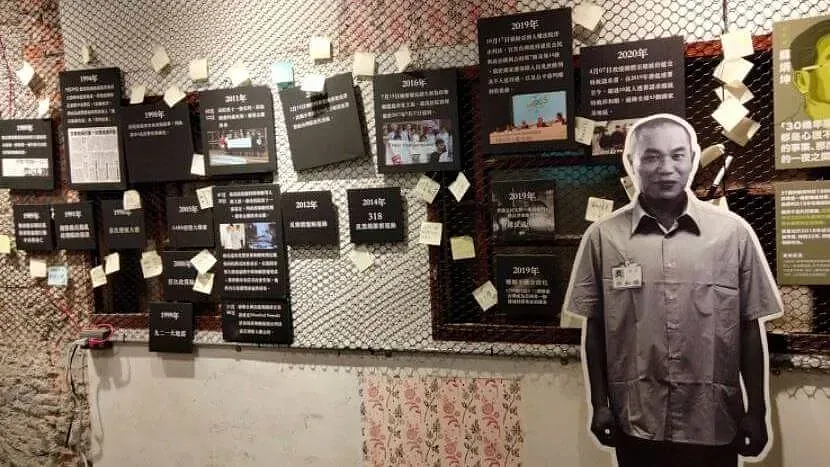
Looking at the cases displayed on the walls-some people eventually exonerated, some already executed, and many still waiting for help-I suddenly understood that these names were not distant symbols from news reports. They were living people, no different from us.
I began asking myself how a justice system could sentence someone to death so readily when evidence was insufficient or even produced through torture. The judiciary is imperfect and can make mistakes. What matters is whether it has the courage to admit those mistakes and correct them.
My feelings remain complicated. I am angry at the freedom taken from Chiu Ho-Shun. Yet when I hear comments such as "no judge wants to bear responsibility for releasing a murderer" or that judges in a hierarchical professional culture are reluctant to overturn earlier decisions, I also glimpse why revisiting a final death sentence can involve enormous pressure and hesitation.
When I went home and told my family about the exhibition, some of my own thoughts became clearer through the conversation. I am grateful to "Hai-Wang's Daybreak" and to the organizations that have spent years working on wrongful-conviction cases. They gave me a chance to break through my own assumptions and think again.
I hope the day comes when Chiu Ho-Shun can personally burn incense for his parents.
This article is an AI-generated translation of the original Chinese text. In the event of any discrepancy, the Chinese version shall prevail.