
When Will the Dark Night Give Way to Dawn? - Visitor No. 448 Meets Chiu Ho-Shun and Reflects on "Hai-Wang's Daybreak" in Zhunan
Last edited: 2026-08-29
Dark night / When will dawn come? /
I am tired / Because of despair /
I weep / Because of sorrow /
Thirty-one years / When will the judiciary's dark night end? / When will it end? / When will dawn come?- Chiu Ho-Shun, "Dark Night"
Before Lunar New Year, I first went to Zhunan for the "Hai-Wang's Daybreak" exhibition and two lectures in the series, then visited Chiu Ho-Shun at the Taipei Detention Center. When I tried afterward to organize my thoughts, they seemed tangled in every direction. What remained most vivid were tiny details: the broad shadow cast across A-Shun's letter paper in the exhibition, the harsh Zhunan sun, and the shy look on his face when I complimented him. Almost none of what stayed with me carried the frightening atmosphere people associate with a criminal case.
When I was sixteen, I heard Hsu Tzu-Chiang and Su Chien-Ho speak and received campaign materials about Chiu Ho-Shun that same day. Hsu had been sentenced to death in his sixth retrial, received life sentences in the seventh and eighth, and finally saw daybreak in the ninth. His experience made me think that the repeated setbacks in Chiu's case would also soon give way to exoneration. Years passed. After the eleventh retrial, however, Chiu Ho-Shun's judgment became final and he remained on death row. Twenty-eight, thirty-two, 7026: how should someone who once knew so little about the justice system understand those numbers? A-Shun was arrested at 28 and has now been detained for more than 32 years. His strongest adult years passed from "I don't know how long they've tortured me, but I still denied being involved" to "I couldn't bear the torture anymore and gave in and confessed," and then through confusion, anger, despair, and eventually the ability to greet strangers who came to care about him with openness and warmth. To me, 28 and 32 belong to the life of a flesh-and-blood person with a name. His detention number, 7026, gains another layer of meaning beside 448-the number A-Shun gave me because I was his 448th visitor.
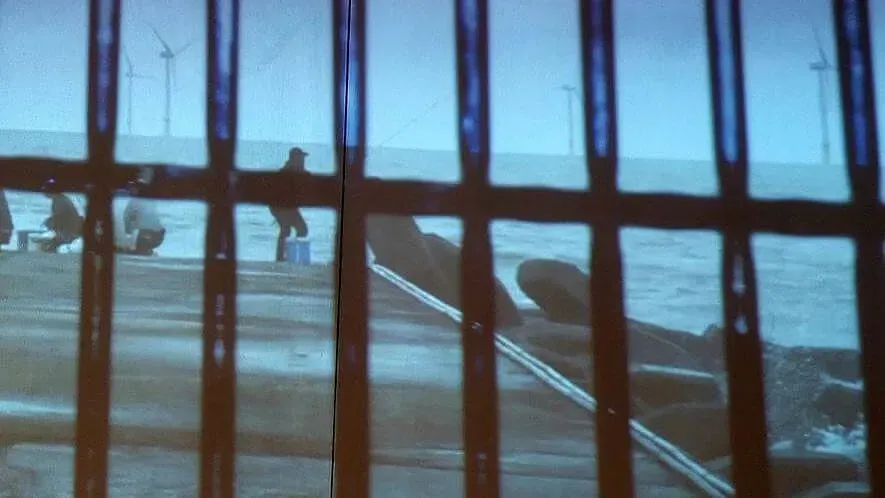
I had expected the exhibition to be filled with the blood and tears of a wrongful conviction. What it displayed most powerfully instead was a person's capacity to feel-not "7026," but someone like you and me who deserves fair treatment. Reading his memoir, I even began to relax. His childhood memories remained vivid in writing produced when he was nearly fifty: the beloved farm child "Hai-Wang-ê," mischievous and playful; the boy who called himself the "little red monster"; the neighborhood's "beggar woman's golden grandson"; the young man with a touch of jianghu bravado and his own way of dealing with the world. That Chiu Ho-Shun felt no different from the A-Shun known to Visitor 448. I held the receiver and listened to him sing three old-fashioned popular songs while looking at his smiling face. In the exhibition's simulated visitation room, a mirror stood behind the glass, so the person I saw across from me was still myself. Because we can feel his pain, and because a trial system can make mistakes, any of us could become another Chiu Ho-Shun. Twenty minutes was not enough to say everything we worried about. But seeing him gather his spirits and talk to me cheerfully, how could I give up hope?
Even before the exhibition, I believed A-Shun was innocent; that was one of the things I had taken away from the lecture at sixteen. For years, the points listed in the campaign leaflet were almost all I knew about the case. I avoided searching for more news or judgments because even small pieces of information about serious criminal cases accumulated over decades caused me intense fear and pain. This January, at a pre-exhibition lecture, Su Chien-Ho reminded the audience that "supporting a wrongful-conviction case should not be blind" and that "we need to understand the context before making a judgment." Only then did I decide to learn more about the Lu Cheng and Ko Hung Yu-Lan cases. Frightened as I was, reading the physical evidence, testimony, and judgments finally allowed me to understand why Chiu's case is regarded as a wrongful conviction and why paying attention to him is itself part of pressing for judicial reform and practicing justice. Unlike my earlier emotional reactions, that understanding could withstand harder questions about what a wrongful conviction really means.
At the detention center, A-Shun asked whether, when he finally sees daylight again, I would go with everyone from JRF to support him. I answered without hesitation. He grinned and reminded me that the call was being recorded. I hope 32 never becomes 33. I hope our promise can be kept: that he can leave the small space in which judgment after judgment has held him, return to Longfeng Li in Zhunan, and teach me-someone who loves roasted sweet potatoes-the trick he learned from his father for making the sweet potatoes he remembers so fondly.
This article is an AI-generated translation of the original Chinese text. In the event of any discrepancy, the Chinese version shall prevail.