
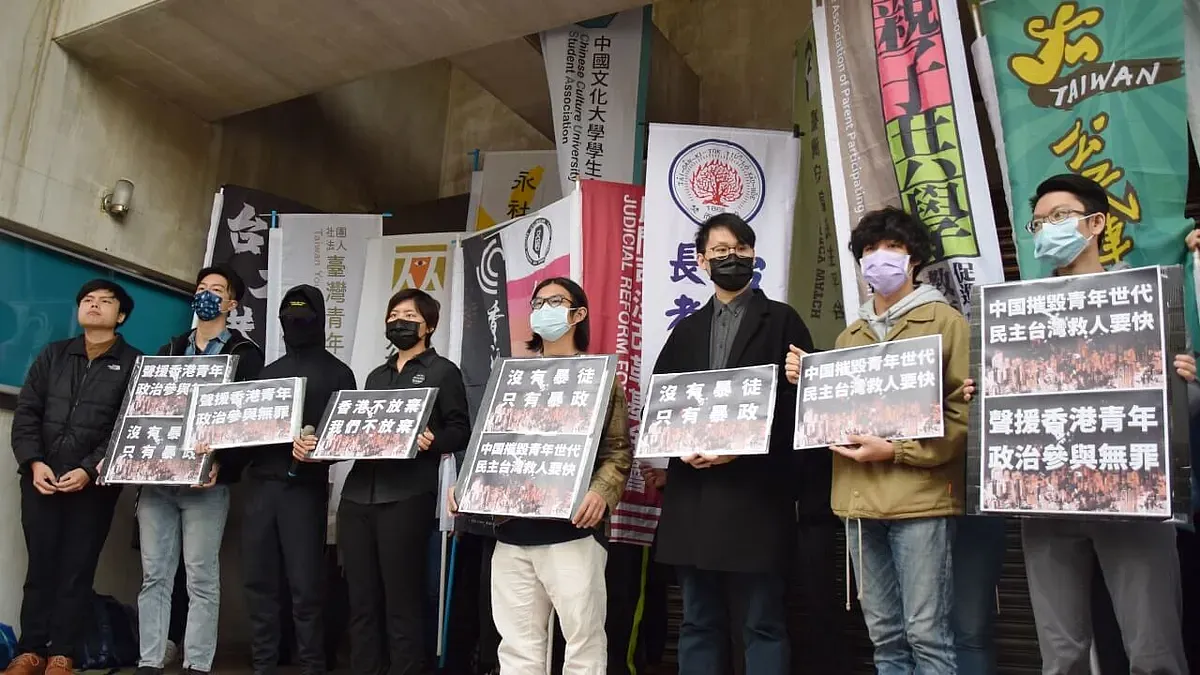
Taiwan and Hong Kong Youth Stand Together Against Repression - Supporting the CUHK Student Union and Hong Kong's "February 28"
Last edited: 2026-08-29
Nearly 20 civil-society organizations, including the National Students' Union of Taiwan and the Economic Democracy Union, held a press conference today (March 2) outside the Legislative Yuan's Qunxian Building to express solidarity with the Chinese University of Hong Kong Student Union and the 47 political figures charged with "subversion of state power" for participating in the pro-democracy primaries.
Huang Ting-Wei, Executive Board Member of the National Students' Union of Taiwan and President of the Fu Jen Catholic University Student Association, said that student associations in Taiwan also face pressure from university administrations over freedom of expression and political participation, but that the situation in Hong Kong is far more dangerous and is deteriorating rapidly. Taiwan, he said, should remain a source of support for Hong Kong and continue standing with its people.
Guan Shan-Yue, a Hong Kong student currently pursuing graduate studies in Taiwan, said that since the 2014 Umbrella Movement, protest in Hong Kong has continuously evolved-from ordinary marches to street occupations-and has shown people around the world who support democracy what accumulated movement experience can achieve. Hongkongers have paid an enormous price for freedom and continue fighting on many fronts. Two major campus confrontations forced many protesters into exile, while those who remained on the front lines continued organizing even as resistance moved underground and Beijing imposed the National Security Law. "Yesterday's Taiwan is today's Hong Kong," Guan said. "A February 28 is unfolding in Hong Kong."
Chen Wei-An, who previously studied at the Chinese University of Hong Kong and now chairs the NTU Hong Kong Research Society, said that under Chinese Communist Party pressure, Hong Kong is no longer the Hong Kong she knew. Students who tried to protect their peers were accused of threatening national security; merely running for student-union president could trigger accusations of illegality and cause the university to distance itself from the student union. The student union withdrew its platform, she said, not because its members had abandoned their ideals, but to protect their families from death threats and to protect fellow students.
On February 28, Hong Kong authorities denied bail to 47 people who had participated in the pro-democracy primaries and charged them with subversion of state power. Chen compared the arrests to the February 28 Incident in Taiwan 74 years earlier, when Chiang Kai-Shek sent troops to suppress resistance and many members of Taiwan's local elite were purged. "As a Taiwanese person, I will not forget the long night endured by those who came before us," she said. "And as someone who loves Hong Kong-or simply as a person with a conscience who values freedom-none of us can bear to see Hong Kong fall into an endless polar night." She pledged to stand with Hongkongers and not retreat in the face of authoritarianism.
Young political activist Wu Cheng said Hong Kong was facing a winter of democracy. The National Security Law, he argued, has no meaningful boundary: participating in a student union or a democratic primary can itself lead to accusations of subverting state power. He called on the public to continue paying attention to Hong Kong and providing support.
Ray, a Hong Kong student in Taiwan, said the CUHK Student Union had served as the representative voice of students and a symbol of student rights, yet the university had now "torn down its own Great Wall" and become an instrument of the National Security Law. The Hong Kong authorities respond to dissent by immediately suppressing it and trying to rule through fear. Taiwan's experience, Ray said, shows that belief in democracy and freedom can still create a way forward. Hong Kong media covering the February 28 arrests ran the headline "If Today Is the Last Day of Freedom," yet many of those prosecuted urged people not to despair and to continue doing what they believed was right. "Hope," Ray said, is the conviction Hong Kong most needs to hold on to. Seeing so many people in Taiwan willing to stand up for Hong Kong has allowed him, even away from home, to feel the strength of solidarity-and that solidarity helps him and many other Hongkongers keep going.
Civil-society groups chanted slogans outside the Qunxian Building including "No rioters, only tyranny," "Stand with Hong Kong youth-political participation is not a crime," and "China is destroying a generation of youth; democratic Taiwan must act quickly to save people." Echoing the CUHK Student Union's appeal before its collective resignation, participants also shouted, "Hongkongers will not give up, and neither will we."
After the press conference, moderator Hsiao Jen-Yu reiterated three demands: first, that the government promptly adopt the proposed Article 60-1 of the Act Governing Relations with Hong Kong and Macau-the "Hong Kong Human Rights and Democracy Clause"-and conduct periodic assessments of Hong Kong's autonomy and formulate corresponding policies; second, that Taiwan continue providing educational pathways so Hong Kong youth do not lose opportunities to study under Chinese Communist Party repression; and third, that, while taking appropriate pandemic precautions, the government act as quickly as possible to provide safe routes of entry for people in need of protection.
Press Contact
Hsiao Jen-Yu / Department of Political Science, Soochow University
This article is an AI-generated translation of the original Chinese text. In the event of any discrepancy, the Chinese version shall prevail.
