
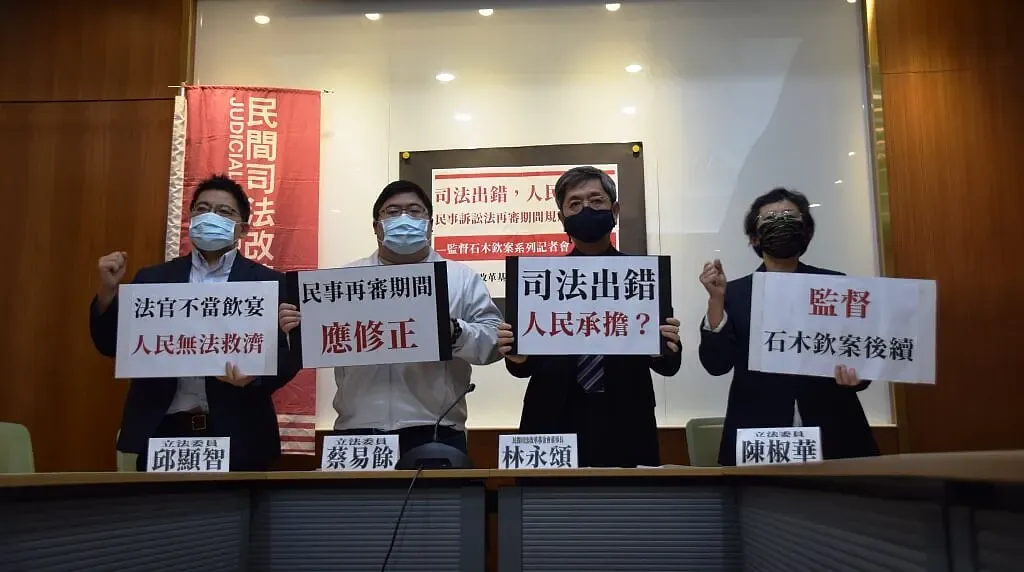
Judicial Error, Litigants Bear the Cost? The Code of Civil Procedure's Retrial Time Limits Must Be Reformed - Shih Mu-Chin Monitoring Press Conference IV
Last edited: 2026-08-29
The Shih Mu-Chin case has continued to unfold as a major judicial-integrity scandal, and this is the fourth press conference JRF has held to follow its aftermath. Investigation and discipline for judicial-ethics violations, reform of the judicial personnel system, and stronger safeguards for internal and external judicial independence are all necessary. But another issue cannot be avoided: many judicial personnel implicated in the Shih Mu-Chin case dined with parties connected to cases while those cases were pending, seriously undermining judicial impartiality and public confidence in the correctness of the resulting judgments. Reexamining judgments that are already final, however, depends on the legal thresholds governing an action for retrial. The Code of Civil Procedure imposes a preclusive period after which an action for retrial may no longer be brought. Although the law contains exceptions, the Shih Mu-Chin case shows that the present rules may not adequately protect litigants' rights. JRF and legislators concerned with civil retrial therefore jointly proposed the amendments discussed here.
After the Shih Mu-Chin Scandal: The Current Civil Retrial System Cannot Remedy Unfair Civil Judgments
One of the best-known episodes in Weng Mao-Chung's improper dealings with judicial personnel is the "Death of a Bank Employee" case. It began when BNP Paribas sought to recover US$10 million from Yi-Hwa Industrial Corporation, a company controlled by Weng's family. Weng arranged for the company's finance manager, Wu Hsien-Fu, to turn himself in to Tainan District Prosecutors Office prosecutor Chu Hung-Yu and Chief Prosecutor Fang Wan-Fu, both of whom had close personal ties with Weng, claiming that the US$10 million promissory note pledged to BNP Paribas was forged. Wu was ultimately sentenced to two years' imprisonment with a three-year suspended sentence, and the "forged promissory note" was confiscated.
Yi-Hwa Industrial Corporation later brought an action against BNP Paribas seeking a declaration that the promissory-note debt did not exist. The "forged promissory note" became a key basis for Yi-Hwa's victory. When the case reached the Supreme Court, it was assigned to the Third Civil Division, where Judge Lin Chi-Fu-who had previously dined privately with Weng-participated. Weng's company ultimately prevailed and was relieved of approximately NT$300 million in liability (Supreme Court Ruling 90-Tai-Chien-Shang-33). Weng later relied on that result to claim that BNP Paribas had pursued the debt unlawfully and caused NT$500 million in interest and reputational losses to Yi-Hwa, and then sought damages from bank employee Chu Ching-En and, after Chu's death, his two minor children. In these proceedings, the judges, prosecutors, and investigation officials involved were repeatedly people with personal ties to Weng; they dined together, and some were suspected of purchasing shares from him. These integrity problems cast serious doubt on both judicial impartiality and the correctness of the outcomes.
The public was therefore waiting to see whether the Judicial Yuan's newly announced April 20 investigation report could finally provide some measure of justice for the bank employee. Yet even if the Judicial Yuan were to find that a judge in the case accepted a bribe in breach of official duties or committed misconduct warranting discipline-facts that could constitute a ground for retrial under Article 496, Paragraph 1, Subparagraph 7 of the Code of Civil Procedure-the action between Yi-Hwa and BNP Paribas became final on November 14, 2002. More than five years have therefore elapsed, and Article 500, Paragraph 2 would bar an action for retrial.
The case exposes a serious defect in the current law. One statutory ground for retrial applies where "a judge who participated in the adjudication committed a criminal offense in breach of official duties in connection with the litigation, or was disciplined for such a breach in connection with the litigation, and the misconduct was sufficient to affect the original judgment." That kind of ground exists precisely because internal judicial-integrity failures may produce a manifestly unfair judgment. Yet the current five-year preclusive period places the burden of the judiciary's own failure on the person harmed by it and can make the judiciary's self-correcting retrial mechanism unavailable when it is most needed.
Not Just One Ground: When the Judiciary Makes the Error, the Code of Civil Procedure Can Still Bar Retrial
The problem is not limited to Subparagraph 7. Other grounds include:
- The court that rendered the judgment was not lawfully constituted (Subparagraph 3);
- A judge who was required by law or by ruling to recuse participated in the adjudication (Subparagraph 4);
- A party's representative, the opposing party, or the opposing party's representative committed a criminally punishable act in connection with the litigation that affected the judgment (Subparagraph 8);
- A civil, criminal, or administrative judgment, other judicial decision, or administrative disposition on which the judgment was based was later altered by a final decision or administrative disposition (Subparagraph 11).
Each of these grounds can arise from errors or failures within the justice system itself. Yet when fairness and justice require the courts to correct those errors through retrial, the five-year preclusive period can leave the parties with no remedy.
A deadline for bringing an action for retrial is designed to balance legal certainty against justice in the individual case. Comparative systems differ on whether such a deadline exists, how long it lasts, and what exceptions apply. It is therefore a policy choice rather than an immutable principle of procedural law. In Taiwan, an action for retrial is already exceptionally difficult to win. Adding multiple strict procedural barriers on top of that difficulty is unnecessary and can instead erode the possibility of achieving justice in the individual case.
Calling on the Legislative Yuan to Promptly Pass the Draft Amendments to the Code of Civil Procedure
For these reasons, JRF and legislators concerned with civil retrial have proposed amendments to the Code of Civil Procedure (see attachments) centered on three changes:
-
Broaden the definition of "new facts or evidence." Such material would no longer have to have existed during the prior proceeding itself. Facts or evidence that existed or were established before the judgment became final but were not investigated or considered in time, as well as facts or evidence that arose or came into existence only after the judgment became final, could qualify. To preserve the Code's balance between substantive and procedural interests, material that a party was responsible for failing to discover or use would be excluded.
-
Extend the outer time limit for an action for retrial from five years to ten years after the judgment becomes final, taking account of the actual duration of litigation and the law's inadequate ability to respond to technological advances.
-
Expand the exceptions to the outer time limit by adding Article 496, Paragraph 1, Subparagraphs 3, 4, 7, 8, and 11. These are grounds in which judicial error or misconduct itself may have produced the erroneous judgment. Allowing retrial in such cases gives effect to the judiciary's responsibility to correct its own errors and restore fairness and justice. This is the central focus of the proposed reform.
The Code of Criminal Procedure relaxed its retrial requirements in 2015 to improve remedies for wrongful convictions, but the retrial provisions of the Code of Civil Procedure have not been materially revised since 2003. The present regime no longer provides adequate protection for the constitutionally guaranteed right of access to the courts. JRF and the participating legislators therefore call on the public to support the proposal and urge the Legislative Yuan to review and enact the amendments promptly.
Attendees
Joseph Lin / Chairperson, Judicial Reform Foundation
Tsai Yi-Yu / Legislator
Chiu Hsien-Chih / Legislator
Chen Jiao-Hua / Legislator
Attachments
This article is an AI-generated translation of the original Chinese text. In the event of any discrepancy, the Chinese version shall prevail.
