
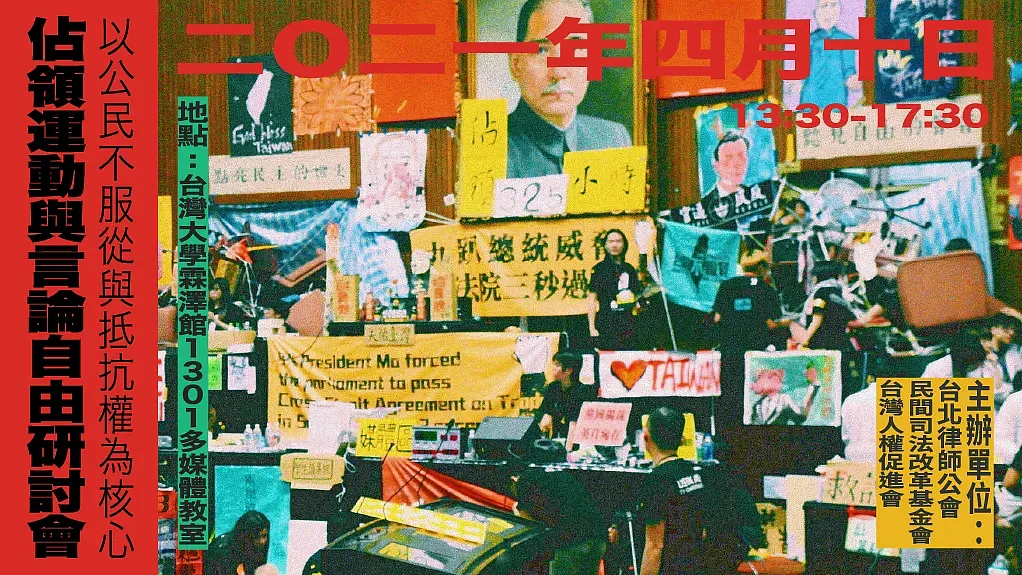
Seminar | Occupation Movements and Freedom of Expression: Civil Disobedience and the Right of Resistance
Last edited: 2026-08-29
On January 18 of this year, the Supreme Court delivered its third-instance judgment in the March 23 Executive Yuan occupation case (Supreme Court Criminal Judgment 109-Tai-Shang-3695). The Court held that civil disobedience-public, nonviolent, conscientious conduct that intentionally violates a legal rule-may, by analogy, be evaluated under the doctrines of necessity or excessive necessity so as to justify the conduct or reduce or exempt criminal liability. The Supreme Court also recognized for the first time that, although Taiwan's Constitution does not expressly enumerate a right of resistance, such a right should be recognized under the constitutional principle of popular sovereignty, and conduct exercising that right may be justified. The Court's treatment of civil disobedience and the right of resistance immediately prompted broad discussion and debate. With occupation-style protest movements also appearing in Hong Kong, Thailand, and even the U.S. Capitol, observers in Taiwan and abroad are paying attention to how Taiwan's legal system-where occupation movements became a major form of protest-will develop a framework for protecting and limiting these rights.
The Judicial Reform Foundation, Taiwan Association for Human Rights, and Taipei Bar Association have long followed the development of freedom of expression, democracy, and the rule of law in Taiwan. The relationship between occupation movements and freedom of expression deserves sustained discussion among scholars of criminal law, public law, and international human-rights law. The seminar will also help members of the Taipei Bar Association clarify and develop the public-interest role of attorneys when handling cases arising from protests and demonstrations.
Everyone concerned with freedom of expression, democracy, and the rule of law is welcome to participate.
Time
April 10, 2021, 1:30-5:30 p.m.
Venue
Room 1301, Tsai Lecture Hall, College of Law, National Taiwan University
Program
| Time | Session | Chair / Speaker |
| 1:00-1:30 p.m. | Registration | - |
| 1:30-1:35 p.m. | Opening Remarks | Guest Yu Po-Hsiang / President, Taipei Bar Association |
| 1:35-1:40 p.m. | Chair's Remarks | Chair Hsu Yu-Hsiu / Former Justice of the Constitutional Court |
| 1:40-2:00 p.m. | Current Standards and Controversies in Taiwanese Judicial Practice Concerning Civil Disobedience and the Right of Resistance | Introductory Speaker Lai Ping-Hsiang / Attorney, Yuan-Chen Law Offices |
| 2:00-2:30 p.m. | Occupation Movements from a Constitutional-Law Perspective | Discussant Wei Pei-Hsuan / Assistant Professor, Department of Public Affairs and Civic Education, National Changhua University of Education |
| 2:30-3:00 p.m. | Occupation Movements from the Perspective of International Human Rights Law | Discussant Weng Yen-Ching / Associate Professor, Department of Political Science, National Chengchi University |
| 3:00-3:30 p.m. | Occupation Movements from a Criminal-Law Perspective | Discussant Hsu Wei-Chun / Associate Professor, Department of Law, Chung Yuan Christian University |
| 3:30-4:00 p.m. | The Right of Resistance in Japanese and South Korean Law and Social Movements | Discussant Hsu Jen-Shuo / Assistant Professor, Hokkaido University, Japan |
| 4:00-4:10 p.m. | Break | - |
| 4:10-5:10 p.m. | Panel Discussion and Q&A | - |
| 5:10-5:30 p.m. | Concluding Remarks | - |
Contacts
Lee Ming-Ju / Attorney, Judicial Reform Foundation (02) 2523-1178 ext. 17
Lin Chih-Fang / Legal Specialist, Judicial Reform Foundation (02) 2523-1178 ext. 31
Organizers
Judicial Reform Foundation
Taiwan Association for Human Rights
Taipei Bar Association
This article is an AI-generated translation of the original Chinese text. In the event of any discrepancy, the Chinese version shall prevail.