
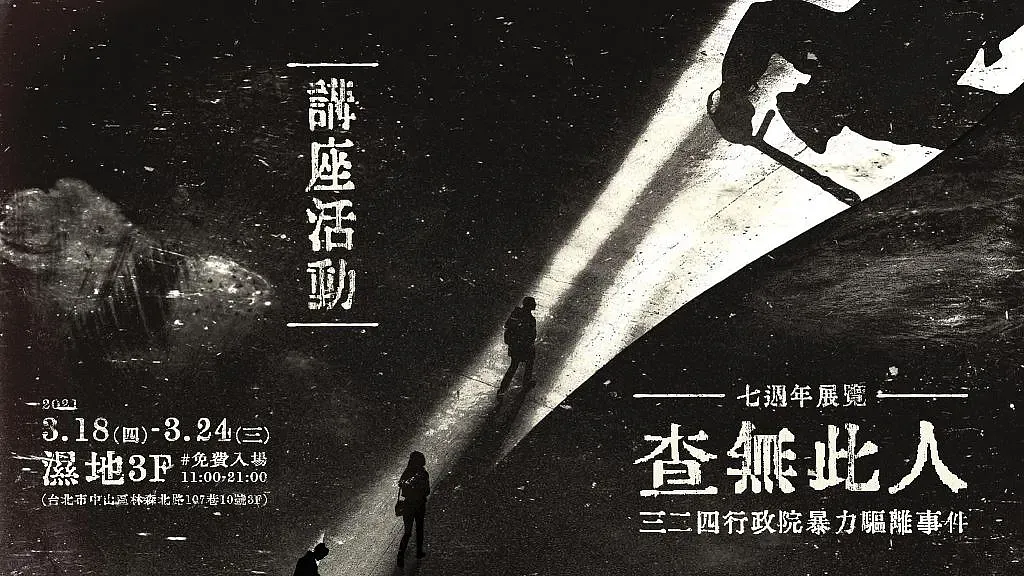
Lecture Series | No Such Person - Seventh Anniversary of the March 24 Executive Yuan Violent Eviction
Last edited: 2026-08-29
Seven years ago, the March 18 Movement erupted. From the occupation of the Legislative Yuan to the occupation of the Executive Yuan one week later on March 23, the largest occupation protest in Taiwan in recent years went on to have a profound impact on anti-authoritarian movements in Hong Kong, Thailand, and elsewhere in East Asia. The response of Taiwan's civil society and the actions of its judicial system also drew attention from around the world.
While the world remembers the inspiring side of the movement, the bloody history of the police's violent eviction on the night of March 23 seven years ago has gradually faded from memory. We do not want to forget. From March 18 to March 24, we will hold an exhibition and lecture series marking the seventh anniversary of the March 24 Executive Yuan violent eviction.
03/19 How Hard Is It to Hold State Violence Accountable? - Seven Years of Light and Shadow with the Pro Bono Attorneys Group
In recent years, when JRF has spoken with young lawyers, we have often heard them say, "March 18 awakened me." Both the movement itself and the work of the pro bono attorneys group that followed undoubtedly influenced many people. It was also a particularly remarkable and vibrant period in the history of lawyers' participation in public-interest work.
Article 1 of the Attorney Regulation Act states: "An attorney shall have the mission to protect human rights, realize social justice and promote democracy and the rule of law." Living up to that mission is no easy task.
At one point, as many as one hundred lawyers took part in the March 18 Anti-Black Box CSSTA Pro Bono Attorneys Platform. Many later stepped away because of career plans, relocation, illness, or heavy workloads. But the light and shadow of these seven years remain vivid for coordinator Yu Po-Hsiang and the four other lawyers who have continued accompanying the parties and working on the cases throughout these seven years: Lin Chien-Hung, Hsiao Yu-Hsin, Chang Ching-Ju, and Hung Wei-Sheng. Few understand more deeply how difficult it is to hold state violence accountable.
For this lecture, we have invited them to discuss just how difficult it is to hold state violence accountable. How do these lawyers understand the obstacles they have faced? What convictions and emotions have kept them going to this day?
- Time:2020/03/19 (Fri.) 19:00-21:00
- Location:Wetland, 3F
Chen Yu-Fan
Former Executive Director, Judicial Reform Foundation; helped establish the pro bono attorneys platform
Speakers
Yu Po-Hsiang, Lin Chien-Hung, Hsiao Yu-Hsin, Chang Ching-Ju, Hung Wei-Sheng
Attorneys from the March 18 Anti-Black Box CSSTA Pro Bono Attorneys Group who have worked on the cases for seven years
03/20 Scars of March 24 - Us, Seven Years Later
Year after year has passed, and this year marks the seventh anniversary of the March 24 Incident. Yet not a single police officer who used violence that night, nor any senior police commander, has been held accountable for the state violence that occurred.
Although seven years have passed, before the end of 2018 virtually none of the private prosecutions that had been filed had entered substantive trial proceedings. On May 30, 2019, five years after the March 24 Incident, numerous victims finally had their first opportunity to address the court during oral argument in the first-instance case brought by Chou Ni-An against Taipei City Police Commissioner Huang Sheng-Yung. It was not until July 2019 that the case became the first of the private prosecutions to receive a first-instance judgment.
"Isn't 'never again' the most important point of transitional justice? That is precisely why we should confront this kind of state violence now," one of the parties told the court at the time.
We have invited several of the parties to talk about how they feel, seven years later, about the conclusion that "no unlawful conduct was found." How have these seven years changed them? For them, has the movement-and the subsequent effort to pursue accountability-left any lasting meaning?
- Time:2020/03/20 (Sat.) 14:00-16:00
- Location:Wetland, 3F
Lo Wan-Ting Veteran attorney with the March 18 Anti-Black Box CSSTA Pro Bono Attorneys Group
SpeakersLin Jui-Tzu, Lin Chih-Chieh, Hsiao Kai-Wen Parties to the Executive Yuan violent eviction cases
03/21 Occupation Movements and Freedom of Assembly - Perspectives from Taiwan and Hong Kong
It has been seven years since the March 24 occupation of the Executive Yuan. The occupation movements of 2014 profoundly shaped discussion in Taiwan-and across East Asia and beyond-about freedom of expression and freedom of assembly.
In 2014, Tang Wen, a Hongkonger living in Taiwan, experienced Taiwan's occupation movement. That same year, Chiang Min-Yen, a Taiwanese living in Hong Kong, experienced Hong Kong's Umbrella Movement. What subtle parallels and contrasts did they observe on the ground? We have also invited Professor Lin Chia-Ho to discuss how recent social movements can help us understand occupation movements and freedom of assembly.
- Time:2020/03/21 (Sun.) 14:00-16:00
- Location:Wetland, 3F
Wang Ting-Yu Editor-in-Chief, Plain Law Movement
SpeakersLin Chia-Ho Associate Professor, Department of Law, National Chengchi University
Tang Wen Hongkonger living in Taiwan in 2014; staff member, Economic Democracy Union
Chiang Min-Yen Taiwanese living in Hong Kong in 2014; Secretary-General, Taiwan Citizen Front
This article is an AI-generated translation of the original Chinese text. In the event of any discrepancy, the Chinese version shall prevail.