
No Such Person | Post-Event Release for the Seventh-Anniversary Exhibition on the March 24 Executive Yuan Violent Eviction
Last edited: 2026-08-29
Photography / Kao Jo-Yu
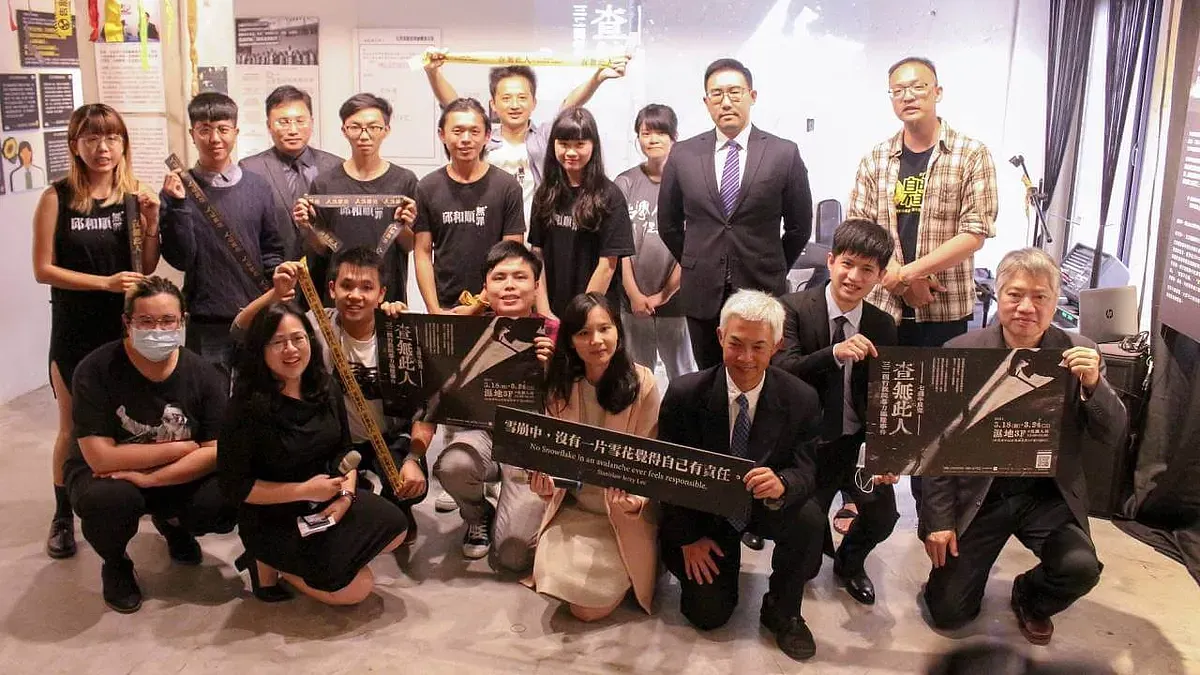
At 1:30 p.m. today, the curatorial team held the exhibition's opening press conference at The Wetland. A band formed by members of the "Hai-Wang's Daybreak" curatorial team opened with two songs, "Forgetting Is Not Our Specialty" and "Light." Seven years after the March 24 Executive Yuan violent eviction, no police officer who used violence that night has faced administrative discipline or criminal prosecution, and none of the senior officers who gave the orders or directed the operation on site has taken responsibility. Through this exhibition, the curators hope to preserve the history of that night and accompany visitors in the search for truth and the light of democracy.
After the performance, representatives of the co-organizing groups spoke about the seventh anniversary of the March 24 Executive Yuan violent eviction:
Yu Po-Hsiang / Convener, March 18 Anti-Black-Box CSSTA Pro Bono Legal Team:
Taiwan endured martial law and White Terror for far too long, when state violence was rampant and no one bore legal responsibility. We all know that history. What we never imagined was that, after so many years of democratic transition, the courts would still be so hesitant to confront state violence and would let it pass so lightly that, seven years later, the perpetrators remain "no such person." There is much to grieve and much to be disappointed by. But one thing still moves me deeply: so many people stayed that night to protect Taiwan even though they knew they might never obtain justice through law. The litigation failed and we did not identify the perpetrators, but we achieved at least one thing in court-we made the judiciary acknowledge that state violence truly happened. That distinguishes this case from earlier historical episodes such as the Kaohsiung Incident, in which even that acknowledgement was denied for years.
Kuo Hao-Jen / Curatorial Team Member and Attorney:
This exhibition is not only meant to remind us that state violence is never very far away. It also asks why Taiwan was able to become the Taiwan we have today. The Cross-Strait Service Trade Agreement, which once created such a strong fear that Taiwan's future was at risk, did not simply disappear. Taiwanese people shed blood to stop it. We should be proud of that. State violence is terrifying-batons striking heads and bodies, shields driven into people's shins, people surrounded, beaten, and kicked. But Taiwanese people did not submit to that violence, and we will not submit to it in the future. We will remember this history and keep moving forward.
Chen Mei-Hui / Curatorial Team Member and Director:
The 2014 anti-CSSTA movement drew in enormous numbers of people and even changed the direction of Taiwanese politics. For me, it also ran through seven years of my work at JRF: taking 24-hour shifts inside the occupied Legislative Yuan, witnessing the March 24 violent eviction, and then pursuing accountability for state violence. Injured people walked into JRF carrying medical certificates. Lawyers and clients crowded into a tiny room and watched the eviction footage again and again. Everyone hoped the judiciary might provide some truth or justice. But year after year passed. Seven years later, it is still "no such person." The violence of that early morning feels frozen in time, while those involved have gradually become disappointed through the litigation. This exhibition is meant not only to remind society of what happened seven years ago and preserve the record, but also to offer some gentleness and comfort to everyone who has walked this road.
Wang Hsi / Deputy Secretary-General, Taiwan Association for Human Rights:
I was only a university student when March 24 happened. As someone studying law, it was the first time I felt that law could be utterly useless. But many classmates and friends refused to give up. Instead, they showed me how law could still matter: litigation could force open the courthouse doors and require a government agency such as the Executive Yuan to answer for wrongdoing; it could establish that even in a democracy, police can still beat people; and it could make history remember what happened. I hope visitors carry those memories of the scene with them and refuse to forget.
Chang Yu-Meng / Chairperson, Taiwan Youth Association for Democracy:
For me, the most important lesson of March 18-beyond confronting the China factor-was that defeatism does not work in Taiwan. Young people can face our history together and look toward the country's future. But March 24 left many things we still have not been able to confront or uncover. Young people today may find it hard to imagine that people our age were once prosecuted by the state simply for participating, while the state violence used against them still has no identified chain of responsibility. There are two things we can do now: continue struggling against injustice both inside and outside the system, and undertake a serious project of memory. Our generation has to remember this together.
Hsu Wen-Tang / President, Taiwan Professors Association:
The police officers who beat people may feel fortunate because they were never identified, but they were only instruments. Then-Premier Jiang Yi-Huah, a scholar of the "banality of evil," ultimately became part of that banality himself. As the opening song said, "Forgetting is not our specialty." We must learn to be people with memory. Only memory can prevent those in power from doing the same thing again.
Huang Yu-Chung / Deputy Chair, Human Rights Committee, Taipei Bar Association:
When the March 18 movement began, attorney Wellington Koo called for formation of a pro bono legal team. The Taipei Bar Association, Legal Aid Foundation, and Judicial Reform Foundation then created a platform connecting lawyers with people at the protest sites who needed legal assistance or feared prosecution for participating. It provided extensive pro bono legal services.
Many of those at the Executive Yuan were university or high-school students who went there outside class. They were beaten, physically injured, and terrified, sometimes too afraid even to tell their parents. A month later, some received police notices telling them they were being investigated or prosecuted for trespass. That is naked violence by the state apparatus: people were injured by the state and then suffered a second injury through prosecution. The pro bono legal team did not retreat. Under the leadership of Wellington Koo and Yu Po-Hsiang, now President of the Taipei Bar Association, hundreds of attorneys went to protest sites, rotated shifts at the Legislative Yuan, gave short legal briefings on Jinan Road and Qingdao East Road, provided consultations, distributed informational materials, and later served as pro bono defense counsel when the state prosecuted protesters. Unfortunately, when those same lawyers helped injured participants pursue the people who had used violence against them, the justice system ultimately answered: "no such person." That became a third injury. This exhibition is therefore not only about remembering the seven years since the Sunflower Movement. It records a moment in Taiwan's history when ordinary people questioned and challenged their government. Seven years of commemorations have already written the episode into Taiwan's history. The state should not imagine that people have forgotten. If a similar protest movement happens again, I believe people in Taiwan will still stand up to challenge state power-and the public should know that lawyers will still be standing behind them.
Chiang Min-Yen / Economic Democracy Union:
Standing in front of the video wall filled with news footage still produces an intense physical reaction for me. Looking back, what remains is not only sadness. The anger toward those in power and the pursuit of justice became part of the life experience of an entire generation of young people, and that is one reason so many people in Taiwan have since devoted themselves to so many different causes. In Hong Kong in 2019 and Myanmar in 2021, we saw similar scenes. Taiwan's continuing efforts are not only for ourselves. They are also a small but meaningful contribution to humanity's struggle against repression by China and other authoritarian regimes.
Hung Chung-Yen / Deputy Secretary-General, Taiwan Forever Association:
In past episodes of state violence, the perpetrators often became "no such person," and sometimes even the victims became "no such person." That is part of what transitional justice tries to address. Yet with contemporary state violence, a digital surveillance network can make people at risk of infection nearly impossible to hide, while many perpetrators still somehow "must" remain unidentified. The judiciary still cannot deliver justice. Responsibility may extend beyond individual police officers to administrative agencies, senior officials, and perhaps even judicial officers who function as accomplices. Speaking finally in my personal capacity, I sincerely invite Fang Yang-Ning-the then-chief of Zhongzheng First Precinct and a police official celebrated for the crackdown, who has since been promoted repeatedly-to visit the exhibition. Much of what is displayed here records what happened under your command. You are welcome to come see it.
Lee Ming-Ju / Attorney, Judicial Reform Foundation:
Some clients still cannot bring themselves to watch recordings of the violence from that night. We therefore placed the footage in small enclosed areas behind curtains so that visitors who do not want to see it can avoid it. But for people who were not there at all, we truly hope you will watch. This happened in democratic Taiwan in 2014-not in some other authoritarian country, and not in a distant era.
Press Contact
Lee Ming-Ju / Attorney, Judicial Reform Foundation
This article is an AI-generated translation of the original Chinese text. In the event of any discrepancy, the Chinese version shall prevail.