
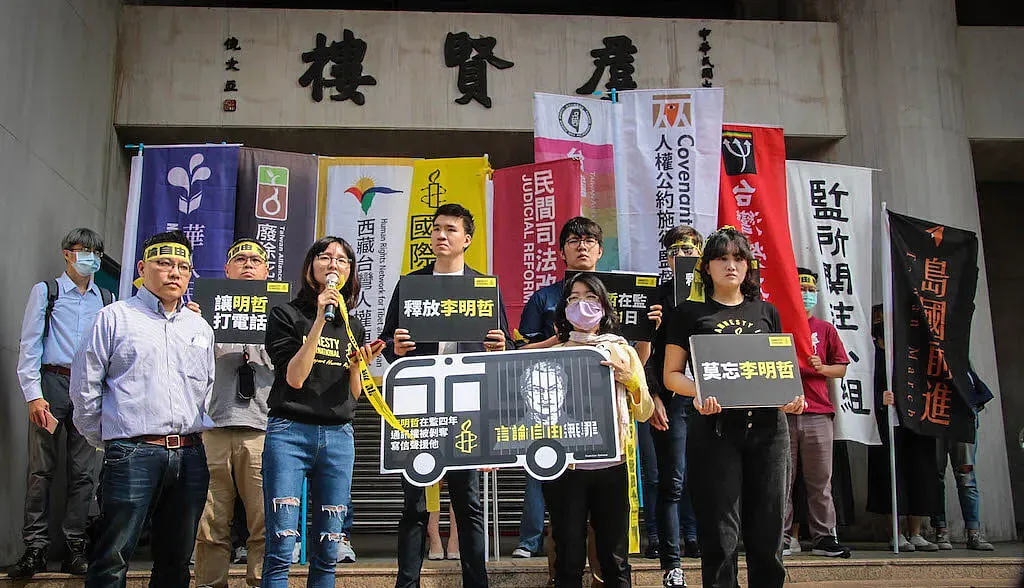
Four Years Since Li Ming-Che's Arrest: Restore His Right to Communicate and Announce His Release Date
Last edited: 2026-08-29
Today marks four years since Li Ming-Che was forcibly disappeared and detained in China. Since the COVID-19 outbreak began last year, he has lost all meaningful ability to communicate with the outside world: his family cannot visit, and he has been unable to make family phone calls or correspond normally by mail. Li has now served four years of his five-year sentence. Because his family was never served with the judgment, however, they still do not know his official release date. His wife, Li Ching-Yu, attended today's press conference to explain the family's demands.
Chiu I-Ling, Secretary-General of Amnesty International Taiwan, said Li Ming-Che has now been imprisoned in China for four years. Since the pandemic began, his wife has been unable to visit him at Chishan Prison and Li himself has effectively been cut off from the outside world. Chinese authorities have still not responded to the family's request that he be permitted to make family phone calls. Amnesty International called on the Chinese government to protect Li's right to communicate, permit correspondence and family calls, and safeguard his right to health. To draw wider attention to his situation, Amnesty International Taiwan placed campaign messages on Taipei bus routes 235, 299, 307, and 262. Chiu encouraged people to keep writing to Chishan Prison in support of Li Ming-Che and to write to Li Ching-Yu as well, so that she also feels continued solidarity.
Li Ching-Yu thanked civil-society groups and people in Taiwan for four years of support and letter-writing, even though Li Ming-Che has been unable to receive those letters. Since the pandemic, his isolation has become even more complete. She said she could understand suspension of in-person visits for public-health reasons, but China had gone much further by prohibiting even basic correspondence and telephone calls; since visits stopped, she has received only one letter. Relying on Chinese law, she made three demands: first, Li has served more than half his sentence and therefore meets the threshold for consideration of parole; second, if visits cannot take place during the pandemic, he should at least be allowed to speak with his family by telephone; and third, he should be allowed normal correspondence with the outside world. For a political prisoner, she explained, maintaining individual will is critical. Information from the free world gives a person strength.
Legislator Chiu Hsien-Chih noted that Articles 47 and 48 of the Prison Law of the People's Republic of China permit prisoners to correspond with others and receive visits from relatives, and that Hunan Chishan Prison already operates a family-telephone system. Li Ming-Che's right to communicate should therefore not be unlawfully denied. Criminal judgments should also clearly state how the sentence is calculated and accurately record the period of custody. Chinese criminal-procedure law requires service of the judgment on the defendant and relevant family members and counsel. The family still does not know Li's release date precisely because the judgment was never properly served, and to this day no family member has seen it. Chiu said people in Taiwan would continue watching closely to see whether China truly governs "according to law" or instead subjects Li Ming-Che to special treatment outside its own rules. He also urged the public to keep writing letters, which can bring hope to people in prison.
Legislator Freddy Lim said four years had passed since Li Ming-Che was arbitrarily arrested and imprisoned by China's authoritarian government. The detention violates international human-rights standards as well as China's own law. Some observers once hoped that economic development would lead China toward greater respect for human rights, he said, but the government's conduct during the pandemic had destroyed those expectations. China not only denied Li rights he should have enjoyed, but cut off even basic correspondence and family contact, leaving relatives unable to determine his health. If public attention fades, such conditions will only worsen. Lim called on people to keep watching the case, connect international support, and continue pressuring China.
Chang Chih, Deputy Director of JRF's Advocacy Department, said Chinese law requires a court to serve its judgment on the defendant and close relatives, yet that did not happen in Li Ming-Che's case, violating basic due process. Based on the sentence as understood under Chinese law, Li should complete his term around April 14, 2022. But in China, completing a sentence does not necessarily mean regaining freedom. Human-rights lawyer Jiang Tian-Yong, for example, completed his sentence in February 2019 but was immediately subjected to unlawful house confinement and has continued to face restrictions on medical care, travel, and reunion with his wife and daughter. Those are restrictions on personal liberty beyond the judgment itself. Li could face similar treatment. Chang therefore called on China to announce Li's release date publicly and to release him immediately when the sentence expires.
Shih Yi-Hsiang, Secretary-General of the Taiwan Association for Human Rights, said the pandemic-era restrictions have made it impossible to know Li Ming-Che's health condition or even whether he has been transferred to another prison. Other imprisoned human-rights lawyers around the world have still been allowed visits and communication. Because prisons make social distancing particularly difficult, governments should provide additional health protections for people in detention rather than use the pandemic to isolate them further. Shih called on the Chinese government to release Li immediately: freedom of expression is not a crime.
Yang Kang, Researcher at Covenants Watch, said Li Ming-Che's treatment should comply with the United Nations Standard Minimum Rules for the Treatment of Prisoners (the Nelson Mandela Rules) and raised concerns under the Convention against Torture. Li's health was especially worrying. During his four years in prison, reports indicated that he had been forced to work excessive hours, given spoiled food, and deprived of cold-weather clothing. Since early 2020, there has been no reliable way to know whether he has received necessary medical care and other conditions needed to maintain his health during COVID-19. And since the previous August's press conference marking the International Day of the Victims of Enforced Disappearances, Li has still been unable to call his family, a form of treatment that can itself harm mental health.
Kuo Li-Hsuan, Advocacy Director of New School for Democracy, said the Xi Jinping government imprisoned Li Ming-Che four years earlier in an attempt to deter Taiwanese people from supporting human rights and democracy in China. Democratic solidarity among people in Taiwan and Hong Kong resisted that effort, yet repression has since intensified: Uyghurs remain confined in mass detention facilities, dozens of elected Hong Kong representatives have been arrested, and Chinese authorities have publicly announced the detention of additional Taiwanese whom Kuo described as more "Li Ming-Ches." As long as people anywhere remain without freedom-especially in China, the society geographically closest to Taiwan and deeply connected with it-Taiwan's own security and way of life cannot be taken for granted. Kuo called on more people in Taiwan, and across Asian democracies facing the same authoritarian threat, to recognize that attention to human rights in China is both a shared responsibility and a shared interest.
Attendees
Moderator
Chiu I-Ling / Secretary-General, Amnesty International Taiwan
Speakers
Li Ching-Yu / Family Member of Li Ming-Che
Hung Sun-Han / Legislator
Chiu Hsien-Chih / Legislator
Fan Yun / Legislator
Freddy Lim / Legislator
Chang Chih / Deputy Director, Advocacy Department, Judicial Reform Foundation
Shih Yi-Hsiang / Secretary-General, Taiwan Association for Human Rights
Yang Kang / Researcher, Covenants Watch
Kuo Li-Hsuan / Advocacy Director, New School for Democracy
Organizers
Amnesty International Taiwan
Judicial Reform Foundation
Taiwan Association for Human Rights
Covenants Watch
New School for Democracy
Taiwan Forever Association
Taiwan Labour Front
Wenshan Community College, Taipei
Taiwan Alliance to End the Death Penalty
Human Rights Network for Tibet and Taiwan
Taiwan March
International Federation for Human Rights (FIDH)
Prison Watch
This article is an AI-generated translation of the original Chinese text. In the event of any discrepancy, the Chinese version shall prevail.