
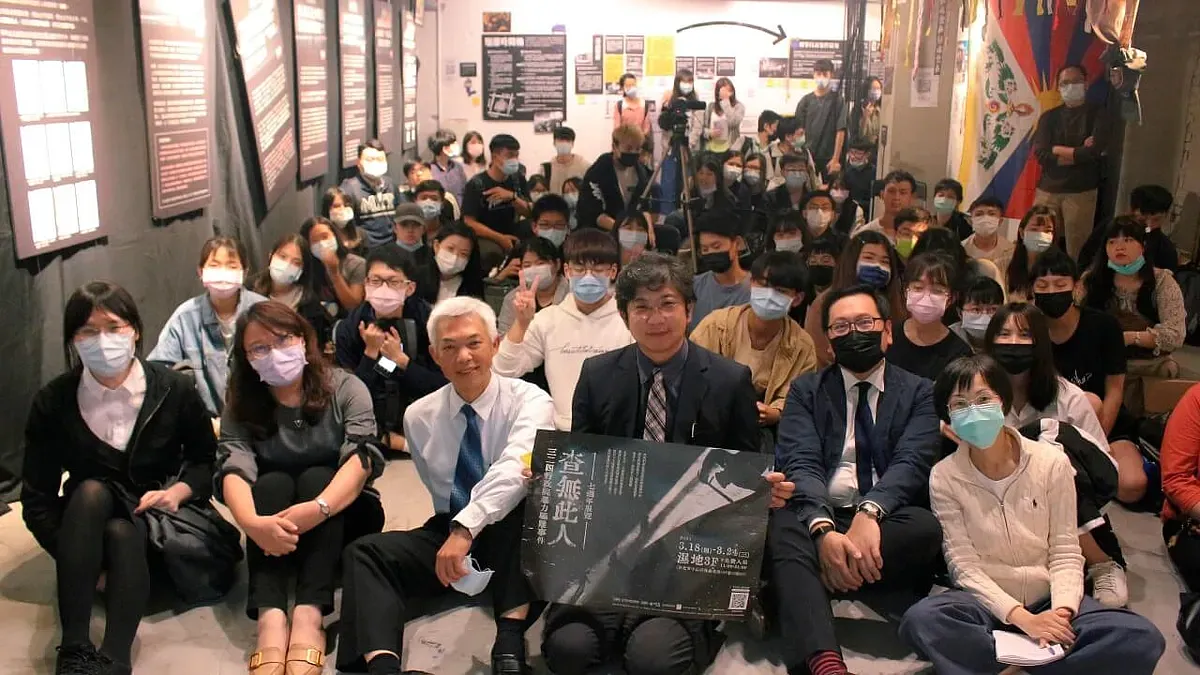
No Such Person | Lecture Record: How Hard Is It to Hold State Violence Accountable? Seven Years of Light and Shadow with the Pro Bono Legal Team
Last edited: 2026-08-29
In recent years, JRF has often heard younger attorneys say that "March 18 was my political awakening." The movement itself-and the work of the pro bono legal team that followed-undoubtedly shaped many people and marked an unusually active period in the history of lawyers' participation in public-interest work.
Article 1 of the Attorney Regulation Act states that attorneys have a mission to protect human rights, realize social justice, and promote democracy and the rule of law. Living up to that mission is not easy.
At one point, hundreds of attorneys participated in the March 18 Anti-Black-Box CSSTA Pro Bono Legal Platform. Many later stepped away because of career changes, relocation, illness, or professional demands. But convener Yu Po-Hsiang and attorneys Lin Chien-Hung, Hsiao Yu-Hsin, Chang Ching-Ju, and Hung Wei-Sheng continued walking with the clients through seven years of light and shadow-and experienced firsthand just how difficult it is to hold state violence accountable.
For this lecture, we invited them to discuss a simple but difficult question: how hard is it to pursue accountability for state violence? How do lawyers understand those obstacles, and what feelings and convictions have kept them going for seven years?
■ Yu Po-Hsiang / Attorney
"Logic alone cannot keep a person going for seven years. I think the lawyers sitting beside me feel the same way. What has kept us going-losing again and again and still returning to fight-is passion. Lawyers are strange creatures. We have to remain extremely calm in court, but what enables us to remain calm under pressure from judges and prosecutors is the passion inside us."
"From the beginning, I knew our chance of winning was close to zero. But the cases still had to be brought. Look at Taiwan's history under authoritarian rule: when the state used violence, did the justice system hold anyone accountable? No. After the Formosa Incident or the May 20 Farmers' Movement, not one government official or police officer was held responsible. Of all the cases involving police torture, how many police officers have actually been convicted? There are only a handful, including the Chang Fang-Tien case and the Chiu Ho-Shun case. The bitter irony is that even when police officers were convicted for torture, the defendants could still remain convicted. Taiwan's courts have historically shown extraordinary tolerance toward state violence."
"Even after decades of democratic transition, I remain pessimistic about whether courts will have the courage to convict police officers. But litigation still matters. Through evidentiary investigation in court, victims can place their experiences on the record. Police footage, news footage, and other evidence can be assembled into a judicial record. History has to be preserved in this way. Otherwise, twenty years from now people may have no idea what happened that night and simply accept the official narrative that everyone there was a rioter."
/
■ Chang Ching-Ju / Attorney
"We grew up believing Taiwan was already a very democratic country. I had only recently begun practicing law when March 24 happened, and I could not imagine police beating people like that. The images were extremely heavy for me, and seeing them again in the exhibition still feels heavy. Early the next morning I received a call asking me to accompany detainees during questioning. So many people had been arrested that lawyers were dispatched not only to Nangang but to police stations across the city. What stayed with me most strongly was the feeling, during those interviews, that the police still did not think they had done anything wrong."
"I am deeply grateful to the clients who stayed with us for seven years. Some eventually stepped away, and that is completely understandable. If none of us could see a realistic prospect of accountability, wanting to leave was natural. By the later stages of the litigation, time had made many people forget. I hope this exhibition can bring some of those memories back."
/
■ Lin Chien-Hung / Attorney
"Facebook reminded me that, on March 18 seven years ago, I was eating shaved ice at Lily Fruit Shop in Tainan and living a peaceful life. That is how life works: suddenly a huge event happens and the wheel of history rolls right over you. People say you can either make history or follow it. The people who joined March 18 had the courage to make history. The fact that we can stand here today and speak freely about what matters to us may be connected to the freedoms they defended seven years ago. Otherwise, perhaps Taiwan could have ended up looking more like Hong Kong."
"On March 23, I was scheduled for a shift inside the Legislative Yuan when news arrived that people at the Executive Yuan were being arrested. Ting Wen-Sheng and I told Wellington Koo that we should go over and see what was happening, so we put on our lawyers' robes and hurried through the night."
"The presumption of innocence tells us that if we cannot identify the person who used the violence or obtain evidence, we cannot prosecute someone just because we suspect them. But we still have to struggle. One of my clients was simply sitting on the ground while people around him shouted, 'Peace, peace.' He was dragged behind the police shields and came out with blood all over his face. When I watched the footage afterward, the words 'peace, peace, peace' kept echoing in my mind."
"I often talk about the 'ontology of an event.' If you climb a mountain and then come back down, the net physical work may be zero, but the fact that you climbed the mountain does not disappear. The same is true of what this pro bono legal team did. The struggle itself cannot be erased."
/
■ Hung Wei-Sheng / Attorney
"I see many young faces here. As Attorney Chang said, it is difficult to imagine something like this happening in a democracy. Many people here never had the experience of taking to the streets under an undemocratic government while worrying about their own safety or their family's. I was fortunate-or unfortunate-in that my father was also an attorney and handled many opposition-movement cases, including defense work arising from the May 20 Farmers' Movement. Every time another street protest occurred, I would see him return home in the middle of the night, sometimes talking about losing a shoe after being thrown aside or about someone whose head had been beaten bloody. My uncle was a police officer, so there were even moments when my father and his own older brother stood on opposite sides of a protest line. People five or ten years younger than me may have no memory of that world. Then March 18 and March 24 happened, and suddenly it felt as though those childhood memories had returned. They were not nearly as far away as I had thought."
"Most people here today probably share similar views. Outside that circle, the case looks very different. Some people say: you lawyers had no evidence and still brought private prosecutions; you knew a private prosecutor could not simply expect the court to investigate everything for you; you lost, and now you are gathering among yourselves for comfort. But I still think we have to give this history depth and keep telling it. If this country cannot hold anyone accountable for something that happened only seven years ago, isn't it extravagant to talk about accountability for what happened seventy years ago?"
"The exhibition quotes part of one of my closing arguments. We happened to argue one hearing around the fortieth anniversary of the Formosa Incident. Forty years earlier, people who went into the streets became defendants before a military court. Forty years later, citizens have still not obtained a result in their effort to hold the state accountable-but at least today the citizens are the plaintiffs, asking the state to answer. Is that progress? Yes. Is it enough? No. We still have to keep going."
/
■ Hsiao Yu-Hsin / Attorney
"The first private-prosecution case, brought by Mr. Chou Jung-Tsung, was filed by my boss. At the time I was just a junior associate. I was assigned to explain how difficult it is to pursue accountability for state violence, so I will describe the obstacles through that experience."
"First, to bring a private prosecution you need an attorney. Then comes the question: whom do you sue? Mr. Chou's chain of command ran from Ma Ying-Jeou and Jiang Yi-Huah through Wang Cho-Chiun, Huang Sheng-Yung, Hsueh Wen-Jung, and unidentified police officers, but that chain was split into three separate cases. If one private prosecutor had not sued a particular person but another private prosecutor had, the first victim had to ask to participate in the other case. When we tried to add claims in the case involving Hsueh Wen-Jung, the request was immediately rejected, and we were not even notified as victims so we could express our views. The Huang Sheng-Yung case was somewhat better: apart from Chou Ni-An, the others could not act as private prosecutors but could speak as victims. Yet we still could not question witnesses. In cases against unidentified police officers, the court sometimes gave only five days to cure the filing or dismissed it."
"In the end, the cases were steadily narrowed down. Duplicative prosecutions were rejected; unidentified officers could not be prosecuted; what remained were cases against senior commanders in the chain of command. The courts then concluded that only a small number of officers had lost control emotionally, that the commanders could not have controlled them, and therefore that the commanders lacked an intent to inflict unlawful harm. Those private prosecutions failed as well. Seven years of attempts at criminal accountability ended without a successful conviction."
/
■ Chen Yu-Fan / Attorney
"After March 18, people came to think of JRF as an organization with a lot of lawyers. JRF itself was not on the front line as an organization, but Wellington Koo-then a JRF board member-was already thinking about whether constitutional litigation could address the way the CSSTA had been pushed through in roughly thirty seconds. At meetings, public-law scholars were invited to discuss constitutional review, while we were simultaneously thinking about how to provide legal assistance and support to protesters. From that simple idea we began inviting lawyer friends to join. Nearly 400 lawyers responded at the beginning, offering to accompany people during questioning and help with litigation. Even later, one or two hundred attorneys continued attending legal-team meetings on a pro bono basis. The same network later supported a series of social movements and cases, including those on April 11, April 27, April 28, and June 26."
"Running a legal team of that size also depended on enormous volunteer labor. Volunteers made hundreds of phone calls and sent hundreds of emails to coordinate lawyers and clients-administrative work that a small NGO like JRF could never have carried alone. Other volunteers helped collect and review video footage from the events. The entire platform depended on the work of many people whose names the public may never know, and we are deeply grateful to both the attorneys and the volunteers."
"Seven years is a long time. The lawyers' lives have changed in many ways, but the litigation has continued. We hope people will keep walking with us until the end and see how the justice system ultimately responds to state violence. Whatever the final outcome, at least we will know-and remember-what we experienced."
This article is an AI-generated translation of the original Chinese text. In the event of any discrepancy, the Chinese version shall prevail.