
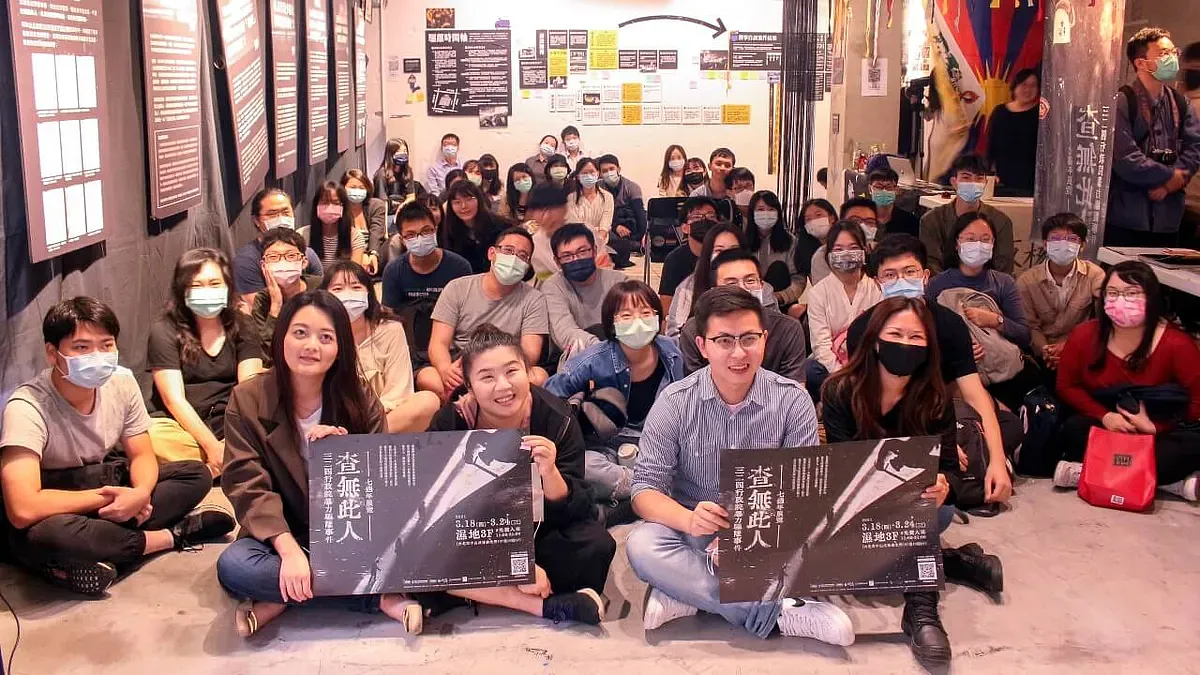
No Such Person | Lecture Record: Scars of March 24 - Seven Years Later
Last edited: 2026-08-29
Year after year has passed, and March 24 has now reached its seventh anniversary. Still, no police officer who used violence that night-and no senior police commander-has been held accountable for the state violence of the eviction.
Although seven years have passed, almost none of the private-prosecution cases had entered substantive review before the end of 2018. It was not until the first-instance oral argument on May 30, 2019 in Chou Ni-An's private prosecution of then-Taipei City Police Commissioner Huang Sheng-Yung that many victims were given their first real opportunity to speak in court. That case did not produce the first first-instance judgment in the March 24 private prosecutions until July 2019.
"Isn't 'never again' the most important part of transitional justice? That is exactly why we have to confront this kind of state violence now," one litigant told the court. We invited several people directly involved in the cases to talk about how they feel seven years later, after the legal process ended with "no unlawful conduct found." How have those seven years changed them? Did the movement-and the effort to pursue accountability afterward-leave any lasting meaning?
/
■ Moderator: Lo Wan-Ting / Attorney
"Seven years ago, when the March 24 occupation of the Executive Yuan took place, attorneys on duty at the scene used a LINE group to call more lawyers over to prepare to accompany people during police questioning. Before we could do that, the police began clearing the site. For about half an hour, the lawyers functioned like a conveyor belt, helping carry injured people out rather than doing anything recognizably 'legal.' Someone asked us to go inside the Executive Yuan and tell people to leave. I found that almost impossible: assembly was their freedom-what right did I have to order them out? But if I encouraged them to stay, I could be accused of inciting an offense. So I simply told the people inside that the police were preparing to clear the building and that they might be injured, and asked them to decide for themselves whether to leave. What I remember most is that no one left."
"As a lawyer walking with these clients, I have felt both guilt and enormous admiration. Repeatedly telling a court about your pain-and then having to persuade the court that the pain was real-is itself painful. On top of that came social stigma. Some people treated the March 24 private prosecutors as criminals or rioters. Every time the legal team received a ruling refusing to entertain a case-meaning the court would not hear it, or would not proceed because the officer who used the violence could not be identified-I had to ask the client whether to appeal again. I always felt torn. Of course I wanted them to continue, but I also understood how exhausting that persistence was. People who appeared in court had to listen to commanders suggest that they had hit their own heads or simply fallen down."
"For many people, March 18 and March 24 are already over. But if the events are never properly addressed, they are not really over at all. I do not know whether Taiwan will see protests of that scale again. If something similar happens, each of us will face a choice: will you be willing to step forward? Everyone attending this lecture is like a seed. Thank you for sprouting today-but don't only sprout. Keep growing, and carry this with you wherever you go."
/
■ Lin Chih-Chieh / Litigant
"I cried after walking through the exhibition just now. So much of it is our own memory. I began as a student full of expectations for society. Then the movement happened and I was beaten. I kept thinking about how we could change the world and make Taiwan better. At the time I felt the government did not believe ordinary people could think for themselves and wanted to stop us from thinking. We were sitting inside expressing our demands when police began striking our hands with batons. I was terrified of being separated from the people beside me because I had no idea where I would be taken. But I had to convince myself not to be afraid because the people around me were even more frightened. Some police officers were kind, but to this day, when I see police, part of me is afraid."
"During the eviction, a police officer kicked me with a boot. I kept saying I wanted to leave, but I could not stand up. Behind me I could hear another officer saying, 'That's right-hit him.' I was terrified and begged them to stop, but it did nothing. By the time they dragged me outside I had lost consciousness. A man carried me on his back and ran toward the first-aid station shouting that someone had passed out. I remember thinking I had finally been saved. The next thing I knew, I woke up in the hospital. The injured person shown later in the exhibition, with blood all over his head, was in the bed beside mine. He kept worrying that if the television news showed him, he would lose his job, and he desperately wanted to leave."
"The hospital brought a second kind of suffering. I had been a healthy person, but suddenly I could not stand or walk to the bathroom. An elderly man with white hair helped me there. I was terrified that I would never stand again. I could not even lift a spoon to my chest. I kept telling myself I was strong, but I did not dare tell my family how much pain I was in or how hard rehabilitation really was-holding the railings to walk slowly, going through electrical stimulation, and trying to regain basic movement."
"The seven years of litigation were exhausting in another way. Every time I entered a new workplace, it seemed a court summons would arrive and I would have to explain to my supervisors why I needed to go to court. The documents contained words like 'attempted murder,' 'Ma Ying-Jeou,' and 'Jiang Yi-Huah,' and I would acquire a strange label. Bosses did not know what to make of me. During my military service I received two or three summonses. You cannot simply take leave in the military, so every request had to be submitted far in advance-and every time I had to explain the story again to the platoon leader, the company commander, and then someone higher up."
/
■ Lin Jui-Tzu ("Hsiao-Chiu") / Litigant
"I'm Jui-Tzu; everyone calls me Hsiao-Chiu. I was inside the Executive Yuan lobby that night. There is plenty of legal material about what happened, and you can find videos online showing the injuries. I still cannot look directly at those images. What I want to talk about instead is what happened outside the courtroom."
"I was a graduate student at the time. After I was injured, I stopped going to school. Professors in my department did not support the anti-CSSTA movement and insisted that every student return to class, so I was absent for a week. When I finally returned, I encountered labels everywhere. Some of the comments shown in the exhibition were said by my own adviser: in class, 'Hsiao-Chiu is like a Red Guard'; in front of other professors, 'Only someone stupid would go to the Executive Yuan'; younger students called me 'too political.' I could not face that adviser anymore, so I suspended my studies. I later tried to return and finish the degree. I knew I had not done anything wrong, but facing the same people and environment was too painful. Eventually I gave up the degree and enrolled instead in Soochow University's human-rights graduate program."
"I grew up in a very conservative, strongly KMT-leaning family. My parents supported Ma Ying-Jeou and later voted for Han Kuo-Yu. Because I left home for school after junior high, their politics did not define mine, but they always told me Taiwan was too small to become strong without China's help. In 2014, when they saw young people's political ideas on the news, that became my political coming-out. My mother knows about the seven years of litigation; my father does not. My mother worries constantly and tells me politics is frightening and I should stay away. Perhaps that fear comes from having lived through martial law."
"When the private-prosecution cases ended last year, I fell into a very low place and disappeared from people for a while. I wondered whether everything would simply become another page in a history textbook. Had all those trips to court meant anything? Then people began sharing the documentary *The Sun Is Not Far Away* again, and I remembered that I appear in the segment 'I Grew Up Overnight.' I saw myself, more than six years earlier, asking: 'Has this country changed, or has it never changed at all?' Those of us who grew up after martial law genuinely believed state violence could not happen here."
"I was fortunate that after March 24 I met documentary filmmakers and, through them, the Chen Wen-Chen Memorial Foundation. The wounds I carried were, in some sense, received and held there. I went with the Foundation to Green Island for White Terror camps five or six times. I watched survivors in their seventies and eighties travel all the way there to speak to young people for thirty minutes, almost as though they were risking their lives to make sure the story was told. At first I did not understand why organizers would put older people through so much trouble, even if returning to the place had meaning."
"Later I joined the Foundation's human-rights banquets and kept listening to survivors' stories. I came to believe those stories had to be carried forward. We also worked with a theater group to talk about the White Terror with very young children; children can understand freedom and democracy. Later came the 'Parallel Lives' exhibition, asking what these people's lives might have been without the White Terror. I began asking what my own life would have been without March 24. It felt like a meteor that knocked my life onto a different orbit. Every time the litigation went badly, I thought of those older survivors. So every time the lawyers asked whether I wanted to appeal, I said yes. If we want transitional justice, we first have to face state violence happening in our own time. Only then can 'never again' mean anything."
"Yesterday I was trying to decide what to say today. I realized I had spent years asking what the litigation meant without noticing that all these apparently scattered things I did afterward were themselves the meaning."
"Every interview forces me to be brave one more time so that the story can surface one more time. But I know my limits. I have an SOP for talking about this; even today I did not describe the details of March 24 itself. The trauma is still there. For years I could not wear my hair long because it reminded me of what happened when I wore a ponytail in 2014. I kept it short until 2019, then slowly began growing it again. That is one small way I have tried to work through what remains."
/
■ Hsiao Kai-Wen / Litigant
"Hello, I'm Kai-Wen. The three litigants speaking today were all in the Executive Yuan lobby that night, although we did not know one another then. In 2014 I had just been admitted to graduate school. I was a single mother studying curatorial practice. When I heard JRF was organizing an exhibition, I immediately volunteered because it was my field and because the subject mattered to me. Then I realized I had said yes too quickly. My mind and body could not actually handle the litigation materials. I thought I could contribute, but as soon as I saw the case records I wanted to retreat. That is one reason I admire how much Hsiao-Chiu has done since the incident. I have tried to understand where my own difficulty and pressure come from. Part of it is that I still do not fully trust Taiwan's political environment-not only the KMT, but the DPP as well."
"A few days ago I forced myself to watch some old footage. I looked at my younger self and thought: my eyes were shining; I looked so certain. That sincere person from 2014 now feels strangely unfamiliar and even a little embarrassing. My daughter was in seventh grade then. While I was inside the Executive Yuan, she drew a picture of me and said I was defending the country. I told her I might go to jail. Now she is a university student studying sociology at National Chengchi University. Before this talk I asked how she sees the mother she knew then. She said she had been too young to understand the whole picture, but looking back now she believes the movement really did stop the CSSTA and deepen public discussion of state violence. She also sees every social movement-whether passionate or rational-as something built on accumulated efforts, not only the Sunflower Movement but the movements that came before it."
"Before sleeping last night I asked myself whether I regret the decision I made. People have asked me that for seven years, and 'regret or not' always feels like a true-or-false question. After hearing my daughter's answer, I think I do not regret it. We used our bodies as witnesses. When I was young, my father drove a taxi and participated in street movements, and that shaped me. I, in turn, shaped my daughter. The meaning is not mine alone. It is collective, and it belongs to an era."
This article is an AI-generated translation of the original Chinese text. In the event of any discrepancy, the Chinese version shall prevail.