
No Such Person | Lecture Record: Occupation Movements and Freedom of Assembly - Taiwan and Hong Kong
Last edited: 2026-08-29
Seven years have passed since the March 24 occupation of the Executive Yuan. The occupation movements of 2014 profoundly shaped Taiwan-and influenced wider discussion across East Asia and beyond-about freedom of expression and freedom of assembly.
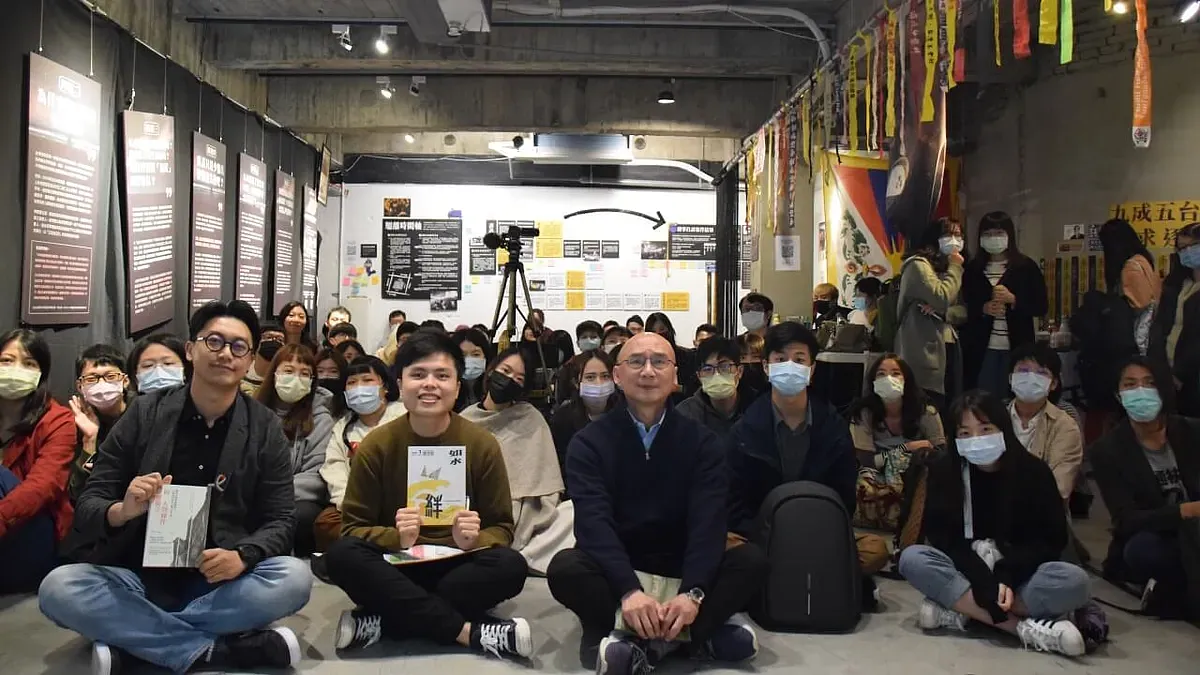
In 2014, Tang Wen was a Hongkonger living in Taiwan and experienced Taiwan's occupation movement. That same year, Chiang Min-Yen was a Taiwanese student in Hong Kong and experienced the Umbrella Movement. What echoes and contrasts did they see between the two movements? We also invited Professor Lin Chia-Ho to reflect, through recent social movements, on occupation as a form of protest and on freedom of assembly.
■ Lin Chia-Ho / Associate Professor, Department of Law, National Chengchi University
"When Chiang Ching-Kuo died, I was at a concert with friends. The Wild Lily student movement happened while I was in graduate school. After I went to Germany, Hong Kong was handed over to China. While I was there, I joined a protest at Cologne Cathedral against China's missile intimidation of Taiwan and its attempt to prevent direct presidential elections. After I returned to Taiwan to teach, the Red Shirt movement happened. Taiwan really has moved forward step by step. Older people can trace that progress through their own memories. Many of the dramatic changes we lived through once seemed impossible-either because we assumed the worst could never happen, or because we believed that even if it did, we would have no power to resist it."
"For Taiwan under martial law, Hong Kong once looked like a beacon. It represented freedom and human rights. Although it was itself a colony, Hong Kong offered Taiwanese people a glimpse of hope. Before martial law ended, my father often went to Hong Kong to read books banned in Taiwan and came home describing how suffocating Taiwan felt. That is one reason Hong Kong has always affected me so deeply. Apart from a few Tangwai magazines, free expression was extremely difficult to encounter in Taiwan then."
"I keep wondering what the next generation of young people will face."
"The March 18 movement was a rope that kept Taiwan from falling off a cliff. We did not fall, but that does not mean the cliff has disappeared. I have heard people in politics say that the challenge Taiwan faces in 2024 may be no easier than the challenge of 2018. I do not want younger Taiwanese to experience so much upheaval, but Taiwan is still not safe. The challenges keep changing and rolling toward us. Each of us is subtly bound by structures, yet we cannot avoid confronting the path our country chooses. I do not know whether Hong Kong is Taiwan's future or Taiwan is Hong Kong's future."
"As a legal scholar, I have confidence in the legal system-but that does not mean every rule in the system has the right origin or always leads us toward justice. Law should be capable of giving an answer on the road to justice. It should not become an impassable barrier that says people must first be branded unlawful before justice can be achieved."
"Even under ordinary legal standards and police law, the March 24 action cannot justify state violence. A nonviolent crowd does not have to be answered with violence. We do not even need to elevate the analysis to civil disobedience. Demonstrations occur in every democracy. A basic principle of legal civilization is that nonviolent conduct should not be met with violence. That is the simplest lesson of March 24."
"Carl Schmitt famously wrote that when political questions are pushed into court, politics gains little and law may lose everything. From a legal scholar's perspective, if we reduce struggles over democratic legitimacy and the right to speak in a democratic society to nothing more than the courtroom question 'legal or illegal,' we may be making the problem far smaller than it really is."
/
■ Tang Wen / Hongkonger in Taiwan in 2014; Specialist, Economic Democracy Union
"I am from Hong Kong. In 2014 I was still a university student, and virtually everyone in my department slept at the March 18 protest site. When the March 24 violent eviction occurred, National Taiwan University refused to lend the College of Social Sciences as a meeting space because it wanted to avoid controversy, so the logistical base there dissolved. I did not know what was happening at the Executive Yuan. I was not part of any organization and had no channel for asking other people what was going on."
"Hong Kong's 2019 anti-extradition movement was leaderless-what people called a movement without a 'big stage' or central leadership. That organizational structure was very different from Taiwan's Sunflower Movement. Looking back at March 18 and March 24, what strikes me is that students had already spent two or three years before the occupation recognizing how much the CSSTA could affect Taiwan and building attention around it. Taiwan was fortunate to be a democracy and ultimately did not move farther down China's path. Roughly half a million people out of a population of around 20 million joined the major march. In a democratic system, public authorization on that scale can force a government to answer politically for its decisions. In Hong Kong in 2019, two million people out of seven million took to the streets. Proportionally, that would be like seven million people marching in Taiwan. If a Taiwanese government still refused to compromise under those circumstances, we would expect it to take political responsibility."
"Another thing that struck me in this exhibition was seeing pro bono attorneys use private prosecutions and state-compensation actions in different ways to help injured people identify those responsible. I felt almost envious. Even if these cases still failed to identify the officers who used the violence, judicial proceedings could at least force the state to confront the fact that it had failed to explain who the perpetrators were. That failure itself becomes something the state and society must address. Courts have limits. They may not be able to identify the officer who used force or trace responsibility all the way up a chain of command. I see the same limits in other areas, including sexual-assault cases, where insufficient evidence may prevent proof beyond the required legal standard. An acquittal does not mean the harm never happened. If justice is going to work better, institutions have to improve."
"When I compare political movements in Taiwan and Hong Kong, Hong Kong has moved backward while Taiwan has moved forward. Taiwan's democratic institutions even allowed voters to remove Han Kuo-Yu after he had won office. Democratic experiences cannot simply be copied from one society to another, especially when confronting violence by an authoritarian government, but the experience of democratic solidarity is transferable. Taiwanese who feel pressure from China can understand what Hongkongers are facing. People in Myanmar, Thailand, and elsewhere are confronting authoritarian pressure too."
/
■ Chiang Min-Yen / Taiwanese in Hong Kong in 2014; Secretary-General, Taiwan Citizen Front
"I was 18 in 2014 and preparing to study in Hong Kong. I took the university entrance exam in January, got my results in February, and came to Taipei for interviews in March. As a student from Taichung, that interview trip was the only chance I had to participate in the movement. I was only a high-school student and did not understand much, but people around me were already asking: wasn't the government democratically elected? Shouldn't the minority accept the majority? How can you be angry and simply bring a crowd into the legislative chamber? How can an occupation that is formally unlawful nevertheless claim substantive legitimacy? Later, as a Taiwanese student in Hong Kong during its occupation movement, I often stayed away from the front line because I worried about my visa and even about whether I would be able to graduate."
"Watching livestream footage of students entering the Legislative Yuan made people in Hong Kong think about civil disobedience. Hong Kong's Occupy Central movement had been debated publicly for a long time. Professor Benny Tai laid out the idea in an Apple Daily column: citizens could use occupation to press the government to respond to democratic demands. The organizers openly argued over whether such an occupation was justified and even conducted a civil electronic referendum. Tai later turned himself in to the police, saying he was willing to accept legal punishment in order to demonstrate the seriousness of the principle he was defending."
"The Umbrella Movement then developed into a 79-day occupation. Professor Tai had expected a sequence of student strikes followed by Occupy Central, but his theory increasingly clashed with the younger generation. Younger activists argued that Hong Kong's constitutional arrangements-including rights frameworks derived through the Basic Law-were products of decisions by China and Britain rather than the democratic choice of Hongkongers themselves. To them, the Basic Law was fundamentally defective: it appeared to promise rights without giving Hong Kong people meaningful control over the system. They were therefore unwilling simply to follow the model Tai had proposed."
"The contrast between Taiwan and Hong Kong is striking. Why could Taiwanese occupy their own Legislative Yuan and ultimately be acquitted, while Hongkongers occupying public space were expected to declare themselves guilty? Why could Taiwanese openly resist pressure from China while Hong Kong remained confined within a structure prescribed by Beijing? Those competing understandings also contributed to division within Hong Kong's movement. By 2019, people were debating whether resistance should remain 'peaceful, rational, and nonviolent,' whether more confrontational tactics were necessary, or whether Hongkongers needed to develop a path of their own."
This article is an AI-generated translation of the original Chinese text. In the event of any discrepancy, the Chinese version shall prevail.