
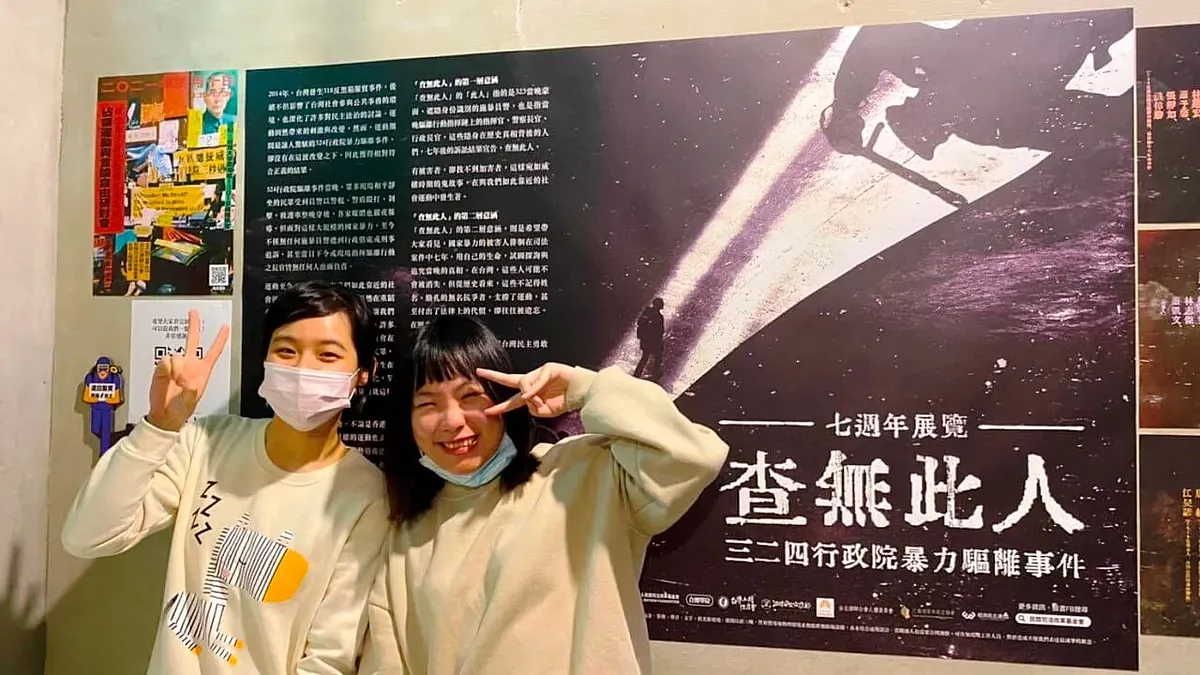
No Such Person | Reflections on Guiding the Seventh-Anniversary Exhibition on the March 24 Executive Yuan Violent Eviction
Last edited: 2026-08-29
This year, through a school internship, I came to understand the "No Such Person" exhibition more deeply by serving as an intern guide. From the first day I helped staff the exhibition to the final day, I watched footage from the eviction area play in a space filled with visitors. I do not think I will ever forget the mixture of emotions that ran through me. One feeling, however, was unmistakably clear: for democracy and freedom, our struggle is not over.
I was in junior high school when the Executive Yuan eviction took place. From one-sided media coverage, I knew only that the student movement had ended violently. At the time, I did not understand why people had to resort to such intense action to express opposition to the Cross-Strait Service Trade Agreement; surely, I thought, there must have been a better way to communicate with the government. It was only at the exhibition, when Attorney Yu spoke of the "sense that the country itself was at risk," that I began to understand that the government had not really intended to communicate with the public. Perhaps that was already evident in the roughly thirty-second, black-box handling of the CSSTA-or perhaps the decision had been taking shape much earlier, in the dangerous ambiguity of Taiwan's relationship with China. From that point on, people were forced into a continuing struggle for their freedom and rights.

During guided tours, visitors sometimes asked questions that stayed with me. One was: "Why did people have to use an occupation movement to express their views?" I had asked myself the same thing. Even after understanding how serious the black-box handling of the CSSTA was, and how the government chose to disregard people's rights, I still wondered whether a more restrained response might have changed the outcome. But there may simply have been no time for that kind of reflection. Faced with the government's passivity and the uncertain, dangerous distance between Taiwan and China, it was difficult not to feel an urgent need to save the situation-and fear about what the future might become. I think of the Formosa Incident, the Wild Lily Student Movement, and the February 28 Incident. Had people not fought intensely for rights guaranteed by the Constitution, perhaps we would not be able to exchange our thoughts and feelings so freely today. The exhibition therefore showed me not only people's struggle for their own rights, but also how much work JRF later put into the litigation so that something close to the full picture of a social movement could be brought into the light of the courts. The outcome was far from ideal, but viewed from another angle, even that process reflects Taiwan's gradual movement toward a more complete democracy.
The exhibition reconstructed the event itself-including the violence in the eviction area and, in contrast, the command center-and also told visitors what the people involved felt when they were subjected to state violence that night and what they experienced through the litigation that followed. Some visitors asked, "Wasn't that simply the price they had to pay?" Hearing people ask the same question I once had, I now find myself asking in return: does that mean the state is permitted to use violence against its people? What many people fail to imagine is that this happened in Taiwan in 2014, in a society that regarded itself as democratic and progressive. Not everyone has to agree that the occupation was justified, but state violence cannot simply be ignored. Footage from inside the Executive Yuan that night shows people sitting down, chanting slogans, and wearing ordinary light clothing. No one was carrying weapons or helmets. They trusted Taiwan so deeply as a democracy that they could not imagine the state itself would one day shatter that trust.
After we finished dismantling the exhibition on its last day, a friend asked what I had taken away from it. I think I will continue to remember what happened that night, the people who were later subjected to state violence, and the wider social meaning of the March 18 Student Movement. Even if those memories have already faded for much of the public, and even though the legal result remains "No Such Person," we need to remember that people once struggled this way for themselves and for all of us. That history needs to leave a trace, one that can point more clearly toward the road ahead for judicial reform.
This article is an AI-generated translation of the original Chinese text. In the event of any discrepancy, the Chinese version shall prevail.