
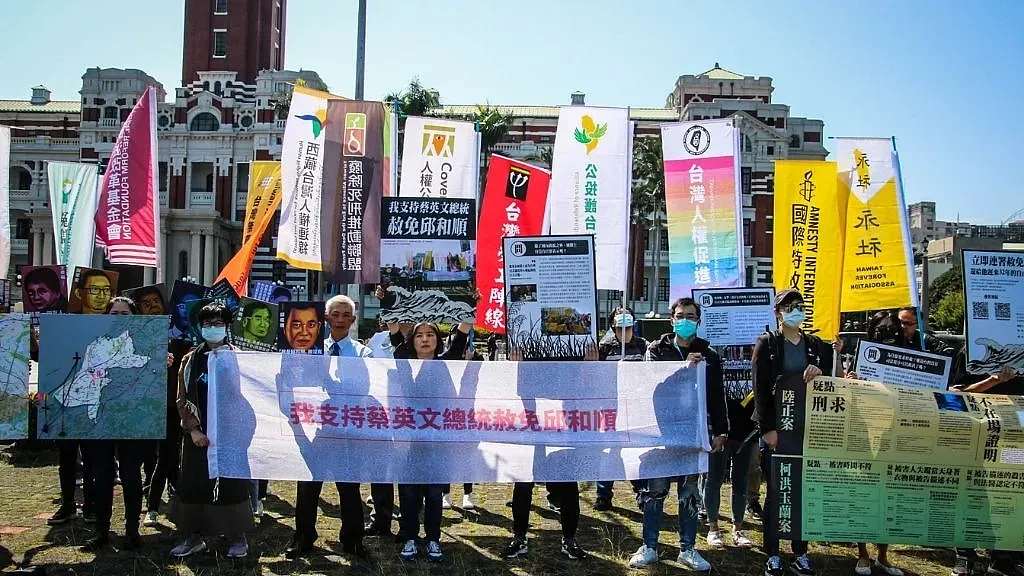
Inviting President Tsai Ing-Wen to Visit the Exhibition | Silent March Marking One Year Since the Chiu Ho-Shun Pardon Petition
Last edited: 2026-08-29
On April 7, 2020, groups supporting Chiu Ho-Shun brought a petition for a presidential pardon, together with supporting signature lists, to the Office of the President. The petition was endorsed by 327 individuals from different sectors, 60 civil-society organizations in Taiwan and abroad, and 27,307 people across nearly 50 countries and regions. More than 100,000 people have since signed in support.
In November 2020, the year Chiu Ho-Shun turned 60, civil-society groups including the Judicial Reform Foundation, Amnesty International Taiwan, Taiwan Association for Human Rights, Taiwan Alliance to End the Death Penalty, and Covenants Watch began presenting "Hai-Wang's Daybreak - Chiu Ho-Shun's Forgotten 32 Years" in Taipei and Zhunan. The exhibition reconstructs the history of the case, presents evidence of the torture inflicted on the defendants 32 years earlier, and recreates the Taipei Detention Center's high-security visitation room so visitors can imagine what it means to sink into the depths of a wrongful conviction. More than 3,000 people attended the exhibitions and learned about Chiu's case in depth.
During the exhibitions, the curatorial team wrote repeatedly to the Office of the President inviting President Tsai Ing-Wen to visit. Each invitation was declined on the ground that the President's official schedule made attendance inconvenient. A full year had also passed since the pardon petition was submitted without any substantive response. On April 7, the support groups therefore brought exhibits to the area outside the Office of the President and walked in silence only steps away from the President, carrying with them Chiu Ho-Shun's forgotten 32 years, a stain on Taiwan's justice and human-rights record, and a pardon petition now supported by more than 100,000 signatures.
The pro bono legal team and support groups also submitted another petition to the Office of the President, attaching the pardon request, an invitation to the Taichung edition of "Hai-Wang's Daybreak," and photo albums from the Taipei and Zhunan exhibitions. Wan Szu-Hsing, Chief of the Petition Section of the Office of the President's Public Relations Office, received the materials on the President's behalf.
At the press conference after the submission, Yu Po-Hsiang, convener of the pro bono legal team, said that substantial new evidence had already been presented in prior retrial petitions and rejected. At this stage, he said, only a presidential pardon offered a realistic path for Chiu Ho-Shun to see daylight again within his lifetime. Chiu's singing voice accompanied the march that day-the only way part of him could physically be present. Yu hoped that by the same time the following year, Chiu himself could stand with the legal team and support groups outside the Office of the President.
Lin Hsin-I, Executive Director of the Taiwan Alliance to End the Death Penalty, said the legal team and support organizations had exhausted numerous avenues before asking the President for a pardon. The 2019 Mock Asian Human Rights Court, reports of the United Nations Special Rapporteur on Torture, Taiwan's two international reviews of the human-rights Covenants, and the Control Yuan's investigation had all identified serious doubts in Chiu's case. At the end of March, the Office of the President responded to an Amnesty International letter by saying that it would "carefully consider views from all sides." Lin asked why the President was always willing to consider other people's views but unwilling to state her own. As a lawyer by training and as President, what, she asked, was Tsai Ing-Wen's own assessment of the Chiu Ho-Shun case?
Legislator Freddy Lim, a longtime supporter of Chiu Ho-Shun, said he had lost count of how many Chiu-related events he had attended. The case, he said, is a major stain on Taiwan's human-rights history: a person has been detained for an extraordinary length of time despite the absence of clear evidence. Society has repeatedly asked the government to confront the case. Lim called on the President to make a courageous decision that would show the world Taiwan is willing to face past injustice and correct it.
Legislator Chiu Hsien-Chih, who previously represented people in several wrongful-conviction cases, said Chiu Ho-Shun's deteriorating physical condition made the situation especially urgent. He had visited Chiu several times over the preceding year and did not know how much longer Chiu's body could endure. Taiwan's history contains too many wrongful-conviction cases-including those of Chiu Ho-Shun, Cheng Hsing-Tse, Su Chien-Ho, and Chiang Kuo-Ching-in which torture and judicial error produced devastating results. A death sentence can be wrong, Chiu emphasized, because human beings, not gods, conduct trials. The pardon power exists in part to provide a minimum measure of justice when ordinary judicial remedies have become exceptionally difficult. He therefore urged the President to pardon Chiu Ho-Shun.
Beginning April 9, 2021, the curatorial team will present the Taichung edition of "Hai-Wang's Daybreak - Chiu Ho-Shun's Forgotten 32 Years" for one month at JRF's Taichung Office. President Tsai is again invited to visit, learn A-Shun's story through art and cultural experiences, and join those seeking to end the state's unjustified insistence on a wrongful result and finally bring Hai-Wang the clearing skies and daybreak delayed for 32 years.
The support groups again call on the President to grant Chiu Ho-Shun a full pardon remitting his conviction and sentence and thereby end the injustice of the case.
Supporters in Attendance
Chiu Hsien-Chih (Legislator)
Freddy Lim (Legislator)
Hsu Tzu-Chiang (Exoneree)
Cheng Hsing-Tse (Exoneree)
Yu Po-Hsiang (Attorney; Convener, Chiu Ho-Shun Pro Bono Legal Team)
Lin Hsin-I (Executive Director, Taiwan Alliance to End the Death Penalty)
Lo Li-Han (Executive Secretary, Taiwan Alliance to End the Death Penalty)
Pan Yi (East Asia Program Officer, International Federation for Human Rights)
Chiu I-Ling (Secretary-General, Amnesty International Taiwan)
Wang Jung (Senior Advocacy Officer, Amnesty International Taiwan)
Chen Ying-Yu (Tainan Office Coordinator, Amnesty International Taiwan)
Shih Yi-Hsiang (Secretary-General, Taiwan Association for Human Rights)
Ko Yun-Ching (Advocacy Director, Taiwan Innocence Project)
Yang Ya-Wen (Executive Secretary, Taiwan Innocence Project)
Jade Y. Huang (Executive Director, Covenants Watch)
Chiang Meng-Chen (Office Director, Covenants Watch)
Sun Hsing-Hsuan (Research and Advocacy Specialist, Covenants Watch)
Chung Yu-Jou (Research and Advocacy Specialist, Covenants Watch)
Shen Chia-Ying (Office Director, Taiwan Innocent Prisoners Action Alliance)
Chang Chu-Chin (Secretary-General, Green Party Taiwan)
Sun Yu-Lien (Secretary-General, Taiwan Labour Front)
Chen Chia-Yu (Secretary, Taiwan Youth Association for Democracy)
Hung Chung-Yen (Deputy Secretary-General, Taiwan Forever Association)
Tashi Tsering (President, Human Rights Network for Tibet and Taiwan)
Lo Yi (Executive Director, Alliance of Referendum for Taiwan)
Chang Chih (Deputy Director, Advocacy Department, Judicial Reform Foundation)
Hsieh Chia-Chen (Advocacy Specialist, Judicial Reform Foundation)
Tsai Meng-Chu (Designer, Judicial Reform Foundation)
Lin Chih-Fang (Legal Specialist, Judicial Reform Foundation)
Ma Chien-Ya (Legal Specialist, Judicial Reform Foundation)
Press Contacts
Chang Chih / Deputy Director, Advocacy Department, Judicial Reform Foundation
Hsieh Chia-Chen / Advocacy Specialist, Judicial Reform Foundation
This article is an AI-generated translation of the original Chinese text. In the event of any discrepancy, the Chinese version shall prevail.