
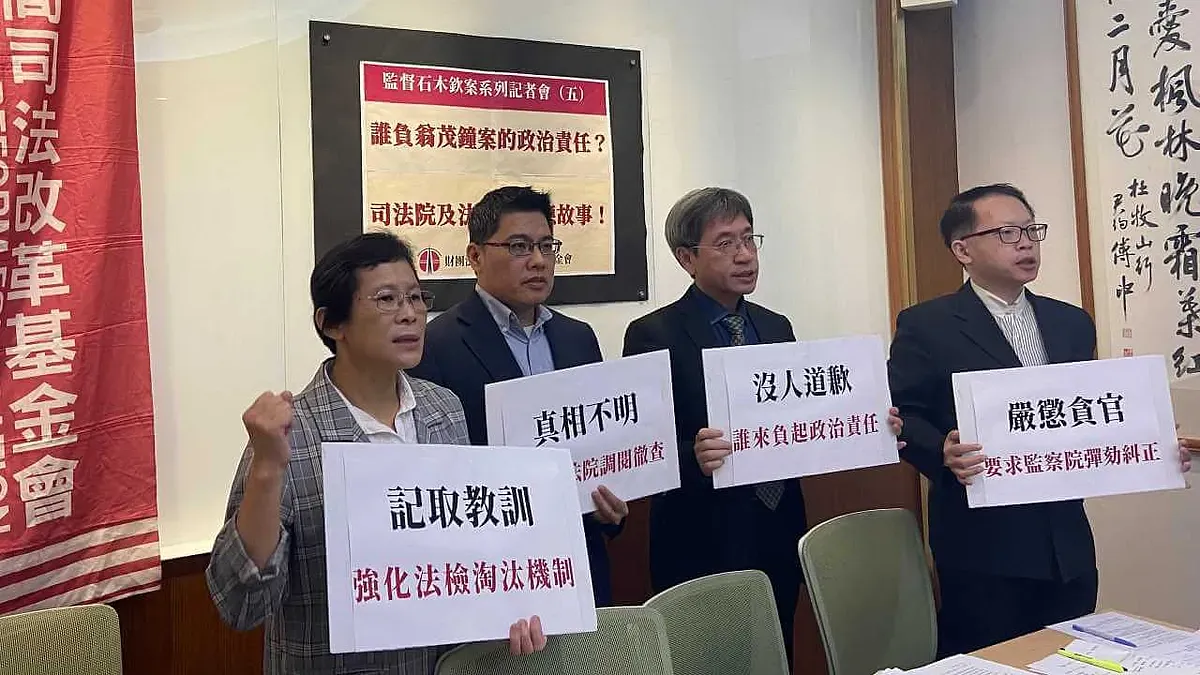
Who Will Take Political Responsibility for the Weng Mao-Chung Scandal? The Judicial Yuan and Ministry of Justice Are Merely Going Through the Motions - Shih Mu-Chin Monitoring Press Conference V
Last edited: 2026-08-29
Yesterday (the 7th), the Judicial Yuan and Ministry of Justice released their second round of disciplinary results concerning Grand Justices, judges, and prosecutors implicated in the Weng Mao-Chung scandal. The scope of discipline, facts investigated, follow-up measures, and whether other possible miscarriages of justice will be uncovered all require continued public scrutiny. In response, JRF calls for a thorough investigation of the underlying facts and for political responsibility to be taken for this major judicial-integrity scandal.
-
No Apology - Who Will Take Political Responsibility?
The Weng Mao-Chung scandal has driven public confidence in the judiciary to a new low. The Judicial Yuan's first disciplinary announcement on January 18 was already deeply disappointing, and it promised another comprehensive investigation in an effort to restore trust.
In the second round announced yesterday, the Judicial Yuan investigated 37 people and concluded that 26 judges or former judges had committed misconduct warranting discipline. Yet the period for exercising disciplinary authority had expired for 25 of them, and only Supreme Administrative Court Judge Cheng Hsiao-Kangwas referred to the Control Yuan. Twelve of the 26 had also been included in the earlier investigation. The Judicial Yuan did not explain what standard changed a case from "no discipline" to "discipline warranted," how it determined whether misconduct was serious, or what action-if any-it would take where the disciplinary period had expired.
The Ministry of Justice investigated an additional 57 people. One investigation official who handled a stock-manipulation case was referred to a district prosecutors office for criminal investigation. Two people, including former Prosecutor-General Wu Ying-Chao, were referred to their former agencies for administrative investigation because they had handled a case involving Weng's father or because a spouse had purchased stock. Eight people, including former Minister of Justice Tseng Yung-Fu, were referred for professional supervision because of frequent banquets or acceptance of gifts. Three were suspected of violating the Act on Property Declaration by Public Servants. The remainder were found either not to have committed unlawful conduct or not to have violated applicable professional-ethics rules. Yet despite the presence of senior figures such as Tseng and Wu, the Ministry announced conclusions without disclosing the standards applied, the underlying conduct, or the next investigative steps.
Judicial Yuan President Hsu Tsung-Li was again absent from yesterday's press conference. As head of the country's highest judicial administrative organ, he must take political responsibility for a scandal involving nearly one hundred judges and potentially contributing to wrongful or unfair cases. It is not enough to dismiss the events as matters from ten or twenty years ago: many of the people involved remained sitting judges in senior positions, and some had been transferred, promoted, or decorated through personnel decisions made after Hsu took office in November 2016, including the examples below. Likewise, Minister of Justice Tsai Ching-Hsiang has said only that investigations would continue, without presenting meaningful reform measures. JRF calls on both Hsu and Tsai to apologize publicly and accept the political responsibility that accompanies leadership when necessary reform has failed.
Judge Investigated Date Position / Action Shih Mu-Chin Presidential Order dated November 28, 2017 Specially appointed President of the Commission on the Disciplinary Sanctions of Functionaries Hung Chia-Pin Decision of the 10th Personnel Review Committee meeting, December 2016 Transferred to serve as a member of the Commission on the Disciplinary Sanctions of Functionaries Wen Yao-Yuan Decision of the 10th Personnel Review Committee meeting, December 2016 Awarded the Second-Class Judicial Medal -
The Truth Remains Unclear - The Legislative Yuan Should Obtain the Records and Investigate
The disciplinary results are disappointing because the Judicial Yuan and Ministry of Justice press conferences and releases do not tell the public what the people investigated actually did. Which judges and prosecutors bought stock? Did they pay for it themselves? Did investigators trace the money? Was the scope of the Judicial Yuan's inquiry adequate? Was the case truly investigated to the end?
After the first-round reports were released on January 18, the Control Yuan stated that the Judicial Yuan and Ministry of Justice had relied primarily on evidence already developed by the Control Yuan, raising questions about both the scope of their authorization and the aggressiveness of their investigations. Did the 14 newly investigated people in the Judicial Yuan's second round account for all information contained in Weng Mao-Chung's 27 notebooks? During the additional three months of investigation, did the Judicial Yuan review the more than 130 relevant case-file volumes? Were important matters left unexamined, or did investigators still lack the necessary material? The Judicial Yuan said nothing about these questions. After two rounds of investigation, the truth still has not been presented to the public. JRF therefore calls on the Legislative Yuan's special task force investigating the damage to judicial confidence caused by judicial, prosecutorial, investigative, and police personnel implicated in the Weng Mao-Chung scandal to obtain the records, investigate comprehensively, and disclose the full picture.
-
Corruption Must Be Seriously Punished - The Control Yuan Should Impeach and Correct
Because the Judicial Yuan's inquiry remains incomplete, Weng Mao-Chung's interactions and financial relationships with judges have still not been fully disclosed. The Ministry of Justice likewise said only that some matters would continue to be investigated. JRF calls on the Control Yuan to publish the investigation reports, continue its own inquiry, obtain all 27 Weng notebooks and the more than 130 volumes from the two "Ta" investigation matters, impeach judicial personnel involved in unlawful dereliction of duty or corruption, and issue corrective measures against agencies that failed to supervise or investigate properly.
-
Learn the Lesson - Strengthen Mechanisms for Removing Unfit Judges and Prosecutors
The Judicial Yuan's press release even cited 2019 amendments to the Judges Act-adding lay assessors to the Court of the Judiciary and allowing members of the public to request evaluation of judges directly-as though they were reforms adopted in 2021 in response to the Weng Mao-Chung scandal. That is window dressing, not reflection. A year and a half after the Shih Mu-Chin case first surfaced, the Judicial Yuan still had not proposed meaningful institutional changes specifically responding to this major judicial-integrity failure. JRF calls on the Judicial Yuan and Ministry of Justice to review the Judges Act's mechanisms for removing unfit judicial officers, strengthen professional supervision of judges and prosecutors through legislation, and move toward comprehensive evaluation.
How can the dignity of the judiciary coexist with a wealthy, well-connected businessman exercising this kind of influence? After decades of judicial reform, when will Taiwan escape the stigma that "money buys life, while poverty buys death"? The Weng Mao-Chung scandal implicates hundreds of judges and prosecutors. The Judicial Yuan and Ministry of Justice must investigate all stock transactions and other financial or personal benefits involving Weng, determine whether any conduct gives rise to serious criminal liability such as corruption, and reexamine related judicial cases-including those involving BNP Paribas and bank manager Chu Ching-En-to determine whether wrongful or unfair outcomes occurred and provide justice to the parties affected.
Attendees
Joseph Lin / Chairperson, Judicial Reform Foundation
Chiang Jung-Hsiang / Chair, Judicial Reform Committee, Taipei Bar Association
Chiu Hsien-Chih / Legislator
Chen Jiao-Hua / Legislator
Hsiao I-Min / Office Director, Judicial Reform Foundation
Press Contact
Lu Cheng-Yen / Staff Attorney, Judicial Reform Foundation (02) 2523-1178 ext. 37
This article is an AI-generated translation of the original Chinese text. In the event of any discrepancy, the Chinese version shall prevail.