
Hai-Wang's Daybreak | Opening Press Conference for the Taichung Special Exhibition - Chiu Ho-Shun's Forgotten 32 Years
Last edited: 2026-08-29
In 1988, police and prosecutors falsely accused Chiu Ho-Shun of being a principal perpetrator in the Lu Cheng and Ko Hung Yu-Lan cases. The record contains as many as 288 confession statements that contradict one another, contain major gaps, and were obtained unlawfully through torture. Yet the courts relied principally on the defendants' confessions and ultimately imposed a death sentence. With ordinary judicial remedies offering little realistic prospect of timely relief, support organizations went to the Office of the President on April 7, 2020 and submitted a petition for a presidential pardon, hoping to end 32 years of injustice. The President had still not given a substantive response when this article was published.
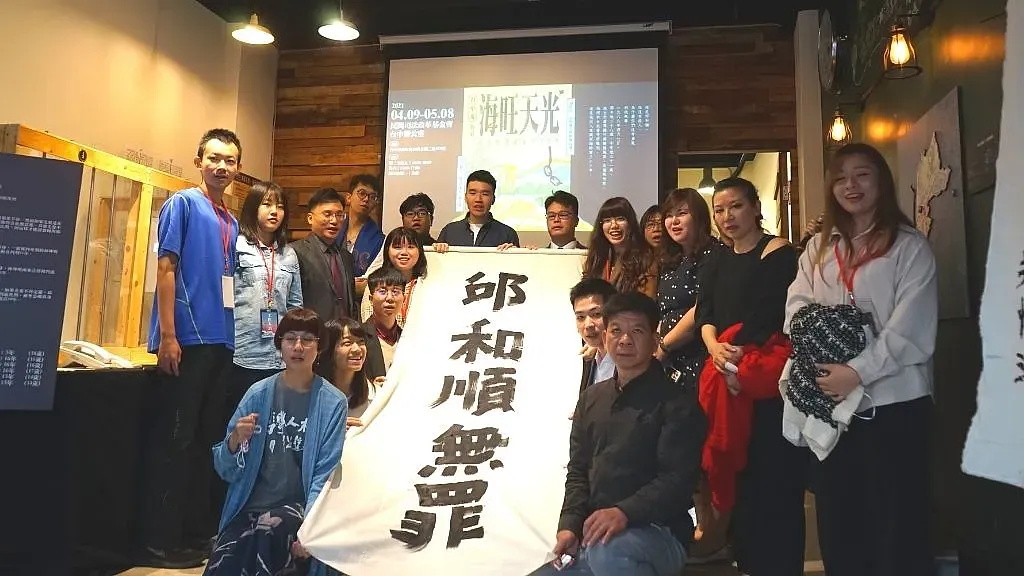
In 2020, the year Chiu Ho-Shun turned 60, support organizations presented "Hai-Wang's Daybreak - Chiu Ho-Shun's Forgotten 32 Years" in Taipei from November 5 to November 18. From January 29 to February 16, 2021, the exhibition returned to A-Shun's hometown of Zhunan, Miaoli. On April 7, one year after the pardon petition was submitted, supporters again made their appeal through a silent march. To continue public dialogue through art and cultural experience, the support team then opened the Taichung edition of "Hai-Wang's Daybreak - Chiu Ho-Shun's Forgotten 32 Years" at JRF's Taichung Office for one month beginning April 9, presenting 32 years of Chiu Ho-Shun's case.
At the opening, exoneree Cheng Hsing-Tse wrote "Chiu Ho-Shun Is Innocent" in calligraphy. Performing artist Chan Tien-Chen of the Tsai Jui-Yueh Dance Research Institute also presented a dance to open the exhibition. Through calligraphy and movement, they spoke for Chiu Ho-Shun in the artistic languages they had chosen for themselves.
At the press conference after the performance, attorney Lin Chun-Hung of the pro bono legal team said candidly that he disliked having to hold exhibitions like this at all. The fact that the exhibition had already traveled through Taipei and Zhunan-and now had to continue in Taichung-meant Chiu Ho-Shun still needed rescue. The only way to stop holding these events, he said, was for Chiu to come home. Taiwan describes itself as a democracy governed by the rule of law, yet wrongful convictions continue to arise from the justice system. The purpose of events like this is to make the state see that it wronged a person and must have the courage to correct its mistake. The legal team hopes the real "battlefield" will not remain the exhibition hall, but return to the courtroom, where Chiu can speak, the court can hear him, and the case can finally be brought to an end.
Sun Hsing-Hsuan, Research and Advocacy Specialist at Covenants Watch, said both the 2013 concluding observations from Taiwan's international review of the two human-rights Covenants and the 2019 Mock Asian Human Rights Court judgment found serious problems under Article 7 of the International Covenant on Civil and Political Rights, which prohibits torture, and Article 14, which protects the right to a fair trial. Covenants Watch reiterated three demands. First, President Tsai should pardon Chiu Ho-Shun immediately. Because Chiu suffered torture, has been held for decades, and is in poor physical and mental health, reopening proceedings alone may come too late. Second, even after a pardon, the justice system should reopen the case so that it can confront and correct past errors and give Chiu a fair trial capable of clearing his name. Covenants Watch therefore urged the Prosecutor-General to file an extraordinary appeal or prosecutors to use the investigation report prepared by Kao Yung-Cheng during his earlier service as a Control Yuan member as a basis for seeking retrial. Third, the National Human Rights Commission should conduct a systemic investigation of the human-rights violations exposed by the case and examine what risks remain in the current system.
Lin Tung, Director of the Southern Office of the Taiwan Association for Human Rights, noted that TAHR had participated in efforts to support Chiu Ho-Shun since 1993. Chiu had already spent 32 years in custody and was entering a thirty-third-longer than Lin herself had been alive. Like other wrongful death-penalty cases supported by the organization, Chiu's case involved torture, reliance on confessions, little scientific evidence, and a disregard for the presumption of innocence. Decades in a detention center, with little meaningful activity and the constant possibility of execution, also severely restrict basic rights. The work can be discouraging, Lin said, but people should have more confidence in their own ability to act together. "Hai-Wang's Daybreak" had been carried not only by JRF but by a group of young volunteers whose average age was under 25. Years earlier, advocates for Su Chien-Ho and his co-defendants sometimes gave talks even when only one person attended; they kept speaking until, eventually, all three were acquitted. The justice system should never have made the mistake in the first place, but Lin believed that persistent collective effort could still help Hai-Wang see daybreak.
Chang Yu-Meng, Chairperson of the Taiwan Youth Association for Democracy, said the Chiu Ho-Shun case is not merely an individual wrongful conviction but a form of systemic violence by the state's justice system. Schools teach that Taiwan is governed by law and that courts provide remedies when people's rights are violated. Teachers may remind students that human judges can make mistakes. But textbooks do not say that police may arrest innocent people under public pressure simply because they "feel" those people committed the crime, or that suspects can be tortured until the presumption of innocence becomes meaningless. Wrongful convictions are therefore also a question of generational justice: do those in power have the courage to confront mistakes committed by the state in the past?
Miaoli County Councilor Sung Kuo-Ting said Zhunan was Chiu Ho-Shun's hometown, while Taichung-the site of this exhibition-was where Sung himself began practicing law. When Sung visits Chiu, their conversations about Zhunan and Taichung are still about places as they were more than thirty years ago. Criminal punishment is the state's most severe coercive power, Sung said, and a death sentence should be imposed only when guilt is established with complete confidence. Yet despite repeated proceedings and substantial doubts, the courts maintained the ultimate penalty in Chiu's case. What should society expect when it gives the state this power? Sung called for a judiciary capable of reflection and worthy of trust, encouraged visitors to go to Zhunan and understand the places that shaped Chiu's life, and expressed his hope that Chiu would regain his freedom as soon as possible.
Through the exhibition, the support groups will continue their dialogue with the public and seek a just answer for Chiu Ho-Shun. They invite visitors to stand with those who continue to place themselves between Chiu and the state's gun and bring Hai-Wang the clearing skies and daybreak he has waited more than 32 years to see. The exhibition also marks the first step in reopening JRF's Taichung Office as a public event space. The three floors from the basement through the second floor will be used for exhibitions, lectures, courses, meetings, and forums. Group tours are available so students and local residents in Taichung can understand the exhibition's message and the story behind it.
Attendees
Hsu Tzu-Chiang (Exoneree)
Cheng Hsing-Tse (Exoneree)
Sung Kuo-Ting (Miaoli County Councilor)
Lin Chun-Hung (Representative, Chiu Ho-Shun Pro Bono Legal Team)
Lin Tung (Director, Southern Office, Taiwan Association for Human Rights)
Tseng Fang-Yuan (Director, Central Office, Humanistic Education Foundation)
Huang Chih-I (Chairperson, Good Citizens Cultural Action Association)
Chang Yu-Meng (Chairperson, Taiwan Youth Association for Democracy)
Fu Yen-Ju (Deputy Executive Director, Good Temperature Taiwan Youth Foundation)
Lo Yu-Yang (Specialist, Good Temperature Taiwan Youth Foundation)
Sun Hsing-Hsuan (Research and Advocacy Specialist, Covenants Watch)
Hsiao I-Min (Office Director, Judicial Reform Foundation)
Chang Chih (Deputy Director, Advocacy Department, Judicial Reform Foundation)
Hsieh Chia-Chen (Advocacy Specialist, Judicial Reform Foundation)
Tsai Meng-Chu (Designer, Judicial Reform Foundation)
Wang Chen-Yun (Legal Specialist, Judicial Reform Foundation)
Chang Hua-Che (Legal Specialist, Judicial Reform Foundation)
Press Contact
Advocacy Specialist, Judicial Reform Foundation
Hai-Wang's Daybreak - Chiu Ho-Shun's Forgotten 32 Years
Exhibition Dates
April 9-May 8, 2021
- Tuesday-Friday, 1:30-8:00 p.m.
- Saturday, 11:00 a.m.-5:00 p.m.
- Closed Sunday and Monday
Venue
Judicial Reform Foundation Taichung Office (No. 845, Sec. 2, Taiwan Blvd., Xitun Dist., Taichung City; near MRT City Hall Station)
The exhibition presents Chiu Ho-Shun's 32 years under state violence through several themes and different media, allowing visitors to trace the violence, absurdity, and helplessness that have shaped the latter half of his life.
Theme I "Blood Before Confinement" uses projections and evidentiary materials from the case to reconstruct, as closely as possible, the circumstances in which Chiu Ho-Shun and others were tortured during interrogation. The aim is to help visitors understand the torture endured by Chiu, then only in his twenties, and the despair, pain, and absurdity it represented.
Theme II "Daybreak Through the Bars" and "A-Shun, How Have You Been?" invite visitors into Chiu Ho-Shun's memories through his letters. A simulated detention-center telephone also lets visitors hear Chiu, who loves to sing, express his feelings in his own voice.
Theme III "The Game of Life" lets visitors step into Chiu Ho-Shun's place, move along squares on the floor, make choices, and reenact the opportunities, turns of fate, and helplessness that have shaped his life.
Theme IV The "Timeline" and "Questions in the Case" wall present more than 30 years of major events together with the case's many unreasonable and unusual features, allowing visitors to see its central problems and injustices.
Theme V "Ten Forgotten Stories" introduces other wrongful-conviction cases in Taiwan. Some have ended in exoneration, some ended with executions carried out by the state, and others still await assistance. The wall invites visitors to see these stories and continue paying attention to wrongful convictions in Taiwan.
Theme VI The "Case Map" combines maps of Hsinchu and Miaoli with three-dimensional markers and route diagrams to show the body-disposal routes and locations found by the courts in the Ko Hung Yu-Lan and Lu Cheng cases. The maps make visible how implausible many of those judicially accepted routes are.
This article is an AI-generated translation of the original Chinese text. In the event of any discrepancy, the Chinese version shall prevail.