
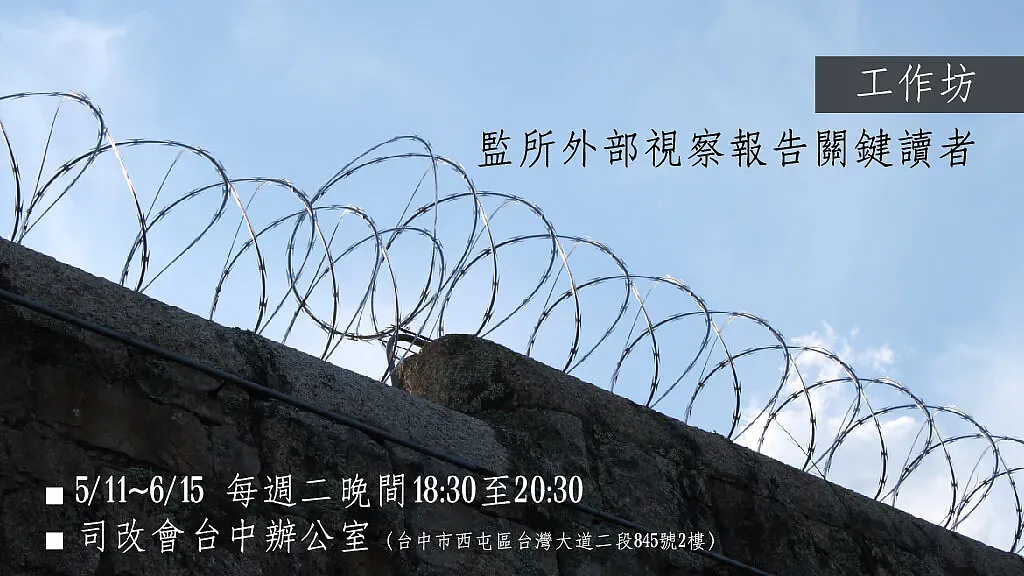
Workshop | Become a Key Reader of External Inspection Reports for Correctional Institutions
Last edited: 2026-08-29
"Inmates are citizens who happen to wear prison uniforms; they are not outcasts from the Constitution's protection of fundamental rights."
- Concurring Opinion of Grand Justice Hsu Tsung-Li, Judicial Yuan Interpretation No. 755
The Grand Justices have made clear that inmates remain protected by constitutional fundamental rights. That principle should not remain a slogan. People in prison are deprived of liberty because of criminal convictions, but once they enter a correctional institution, nearly every aspect of daily life is controlled by the state and personal autonomy becomes extremely limited. Prison walls also make the people living behind them largely invisible to society, meaning that problems and difficulties inside can remain unknown outside. If constitutional protection for inmates is to mean something in practice, institutions must exist to safeguard those rights.
The amended Prison Act took effect last year. One important reform requires correctional institutions to establish independent external inspection panels. The idea is to make prisons more transparent: reducing the risk of human-rights violations while also helping the public understand the operational problems correctional institutions themselves face. To give effect to transparency, the Prison Act requires external inspection panels to issue reports so the public can better understand institutional conditions and evaluate how the inspection mechanism is functioning.
JRF has continued monitoring external inspection since the new Act took effect. The first reports issued by panels after they were established-the Q4 2020 reports-raised concerns that the system's actual operation might differ substantially from the legislature's intent. JRF therefore published Comments and Recommendations on External Inspection Reports.
Because of limited staff capacity, that paper addressed mainly system-wide issues and could not engage in detailed dialogue with every institution's inspection panel. Our next goal is therefore to bring more people into the process: to read the reports carefully, one by one; record observations and questions; and send that feedback to the relevant external inspection panels. We want panel members to know that their reports are being read seriously and discussed by the public-and, we hope, to give them greater motivation to conduct meaningful inspections and prepare informative reports.
We invite anyone who cares about correctional issues and wants to contribute to become a "key reader" of external inspection reports. As you read, you can raise any observations, questions, or recommendations you think matter and help turn careful reading into institutional change.
Time
Every Tuesday, 6:30-8:30 p.m., from May 11 through June 15, for six weeks
(May 11, May 18, May 25, June 1, June 8, June 15)
Venue
Judicial Reform Foundation Taichung Office (2F., No. 845, Sec. 2, Taiwan Blvd., Xitun Dist., Taichung City)
Who Should Apply
Anyone who cares about correctional issues and brings curiosity and a willingness to ask questions.
Capacity
20 participants. If applications exceed capacity, priority will be given to applicants who can attend the entire series and demonstrate stronger motivation.
Format
Each week begins with an introduction to a different aspect of external inspection and how to read the reports. Participants will then work in groups to review reports from different correctional institutions. At the end, the groups' observations and questions will be compiled and sent to the relevant external inspection panels.
This article is an AI-generated translation of the original Chinese text. In the event of any discrepancy, the Chinese version shall prevail.