
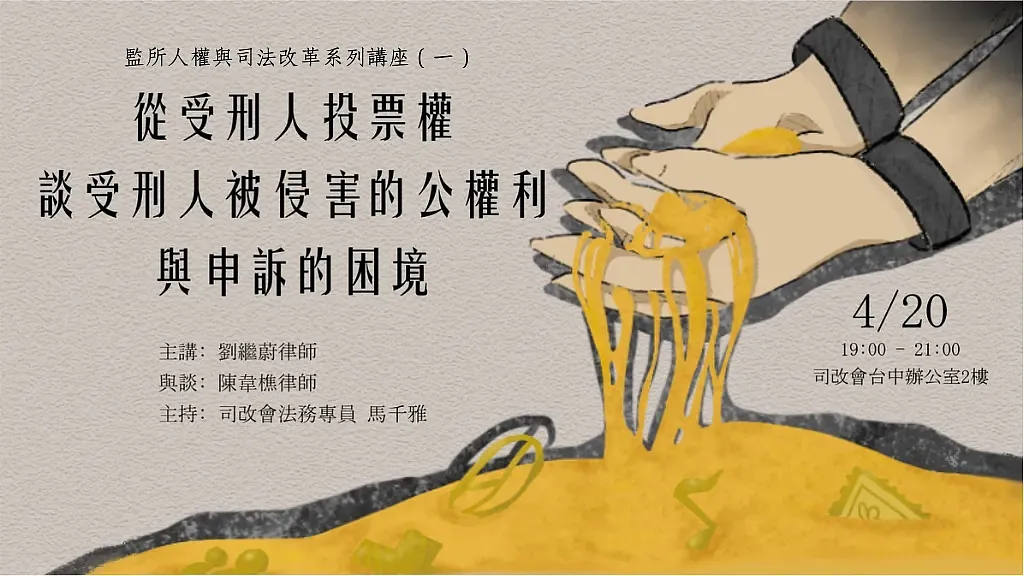
Correctional Human Rights Lecture | From Inmates' Voting Rights to Other Political Rights and the Difficulties of Filing Complaints
Last edited: 2026-08-29
Ten referendum questions appeared on Taiwan's ballot in 2018, and four more were expected to go to a vote that August. Referendums are only one example: Taiwanese citizens also use ballots to choose the President, local chief executives, and legislators and thereby express political preferences. Yet even as Taiwan takes pride in its democracy, one group of people living here is in practice denied the opportunity to express those preferences through voting.
Fifteen years earlier, in 2006, the Criminal Code was amended to remove the provision in Article 36 that deprived inmates of the four political rights of election, recall, initiative, and referendum. The legislative explanation noted that indiscriminately depriving people of voting rights regardless of the nature or circumstances of the offense appeared inconsistent with the goal of social reintegration. Fifteen years later, however, rules requiring people to vote where they are registered still effectively prevent many inmates from exercising the right to vote.
In his concurring opinion in Judicial Yuan Interpretation No. 755, Grand Justice Hsu Tsung-Li emphasized: "Inmates are citizens who happen to wear prison uniforms; they are not outcasts from the Constitution's protection of fundamental rights." Do you care about human rights in correctional institutions? Beyond voting, what other political or civic rights are people in prison effectively denied? And in an environment subject to constant surveillance, how difficult is it to assert the rights one is supposed to have?
JRF's Taichung Office has invited Attorney Liu Chi-Wei to speak, with Attorney Chen Wei-Chiao as discussant and JRF Legal Specialist Ma Chien-Ya as moderator. Join us to examine infringements of inmates' public rights, the difficulties of using complaint mechanisms, and the broader relationship between prison human rights and judicial reform.
Time
April 20 (Tue.), 7:00-9:00 p.m.
Venue
2F., Judicial Reform Foundation Taichung Office
Speakers
Keynote Speaker Liu Chi-Wei / Attorney
Discussant Chen Wei-Chiao / Attorney
Moderator Ma Chien-Ya / Legal Specialist, Judicial Reform Foundation
This article is an AI-generated translation of the original Chinese text. In the event of any discrepancy, the Chinese version shall prevail.