
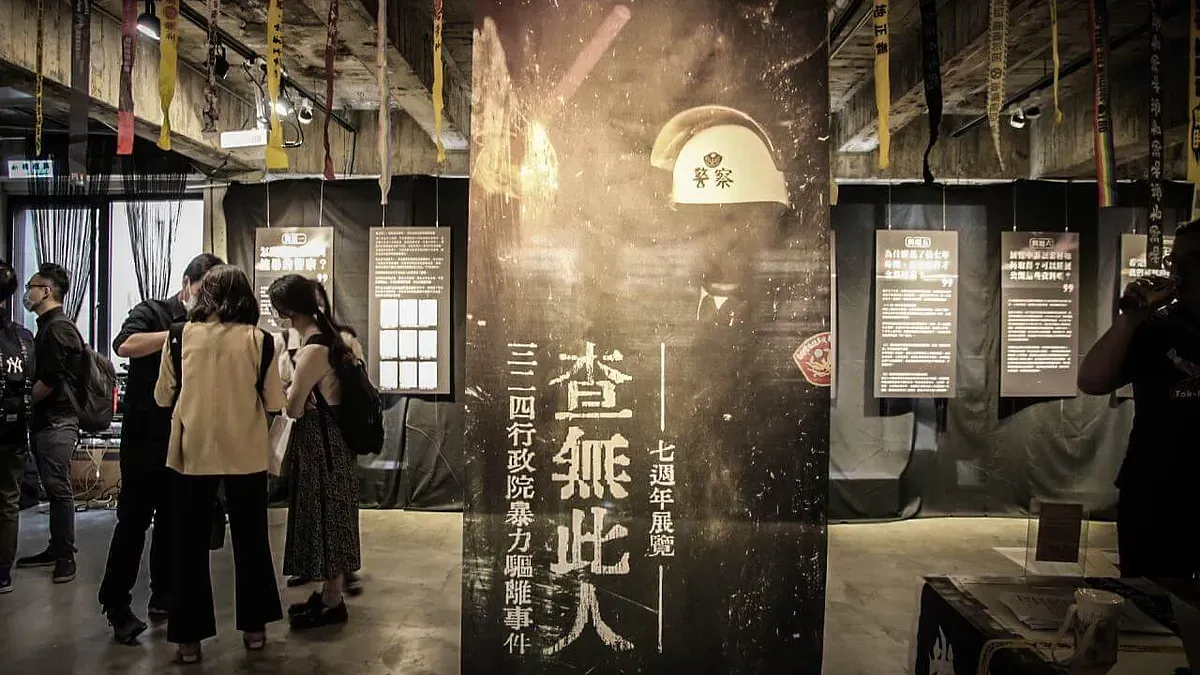
John Doe | Exhibition Introduction: 7th Anniversary of the March 24 Executive Yuan Violent Eviction Incident
Last edited: 2026-07-27
The materials for this exhibition are transformed from the data accumulated by the pro bono legal team over the past seven years. Seven years of litigation, along with the accumulated documents and footage, constitute an important history. With the consent of the record-copying lawyers and the plaintiffs, and after thorough anonymization and organization, we present the concepts of this exhibition through an arts and cultural approach.
The written materials we referenced include: transcripts of open court sessions examining witnesses or reviewing footage from that night, lawyers' briefs, court official letters, and court judgments. As for video materials, in addition to footage collected from the public by the JRF back then and news broadcasts from various outlets, much of it consists of police dashcam and bodycam footage obtained by the legal team through the evidence preservation procedure in state compensation litigation.
In addition, we invited plaintiffs who suffered state violence at the time and entered into private prosecution and state compensation proceedings, as well as a plaintiff who threw paint at the National Police Agency on the fourth anniversary of the March 24 violent eviction incident to protest the failure to hold anyone accountable, to share with us the emotional turns they experienced over the past seven years and how they now view the outcome of "John Doe" (unidentified perpetrators).
Seven years ago, some people were still young and had never even heard of this movement; others had not yet undergone political awakening and embarked on entirely different paths after this movement. During this movement, some found like-minded partners and initiated diverse forms of dialogue and paths for reform; some stepped onto the political stage, while others stepped up and then walked down; some discussed social movements with older generations for the first time, while others first realized the information gap between themselves and the younger generation; some were inspired, some felt disappointed, some felt proud, some felt guilty; some continue to strive, while others turned and left.
Regardless of which category you fall into, in this exhibition, we attempt to use a first-person perspective to walk you through the light and shadow of these seven years.
■ The Beginning of Everything | The 318 Occupation Zone
"02-25231178" At that time, many people in the occupation zone silently memorized this string of numbers while hoping they would never need that phone number.
The occupation timer in the center of the legislative chamber had quietly reached three digits. I heard that more and more supporters were arriving outside, but the number of police officers was growing without decrease. I remember the medical care area on the right side of the podium operated smoothly, always greeted by warm applause during shift changes. The pro bono lawyers stayed in the chamber at all times to protect us. But an uneasy atmosphere kept lingering...
You ask what happened outside the legislative chamber?

Although this exhibition depicts the state violence of the March 24 Executive Yuan eviction incident, discussing March 24 inevitably requires understanding the March 18 incident first. This exhibition area recreates the most memorable movement footage of that time. Serving as a small corner of the entire exhibition, it is nevertheless the beginning of everything, allowing everyone to return to the time and space of seven years ago through a replicated portrait of Dr. Sun Yat-sen, the occupation timer, and the pro bono lawyer contact cards issued by the JRF back then.
■ Dawn Shrouded in Blood and Mist | The Eviction Zone
Staying on Ch'ing-tao East Road, I heard a series of shouts echoing from afar: "Peace, peace, peace," and "Police are beating people, do not attack students." I could no longer endure the pressure of continuous sit-ins and sprinted toward the source of the sound.
Bright red blood that had no business being on the asphalt, citizens sitting paralyzed on the ground, medical staff running around—and of course, police officers equipped with batons and shields closely following behind. As dawn approached, what met my eyes was not the first light of day, but the muzzle of that high-pressure water cannon.

This exhibition area is perhaps the one that requires plaintiffs to muster the most psychological preparation before stepping in.
We replicated a small water truck, facing which is a projection screen broadcasting scene after scene of the violent eviction that night. On the wall are descriptive statistical information and medical rescue records of injuries sustained by those evicted that night, presenting the fact that the eviction caused civilian injuries. Judging solely from the recorded data in the Ministry of Health and Welfare's emergency medical system, major hospitals dispatched at least 61 ambulance trips, and over 200 people sought medical treatment at hospitals due to this eviction operation. In addition to presenting the medical treatment conditions of that night using descriptive statistics, we also reveal the nature of their injuries through the medical records of 25 plaintiffs: extensive contusions on both legs and arms, lacerations on the scalp, etc., which clearly differ from the wounds that police commanders claimed in court over the years were caused by citizens "falling on their own" or "bumping into utility poles."
On the walls on both sides, we use display boards to present the text recorded during the judicial examination of that night's eviction footage in open court, juxtaposing it with the police commanders' justifications to highlight the heavy burden of violence without accountability. We also organize the regulatory SOP for water cannons to emphasize that the eviction methods used that night were indeed inappropriate.
■ The Premier's Lullaby | Command Center Zone
Where were you when the eviction took place that night?
"I was already asleep." "I did not order a forced eviction." "I was not the highest commander." "There was a phone call, but no order was given to me to evict." "I had to wait for the police chief's decision." "I had no criminal intent, and I deny the crime. I was performing official duties in accordance with the law, and I had no intent to harm or kill anyone." "Not only do I not regret it, but I feel I have never made a more correct decision than this [eviction]." "President Ma did not regret it, I did not regret it, the Minister of the Interior did not regret it, and the National Police Agency Director-General did not regret it. We were all doing what we were legally supposed to do. You can ask around, does everyone support the Sunflower Movement? Many things must wait for history to make the final judgment."
"I went to sleep around 1:30 AM."
This article is an AI-generated translation of the original Chinese text. In the event of any discrepancy, the Chinese version shall prevail.
Because of you, we have the power to reform and progress !
Support judicial reform activities
Donate Now