
JRF Newsletter
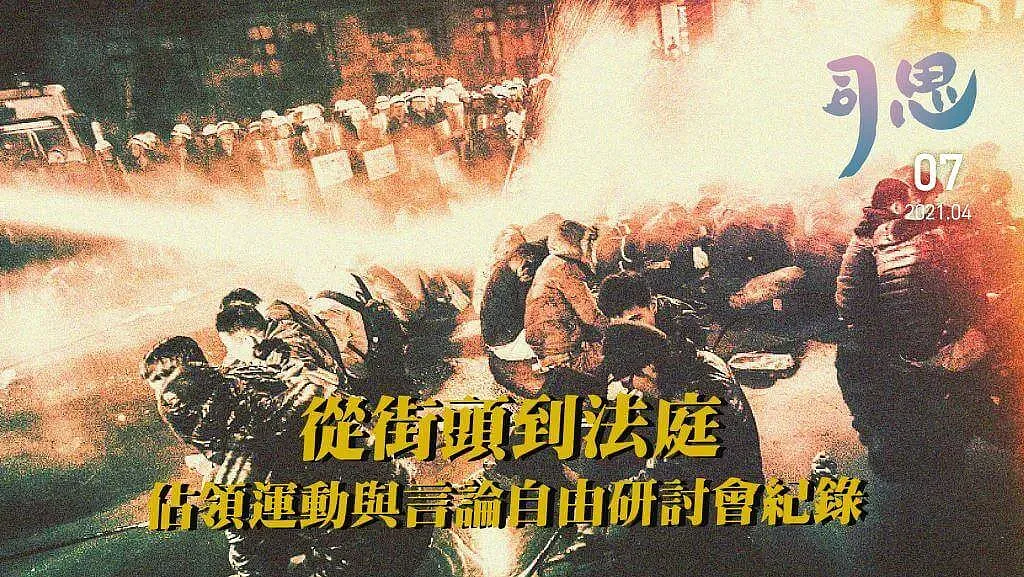
From the Street to the Courtroom | Occupation Movements and Freedom of Expression: Seminar Record on Civil Disobedience and the Right of Resistance
Last edited: 2026-08-29
On January 18, 2021, the Supreme Court delivered its third-instance judgment in the March 23 Executive Yuan occupation case (Supreme Court Criminal Judgment 109-Tai-Shang-3695). The Court held that civil disobedience-public, nonviolent, conscientious conduct that intentionally violates a legal rule-may, by analogy, be evaluated under the doctrines of necessity or excessive necessity, thereby justifying the conduct or reducing or exempting criminal liability. The Supreme Court also recognized for the first time that, although Taiwan's Constitution does not expressly enumerate a right of resistance, such a right should be recognized under the constitutional principle of popular sovereignty and may justify conduct undertaken in its exercise.
The Judicial Reform Foundation, Taiwan Association for Human Rights, and Taipei Bar Association have long followed the development of freedom of expression, democracy, and the rule of law in Taiwan. With occupation-style protest movements also appearing in Hong Kong, Thailand, and even at the U.S. Capitol, observers in Taiwan and abroad are paying attention to how Taiwan's legal system-after its own major occupation movement-will develop the foundations and framework for protecting related rights. This seminar therefore brought together scholars of criminal law, public law, and international human-rights law to examine the relationship between occupation movements and freedom of expression.
※ To request the seminar handbook, email contact@jrf.org.tw.
Guest Yu Po-Hsiang / Convener, March 18 Anti-Black-Box CSSTA Pro Bono Legal Team

As convener of the legal team, Yu observed that seven years of litigation had produced genuine gains in judicial practice. The movement's impact on courts was not as immediate as its political or social impact, but changes were gradually becoming visible.
Introduction Lai Ping-Hsiang / Attorney, Yuan-Chen Law Offices

Reviewing the outcomes of litigation arising primarily from the March 18 and March 24 events, Lai analyzed the positions adopted by the courts and the legal doctrines they relied on, establishing a foundation for the seminar's discussion of the right of resistance.
Discussant Wei Pei-Hsuan / Assistant Professor, Department of Public Affairs and Civic Education, National Changhua University of Education

Wei defended the right of resistance at the constitutional level from the perspective of traditional public law. She argued that Taiwanese judgments describing the right as an "immature concept" rest on a mistaken premise, and she examined both the risks people face when participating in resistance movements and the role of "violence" in assessing such movements. She ultimately asked why, given Taiwan's distinctive constitutional history, a democratic system must leave room for a right of resistance.
Discussant Weng Yen-Ching / Associate Professor, Department of Political Science, National Chengchi University

Approaching protest rights through international human-rights law, Weng introduced recent international standards and examples from occupation movements to explain how the right of peaceful assembly should be assessed. She emphasized that peaceful assembly is an instrumental right through which people exercise or pursue other rights, that "violence" should be defined narrowly when determining whether an assembly remains peaceful, and that the ultimate assessment must return to the circumstances of each case.
Discussant Hsu Wei-Chun / Associate Professor, Department of Law, Chung Yuan Christian University

Starting from John Rawls's classic definition of civil disobedience, Hsu looked for common ground between political philosophy and legal philosophy. Bringing Rawls's distinction between "illegality" and "justification" into legal analysis, he argued that an act of civil disobedience Rawls would regard as justified may be formally unlawful without being substantively wrongful. On that account, civil disobedience itself can operate as a legal ground of justification.
Discussant Hsu Jen-Shuo / Assistant Professor, Hokkaido University, Japan

Asian examples appear only rarely in modern discussions of the right of resistance. Hsu examined Japanese and Korean experiences of resistance to colonial rule and authoritarian regimes. He asked whether a right of resistance has room to operate before constitutional checks are fully established, and what options remain when a mature constitutional order exists but every domestic remedy has been exhausted and effective relief is still blocked by pressure from a foreign power. In the East Asian context, he argued, two less-discussed forms of constitutional injury-obstructing the constitutional order and hollowing it out-deserve particular attention.
Q&A Hsu Yu-Hsiu / Former Justice of the Constitutional Court

In closing, Hsu argued that the "last resort" principle should not be treated primarily as a condition restricting people's resistance. Rather, it is a rule that those who exercise state power must observe most strictly. Only when government itself follows due process, she said, can the rule of law truly be realized.
This article is an AI-generated translation of the original Chinese text. In the event of any discrepancy, the Chinese version shall prevail.