
JRF Newsletter
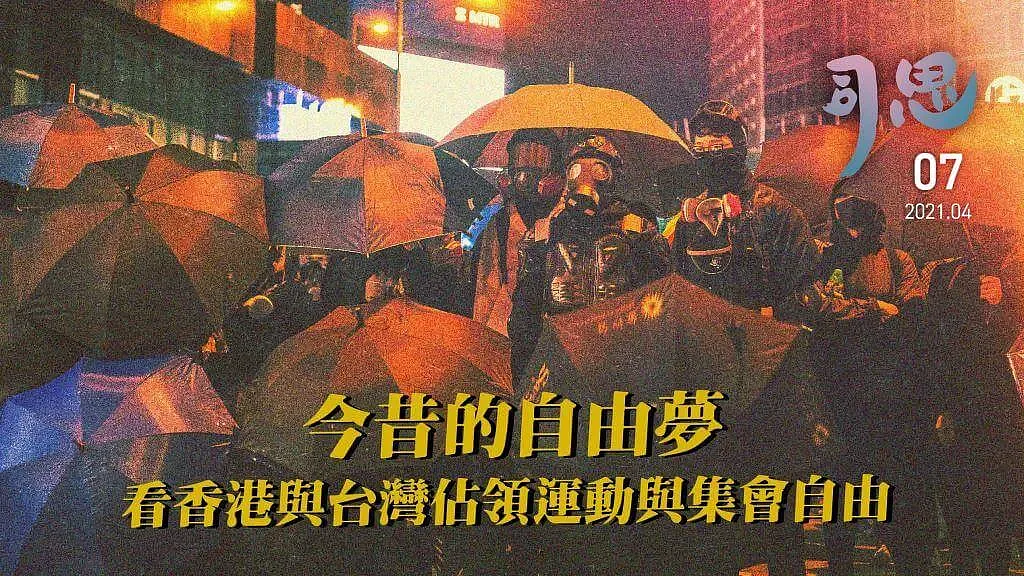
Freedom Dreams, Then and Now | Hong Kong and Taiwan's Occupation Movements and Freedom of Assembly
Last edited: 2026-08-29
The author is a Hongkonger studying in Taiwan, born in 1998-part of a generation even more uncertain than those simply described as "post-1997." During the most rebellious years of adolescence, I watched the anti-Moral and National Education campaign, protests against development in the Northeast New Territories, the August 31 Decision, the university student class boycott, and the Umbrella Movement. My political awakening began with a simple thought: "It would be amazing to vote for the Chief Executive I actually want." On July 1, 2014, I joined a peaceful march for the first time. I later took part in a university student boycott and the Umbrella Movement that, in a sense, were not even "my" movements. My role was moving supplies and sitting in the street eating popsicles. When my father asked, "Do you know what democracy is?" I answered, "I just want to vote for the person I want."
"Hong Kong represents human rights and freedom. For Taiwanese people, it was a source of hope-a lighthouse." Professor Lin Chia-Ho used those words to describe how many Taiwanese viewed Hong Kong in the 1970s.
After seeing images from two years earlier of police swinging batons indiscriminately, men in white shirts chasing and beating protesters dressed in black, and more recent footage from National Security Education Day, the statement sounds almost ironic. It is difficult to imagine that the Hong Kong Taiwanese people once looked toward "actually looked like this."
Yet the stories of two younger people still suggest something else: Hong Kong, in the past, the present, and the future, has represented-and can continue to represent-human rights and freedom.
When a Leaderless Crowd in Black Became a Global Lighthouse for Human Rights
 Photo / Studio Incendo
They dressed in black and wore masks. These "unnamed" people nevertheless appeared on *Time* magazine's list of the internet's most influential figures and shook the international community.
The year of Taiwan's Sunflower Movement was also Tang Wen's first year studying in Taiwan. A Hongkonger in a sociology-related field, Tang traveled overnight from western Taiwan to Taipei, beginning a career path that had never been part of the plan.
"When the Umbrella Movement began, I cried watching the news. I thought about buying a plane ticket immediately and going back to Hong Kong to stand with everyone. In the end, I chose a 'different way.'" Not yet twenty, Tang emailed professors teaching more than one hundred general-education courses across the university, volunteering to visit their classes and explain to Taiwanese students "what is happening in Hong Kong." It was a form of influence available precisely because Tang was young.
"I went into general-education classes and explained how Hongkongers had been pressured over the years. I thought nobody would care. To my surprise, the response was actually pretty good."
The Sunflower Movement came before the Umbrella Movement. In 2014, a younger generation in Taiwan watched with curiosity, hope, and a certain idealism as Hongkongers held umbrellas against batons and water cannons. People in Taiwan wanted to understand how they managed it.
"The Umbrella Movement and the Anti-Extradition Law movement deeply affected the direction of my life," Tang said. Part of that came from fear that Taiwan might become the next Hong Kong-that once Hong Kong was reduced to "Hong Kong, China," Taiwan would become the next target.
Hongkongers: Guilty by Birth?
 Photo / Wikipedia
"Why can Taiwanese people occupy the Legislative Yuan, while Hongkongers who occupy the streets are told they acted illegally and must turn themselves in and plead guilty?" Protesters in Taiwan and Hong Kong have both had reason to ask that question.
Chiang Min-Yen's experience was almost the reverse of Tang Wen's. Chiang is Taiwanese and was studying at the University of Hong Kong in 2014 when the Umbrella Movement unfolded. Worried that deeper participation in political action could jeopardize his visa and even his degree, he did not stay on the front line. Yet precisely as an outsider, he saw a side of Hong Kong that contradicted the stereotype of political apathy: people across different parts of the political spectrum were willing to contribute in ways consistent with what they believed.
"In 2019, Hong Kong debated whether the movement should remain peaceful, rational, and nonviolent; turn to more confrontational tactics; or develop a path of its own." The movement eventually became "leaderless," without a fixed route or single center. Over a prolonged period of resistance, people found their own roles, strengths, and positions and contributed in different ways.
Even in societies with greater political freedom than Hong Kong-the United States, Germany, or Taiwan-civil society does not always achieve that level of solidarity. The unity Hongkongers displayed across the Umbrella Movement and the 2019 protests created a distinctive form of social movement that people in Taiwan wanted to learn from and that drew admiration internationally.
Is Taiwan the Next Hong Kong-or Could Hong Kong Become the Next Taiwan?
 Photo / Studio Incendo
After the two younger speakers shared their experiences, Professor Lin posed two questions that abruptly changed the direction of the discussion.
The first drew on his field of public law: if Chang An-Le-"White Wolf"-were to mobilize supporters of cross-strait unification, occupy the Legislative Yuan chamber, and declare, "This is civil disobedience," would the action satisfy the definition of civil disobedience?
The second was purely political: is Taiwan ultimately the next Hong Kong, or could Hong Kong be the next Taiwan?
The two younger speakers worried that Taiwan might eventually become the next Hong Kong. Lin offered another possibility: Hong Kong could instead become the next Taiwan.
Taiwanese people have long watched Hongkongers confront pressure from China: rejecting the government's "Act Now" constitutional-reform campaign, refusing the logic of "pocket it first," and demanding genuine universal suffrage for both the Chief Executive and the legislature. Taiwan has had reason to ask: if "One Country, Two Systems" had first been imposed here, could Taiwanese civil society have mobilized 6.5 million people to take to the streets against pressure from China?
From the 1970s to 2014, and from 2014 to 2021, Hong Kong's image still carried the meaning Lin Chia-Ho described: human rights and freedom, hope for Taiwanese people, a lighthouse. Half a century later, however, that image is accompanied by bodies floating in the sea and by the blood and tears of many people.
And perhaps the human rights and freedom Hong Kong symbolizes have gradually become a lighthouse not only for Taiwan, but for the world. The rain has not stopped and the road ahead remains uncertain. Even so, we have to believe that the sky can clear after the storm.
This article is an AI-generated translation of the original Chinese text. In the event of any discrepancy, the Chinese version shall prevail.