
No Such Person | Seven Years Later, Learning Again What State Violence Means - Volunteer Reflection
Last edited: 2026-08-29
Before volunteering at "No Such Person: Seventh-Anniversary Exhibition on the March 24 Executive Yuan Violent Eviction," I honestly understood only fragments of what had happened. I had been in eighth grade at the time. Under the intense media coverage, positive and negative judgments filled society with an atmosphere of confrontation and unease, while restless young people gradually stepped into the sunlight and stood up to hold on to their own future.
That atmosphere inevitably reached adolescents like us, who were already eager to push beyond the limits of what adults showed us. In the only class that seemed even remotely connected-junior-high civics-someone finally asked, "Teacher, can you tell us what everyone is protesting about?" Students who had been bent over their books looked up at the person we regarded as the authority on knowledge. We had all wanted to ask but no one had dared. Now that someone had raised a hand, we genuinely wanted to know: what were these young people, so often called "rioters," actually protesting for?
Amid chaotic media narratives and the values adults around me tried to instill, I was repeatedly told, "This has nothing to do with you." As long as I went to school on time, attended cram school, and lived obediently, the ordinary life I knew would continue unchanged; whatever other people were protesting could never affect or harm me. Our civics teacher paused and said, "This won't help you get into a better school, and it won't appear on the entrance exam." He also told us not to attend any march or protest related to the issue. I believe that came from genuine concern and a teacher's duty to protect us. We were indeed young, and teachers had many responsibilities to consider, so I do not blame him. But as adults around us repeatedly shut down the subject, the event really did begin to feel as though it had "nothing to do with me." I grew up in that fog, passing through countless days in which ordinary life seemed to repeat exactly as promised.
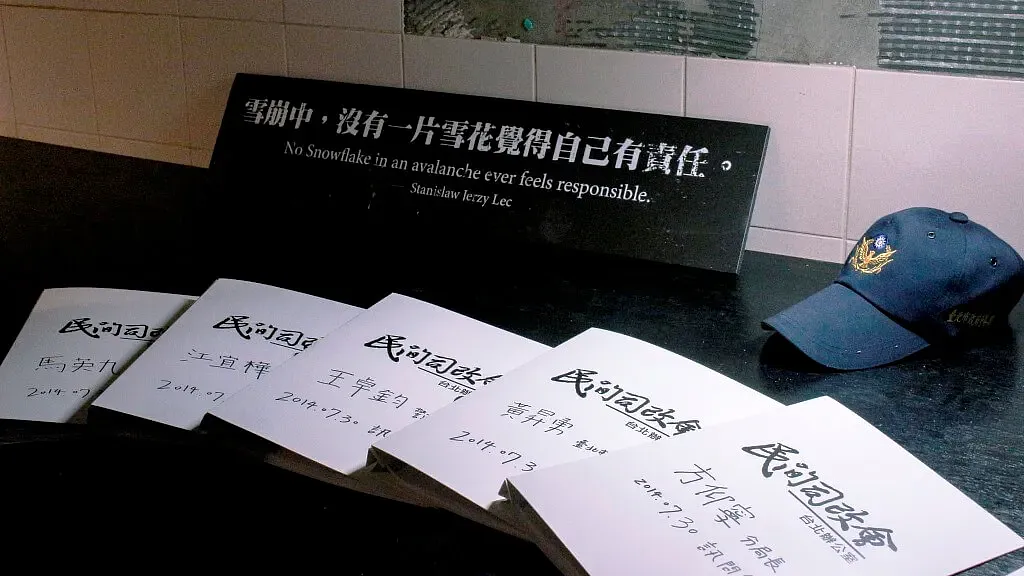
That confused adolescent eventually stumbled into law school and gradually learned more about what had happened, though still only from one corner of the story. Later, through an internship at JRF, I became an exhibition volunteer and attended guide training. We learned by asking questions about the exhibits and evidence. What affected me most was the first time I saw footage of legislator Kuan Bi-Ling questioning the National Police Agency Director-General. The footage showed police deliberately removing the media from the Executive Yuan, followed by large numbers of heavily equipped special police surrounding and intimidating students and then beginning to beat and arrest them. As the media were driven away, students chanted together: "Media, stay! Media, stay! Media, stay!" As the voices faded, I trembled and cried from grief and anger. It felt as though once outside scrutiny disappeared, the state could use any amount of violence to achieve its goal without anyone being held accountable. Even through a recording, the helplessness and fear of that night reached me seven years later. I thought that if I had been born only a few years earlier and had been the same age as those protesters, I almost certainly would have been among them-perhaps even one of the people in the footage.
The visitors who left the deepest impression on me were two elderly women who arrived one evening. They told us that seven years earlier they had themselves been protesters. That surprised me: they had already been older women then, yet despite having less physical strength than younger participants they still went to the scene to express their views. One had undergone surgery shortly before the event and was still physically weak. Her younger sister was struck in the head with a police baton, lost a great deal of blood, and had to be taken to the hospital for stitches. Fortunately, she recovered. The story alone was disturbing enough; it was hard to imagine how many similar episodes of state violence were happening around them that night. That something so absurd could occur in a democracy only seven years earlier made the authoritarian era feel far less distant than I had imagined.
The two women asked why the exhibition was called "No Such Person." They could not understand how people could be injured yet no perpetrator could be found, or why those who struck people's heads with batons were never punished. Seven years later, that injustice still angered them. I have come to love the exhibition title. On the surface it refers to the perpetrators who disappeared from accountability. Underneath, it also speaks of the anonymous protesters. Beyond the familiar activists whose names the public knows, many more were ordinary people from our neighborhoods who quietly chose to stand up.
When the women saw how young the interns were, they said they were relieved that people our age still cared. I still remember one of them telling us, almost as though a burden had lifted: "We are old now. We cannot keep protecting the future for you. From here on, you have to protect your own future." Only then did I truly understand that the "this has nothing to do with you" I heard seven years earlier was never true. The ordinary life I cherish was paved by the difficult paths opened through the struggles of people before me; the rights I enjoy were won by many people whom history may record only as "no such person." Beyond feeling grateful for the everyday life I know, I remind myself constantly that democracy and freedom are precious and irreplaceable. As the woman said, if our democratic freedoms are threatened, the work of defending our future cannot simply end.
This article is an AI-generated translation of the original Chinese text. In the event of any discrepancy, the Chinese version shall prevail.