
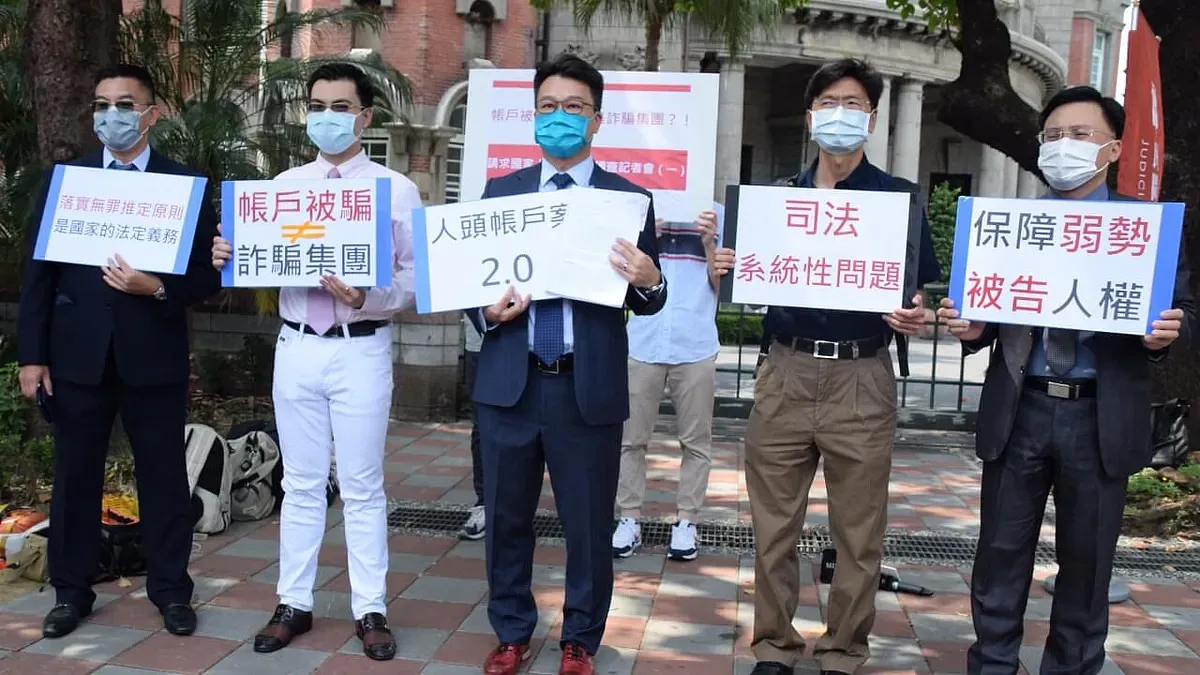
If Your Account Is Used, Does That Make You Part of a Scam Ring?! - Press Conference on Petitioning the National Human Rights Commission
Last edited: 2026-08-30
Civil-society groups were already criticizing Taiwan's treatment of "dummy account" fraud cases in 2014. That year, scholars compared district-court and high-court judgments on criminal liability for aiding fraud and criticized the High Court's method of inferring a defendant's knowledge as inconsistent with the principle of in dubio pro reo. The 2014 advocacy plainly did not solve the problem. Dummy-account fraud cases have continued to increase, while judicial standards for finding conditional intent to aid fraud remain broad and inconsistent. More recently, people who provide accounts have also begun to face money-laundering convictions, producing another layer of doctrinal and practical controversy.
JRF therefore reviewed conflicting first- and second-instance judgments and selected four cases illustrating problems in how courts infer subjective criminal intent in dummy-account cases:
In the "Chao O-Lin Case," the defendant gave her bank account to her husband. Her husband was deceived by a fraudulent job offer and in turn provided the account to a scam ring. Because the victims were located in different prosecutors-office jurisdictions, the couple's cases were investigated separately. Her husband-the person who directly handed over the account-received a non-prosecution disposition. She, who had only given her account to her husband, was convicted.
The "Tien O-Yu Case" illustrates how courts often infer fraudulent intent simply because a defendant supposedly failed to verify the situation. Here, the defendant produced chat records showing that she had repeatedly asked questions and tried to verify what she was told, but was nevertheless deceived into handing over her account. The court still found that she had the intent to aid fraud.
In the "Li O-Ching Case," the defendant had only a junior-high education and an intellectual disability. The court nevertheless treated him as having the same capacity to foresee fraud as an ordinary person and convicted him.
The "Kuo O-Ting Case" exposes a front-line policing problem. When a passbook and ATM card are lost, prompt acceptance of a police report and creation of an official record can later help show that the account holder genuinely lacked any intent to assist fraud. In this case, however, the police station refused to accept the defendant's report after her account materials were lost. She was therefore unable to preserve evidence supporting her lack of fraudulent intent, yet the court still convicted her.
These cases show how arbitrary standards for inferring subjective intent can determine whether a person is convicted. The problem directly undermines the presumption of innocence and the right to a fair trial. It is no longer merely an issue of isolated cases or competing legal interpretations; it has become a systemic access-to-justice problem affecting socially vulnerable defendants. Without systemic reform, wrongful convictions will continue. There may also be an unmeasurable number of people who never intended to participate in fraud but, facing lengthy proceedings and believing the courts are unlikely to vindicate them, plead guilty simply to obtain a suspended sentence.
This is JRF's first complaint to the National Human Rights Commission since the Commission began operating in August 2020. We ask the Commission to investigate this systemic problem and prevent further violations of the fair-trial and judicial rights of vulnerable defendants.
Press Conference Statements
"Today is JRF's first time coming to the National Human Rights Commission to submit a complaint. We have followed dummy-account cases for a very long time, and they are a serious problem in current judicial practice. Our courts apply an extraordinarily loose standard when deciding whether a person who allows someone else to use a bank account thereby becomes part of a scam ring or a money-laundering operation. The approach can even violate the presumption of innocence. If an account you provided is later used by a scam ring and helps create a break in the money trail, courts may rapidly conclude that you committed fraud and money laundering. In that kind of routine reasoning, defendants barely get a meaningful opportunity to explain whether they actually participated in the scam ring, knew what it was doing, or knew the nature of the fraud. Once courts see that an account was provided, they move quickly to the label 'scam ring.' But reality is not that simple. Some people provide accounts to supposed employers when applying for work. Some lose account materials that are later used by others. Some provide accounts for completely ordinary personal reasons. None of those situations automatically proves an intent to aid fraud or money laundering. Judicial reasoning has become formulaic: anti-fraud campaigns are everywhere, so if you provide an account, how could you not know it might be used for fraud? But courts are not actually examining what individual defendants knew. To some extent, this is a systemic failure of the state. Why? Because we often cannot catch the organizers of scam rings. We cannot catch the big fish, so we catch the small ones-the people whose accounts were exploited-and make them the scapegoats for the real perpetrators. The state cannot solve the underlying scam-ring problem, so instead it punishes vulnerable defendants whose accounts were used and presents those convictions as an answer to the public. In reality, it has not solved the fraud. It has traded away these defendants' rights to create an illusion of enforcement. We hope the National Human Rights Commission will confront this systemic error, investigate it seriously, and help correct the judicial practices that produced it. That is why we are here today."
- Lin Chun-Hung / Attorney; Convener, JRF Case Support Group
"In current judicial practice, once a person objectively hands over a copy of a passbook, an ATM card, or a password, judges often reason that the person is an adult of normal intelligence with ordinary social experience and therefore must have intended to aid fraud. But people differ in intellectual ability, upbringing, and life experience. Their capacity to understand and assess risk is not identical, and courts cannot simply ignore those individual differences. In some cases, a defendant repeatedly asked questions and tried to verify the situation, only to be persuaded by the scam ring's story and deceived into providing a passbook and ATM card. In another case, the defendant had an intellectual disability and rarely left home, plainly giving him less experience and weaker judgment than an ordinary person. Yet the court still relied on stock language saying his thinking and behavior appeared normal and that he should have known from life experience that his conduct was unlawful. These cases show how injustice can arise when courts replace individualized proof with assumptions.""
- Kao Pei-Heng / Attorney; Pro Bono Attorney, JRF Case Support Group
"The Code of Criminal Procedure places the burden of proof on the prosecutor. But in dummy-account cases, courts often do not require prosecutors to meet that burden. Instead, they use the concept of conditional intent-dolus eventualis-to expand the inference that a defendant intended to assist fraud. It is one thing to say a person knew an account *might* be used to defraud someone. The court must still determine whether the person accepted that possibility and intentionally provided the account in order to assist the fraud. That further step still has to be proved. Current practice often skips it: once a defendant is found to have recognized a possibility of fraudulent use, conviction may follow. Systemically, that means the justice system has failed to give real effect to the presumption of innocence. It skips the point that should be proved-the defendant's intent to aid-and that omission can generate wrongful convictions. Could any of us be deceived into handing over an account? Perhaps we think we would not be, because we are experienced adults. But even I cannot say with confidence that my child would never be deceived. A young person taking a first job may genuinely believe that providing an account is part of employment paperwork and never imagine that the account will be used as a tool by a scam ring. Under current judicial practice, anyone's child could become a potential defendant for aiding fraud simply because of a job search. We should not accept that. That is why we are asking both prosecutors and courts to examine these cases rigorously. Is there evidence proving that this particular defendant actually recognized that the account was being used by a scam ring and nevertheless intended to assist? If not, the presumption of innocence requires an acquittal. If courts follow that principle, families will no longer have to live with the fear that an ordinary job search could turn their child into a criminal defendant."Thank you."
- Huang Ming-Chan / Attorney; Pro Bono Attorney, JRF Case Support Group
"First, the large-scale criminalization of dummy-account providers began before 2009 and has continued for roughly fifteen years. Second, those convictions involve two recurring problems: (1) displacement of the legal standard- in practice, 'negligence' is substituted for 'intent.' Defendants are blamed for failing to pay enough attention to widespread fraud and for providing accounts too readily, producing a large number of judgments that misapply the law; and (2) courts rely on unreliable 'rules of experience' to presume that account providers knew they were assisting fraud. Third, over those fifteen years the judiciary may have produced an incalculable number of wrongful convictions in dummy-account cases. The offenses may be comparatively minor, but a criminal record makes it even harder for people who were already struggling economically to find a way to support themselves. In 2014, I led students in reviewing a sample of cases and estimated that one or two out of every ten-roughly 10 to 20 percent-could be wrongful convictions. Fourth, many people become convicted offenders through summary judgments or because they lack the resources to navigate full criminal proceedings. Fifth, judges in some district courts have tended to push defendants toward guilty pleas on a large scale. The High Court has become more conscious in recent years of the problem of mass criminalization, but the situation remains serious in some district courts. Sixth, where an account was provided for compensation, courts often infer intent to aid regardless of the surrounding circumstances. Seventh, recent practice has shifted toward the more serious offense of aiding money laundering, which is even more concerning. Eighth, German courts do not automatically infer intent to aid fraud or money laundering simply because a person provided a dummy account. They adhere to the definition of intent instead of replacing it with presumptions like the 'rules of experience' found in many Taiwanese judgments. Ninth, German law addresses these cases through an offense of grossly negligent money laundering, yet even there courts do not readily find gross negligence merely because an account was provided for compensation. Finally, we have to take seriously the possibility that dummy-account cases have created a large number of wrongful convictions. We came to the National Human Rights Commission today because we hope this complaint can be a proper beginning.""
- Hsu Wei-Chun / Associate Professor, Department of Financial and Economic Law, Chung Yuan Christian University; Standing Executive Committee Member, JRF
"In Taiwan, when a person simply provides a dummy account to an unfamiliar scam ring, courts commonly apply the standard of an 'ordinary person of normal intelligence.' They reason that an ordinary person would know that handing account information to another person could allow it to be used as an instrument of fraud, and therefore convict the provider of aiding fraud. In recent years, amid stronger anti-money-laundering enforcement and a policy preference for heavier punishment of scam rings, courts went further: they reasoned that an ordinary person should also know that providing account information could help create a break in the money trail and conceal the destination of criminal proceeds, and on that basis treated account providers as principal offenders of money laundering. That produces a 'double fiction.' The same supposed state of mind is used first to characterize the person as an accessory who intended to assist someone else's fraud and then again to characterize the person as a principal who conditionally intended to participate in money laundering personally. The result risks duplicative or excessive attribution of liability under principles of objective attribution, and the two characterizations are logically difficult to reconcile. The Supreme Court Criminal Grand Chamber later unified the law in Ruling 108-Tai-Shang-Da-3101, issued December 16, 2020. It held that merely providing an ATM card and password for a financial account to an unfamiliar person is not itself a money-laundering act under Article 2 of the Money Laundering Control Act and does not make the provider a principal offender under Article 14, Paragraph 1. But if the provider recognized that the account might be used to receive and withdraw proceeds of specified crimes, understood that withdrawal by others would interrupt the money trail and help evade state investigation and punishment, and nevertheless provided the account with intent to assist, the provider may be liable as an accessory to the Article 14, Paragraph 1 offense. Accordingly, beyond today's problem of inconsistent decisions among acquittal and conviction for aiding fraud-what we might call 'Dummy Account Cases 1.0'-future practice may now become inconsistent over whether a person committed only aiding fraud or also aiding money laundering: 'Dummy Account Cases 2.0.' The deeper reform should target formulaic judicial reasoning that uses legal fictions in place of individualized proof. Courts should move away from automatically inferring intent to aid from the 'person of normal intelligence' standard and the concept of conditional intent. We hope the National Human Rights Commission will conduct a systemic investigation and correct this failure of judicial practice. That is the principal reason for today's complaint.""
- Kao Yang-Hui / Attorney; Standing Executive Committee Member, JRF
Attachment
Complaint to the National Human Rights Commission Concerning Dummy-Account Cases
Special thanks to the attorneys who participated in drafting the complaint: Teng Chi-Hung, Wang Chih-Te, Kao Pei-Heng, Ho I-Hsuan, Chang Yu-Chi, and Huang Ying-Chia.
Attendees
Lin Chun-Hung / Attorney
Huang Ming-Chan / Attorney
Kao Yang-Hui / Attorney
Kao Pei-Heng / Attorney
Hsu Wei-Chun / Associate Professor, Department of Financial and Economic Law, Chung Yuan Christian University
Contact
Lee Ming-Ju / Staff Attorney, Judicial Reform Foundation
This article is an AI-generated translation of the original Chinese text. In the event of any discrepancy, the Chinese version shall prevail.